Content overview
Application overview
1. Cell culture
2. Cell isolation
3. Phenotyping and quality control
Content
- Application overview
- 1. Cell culture
- 2. Cell isolation
- 3. Phenotyping and quality control

Pluripotent stem cells (PSCs) are a promising new source for differentiated NK cells, T cells, and macrophages. Generating these cells, however, requires several supporting technologies within cell culture, quality control, and cell isolation.
We offer comprehensive support for every one of these steps along the way, with solutions in research and GMP grade, to achieve viable cell differentiation.
Content overview
Application overview
1. Cell culture
2. Cell isolation
3. Phenotyping and quality control

Immunotherapy, such as CAR T cell therapy, has revolutionized medicine by boosting the body's immune system to combat disease. However, traditional autologous cell-based immunotherapy faces challenges such as high costs and limited sources. The use of human PSCs as a source for immune cells may be a solution to these challenges.
For the successful differentiation of PSCs to immune cells, notably NK cells, T cells, and macrophages, high-quality reagents across different technologies are needed. We offer solutions to enable and support each step of your workflow for the successful differentiation of PSCs to immune cells.
These steps are:
Regardless of the specific PSC differentiation protocol you follow, we offer a comprehensive range of cell culture reagents to support you from basic to clinical research.
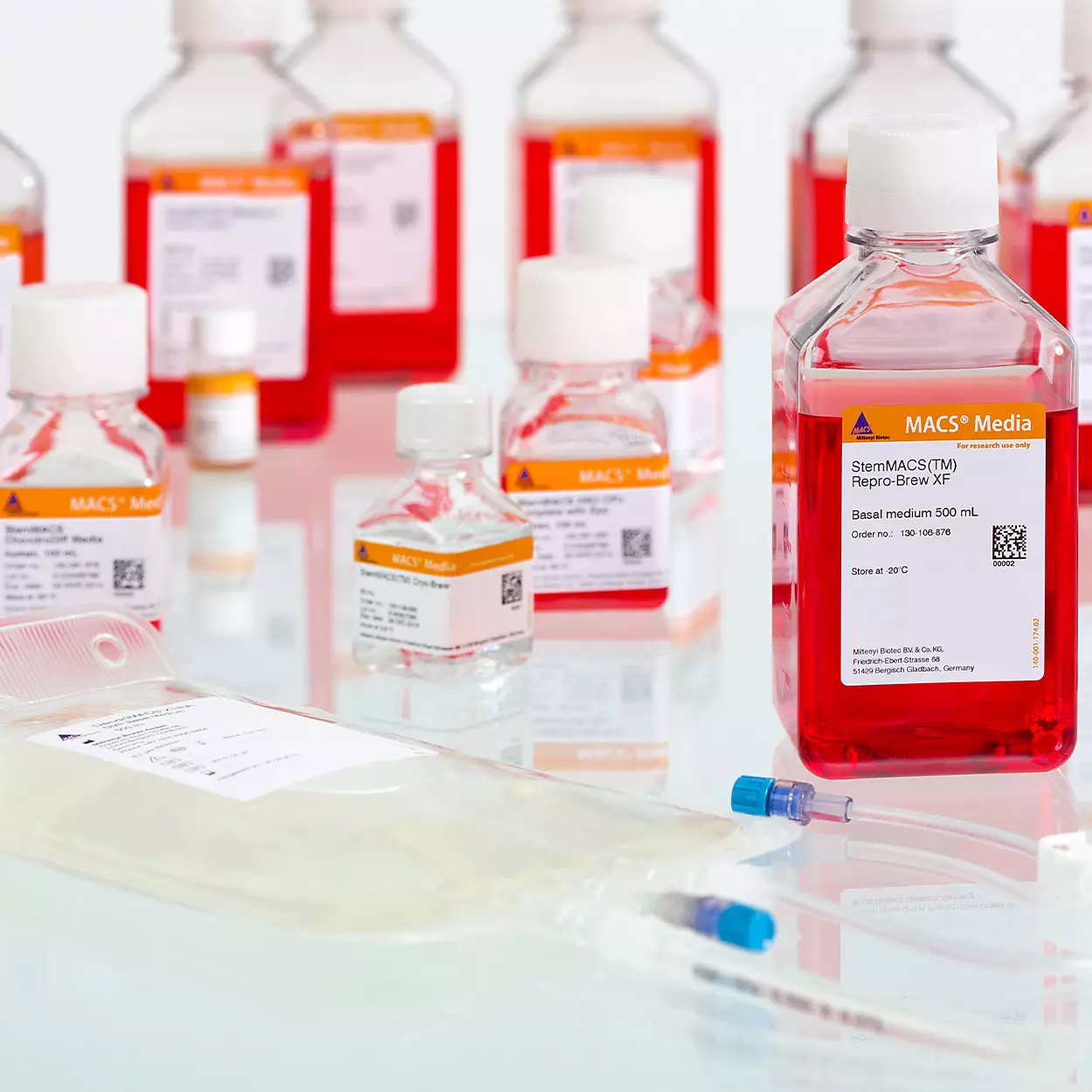
The right cell culture medium is a cornerstone for high-quality cell cultures and a successful PSC differentiation workflow. High quality, consistent, and rigorously tested, our collection of MACS® Media enhance the performance of stem and immune cells.
Our media has proven effective for supporting genetically engineered PSCs1,2 and the differentiation of PSCs into HSCs3-6, as well as providing support for challenging situations, such as clonal selection or gene editing7. Moreover, our media and stimulation reagents support the differentiation and expansion of HSC-derived NK and T cells8-11.
Cell culture reagents for PSCs, NK cells, and T cells

Cytokines, growth factors, and small molecules are indispensable for PSC differentiation to any cell, including immune cells. Offering such a comprehensive range of these reagents ensures our ability to meet your specific needs, no matter the protocol. Many of our cytokines are used in the generation of NK cells, T cells, and macrophages from PSCs or HSCs.8,9,10,12
Most of our cytokines needed for PSC to immune cell differentiation are available as both research MACS Premium-Grade Cytokines (with lot-specific cytokine activity) and MACS GMP Cytokines (highly active and pure cytokines that meet the requirements of cell manufacturing), ensuring a seamless transition to the clinic.
Cytokines, growth factors, and small molecules for PSC to immune cell differentiation*
| PSCs | PSCs to HSCs | HSCs to NK cells | HSCs to T cells | HSCs to macrophages | |
| Cytokines and growth factors | FGF2 TGFβ1 | BMP4 Flt3-L G-CSF IL-3 IL-6 SCF SHH TPO VEGF | Flt3-L IL-2 IL-3 IL-7 IL-11 IL-12 IL-15 IL-18 SCF | IFNγ IL-2 IL-3 IL-4 IL-6 IL-7 IL-15 SDF-1α TGFβ1 | DKK-1 FGF2 Flt3-L GM-CSF IL-3 IL-6 M-CSF SCF VEGF |
| Small molecules | CHIR99021 SB431542 Y27632 |
*This is not a complete list of cytokines. Explore our cytokine and growth factor portfolio for more products.
Isolation of your desired cell population is vital for PSC differentiation, as it can increase yield and purity of the final cell population. With our innovative cell isolation kits, featuring our MACS MicroBeads, and the MACSQuant® Tyto® Cell Sorter with patented micro-chip based technology, isolation of desired cell populations is simple.

Our nano-sized MicroBeads and specialized MACS Columns ensure gentle cell isolation with minimal labeling. Effortlessly isolate various cell types with our MicroBeads, such as anti-TRA-1-60 for PSCs in 10 mins13, CD34 for over 95% pure HSCs3,10,12, 14-16, CD56 for NK cells, and CD4/CD8 for T cells, all with different regulatory variants, and efficient CD14 MicroBeads for positive selection or depletion of monocytes and macrophages12,17,18.
MACS MicroBeads for cell isolation of all cell types from the PSC to immune cell pathway

For gentle isolation of your target population in a closed and GMP-compliant environment, we have developed the MACSQuant Tyto Cell Sorter. Unlike a standard flow cytometer, the MACSQuant Tyto is a microfluidics sorter known for the gentle flow of cells and isolation within a fully closed system.
The MACSQuant Tyto has been successfully used to isolate gene-edited GFP-positive PSCs19, HSCs20, antigen-specific T cells, and specific NK populations.
Phenotypic analysis and quality control (QC) of stem cells and other final cell types are critical to ensure complete differentiation and that the final cells have the correct phenotype. With flow cytometry being the gold standard of marker analysis of immune cells, we offer a broad range of flow cytometry antibodies, tested antibody panels, as well as multiplex assays for characterization and QC along the differentiation pathway of PSCs to immune cells.
Our wide range of flow cytometry antibodies, including primary and secondary isotype control antibodies, along with ready-to-use kits, are designed for both high specificity and bright signals.
Furthermore, pre-tested antibody panels known as MBTPs (Miltenyi Biotec Tested Panels), allow easy and accurate flow cytometry analysis.
Pre-tested, multicolor antibody panels for accurate flow cytometry analysis
| PSCs | NK cells | T cells |
| MBTP 22: PSC trilineage differentiation potential Includes CD144, CD140b, CD184, CXCR4, Sox17, PAX-6, Sox2, propidium iodide | MBTP8: Immunophenotyping of NK cells Includes CD56, KIR2D: CD159a, CD159c, CD314 | MBTP 46: CAR T differentiation immunophenotyping Includes 7AAD, CD3, CD4,CD8, CD19 CAR Detection reagent, CD45RA, CD45 RO, CD62L, biotin |
| MBTP 25: PSC pluripotency Includes TRA-1-60, CD15, SSEA-4,SSEA-5, OCt3/4 isoform A, Sox2 | MBTP 20: Immunophenotyping of the activation status of NK cells Includes 7-AAD, CD3, CD14, CD16,CD28, CD45, CD56, CD314, CD335, CD336,CD337 | MBTP 53: Immunophenotyping of CAR T cell Includes 7-AAD, CD3, CD4, CD8, CD19 CAR detection regent, CD25, CD137, CD154, biotin |
| MBTP 30: Immunophenotyping of KIR-expressing NK cells Includes 7-AAD, CD3, CD14, CD45, CD56, FoxP3, KIR2DL1, KIR2DL2/DL3/DS2, KIR3DL1, NKG2A | MBTP 56: Immunophenotyping of human CD4+ and CD8+ T cell activation Includes 7AAD, CD3, CD4,CD8, CD25, CD45RA, CD69, CD197 (CCR7), biotin | |
| MBTP 60: Immunophenotyping of CAR T cell fitness Includes 7 AAD, Annexin 5, CD3, CD4, CD8, CD19 CAR FMC63 |
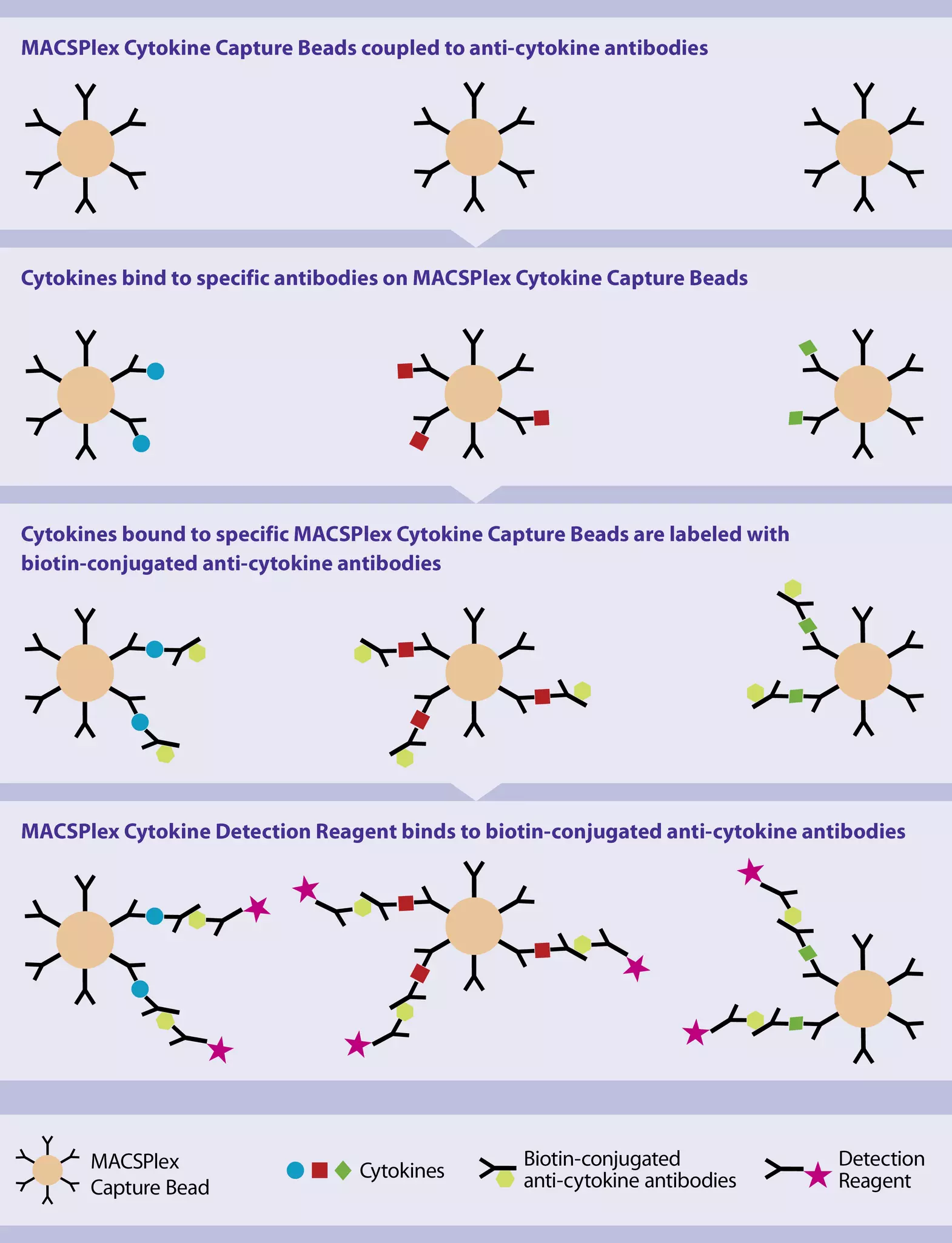
When it comes to immune cells, detailed profiling of secreted cytokines, toxicity evaluation, and the characterization of extracellular vesicles (EVs), like exosomes, can significantly improve our understanding of the phenotype and functionality of the differentiated cells. Our ready-to-use MACSPlex assays and mix-and-match MACSPlex options allow you to analyze the cytotoxic potential of your target immune cells and the secreted cytokines, using up to 39 specificities each time. Furthermore, our MACSPlex EV Kit IO, human, detects 37 surface markers of EVs, and has also been applied to EVs from T cells and macrophages.21,22
MACSPlex kits for NK cell, T cell, and macrophage analysis

We have developed a range of workflows for the CliniMACS Prodigy, including the expansion of PSCs and immune cells, in addition to genetic engineering. These workflows are all clinical-grade and include:
Any reference to GMP Miltenyi Biotec products within this page specifically signifies MACS GMP quality and standards.
You have previously chosen International as your location.
What do you want to do?
