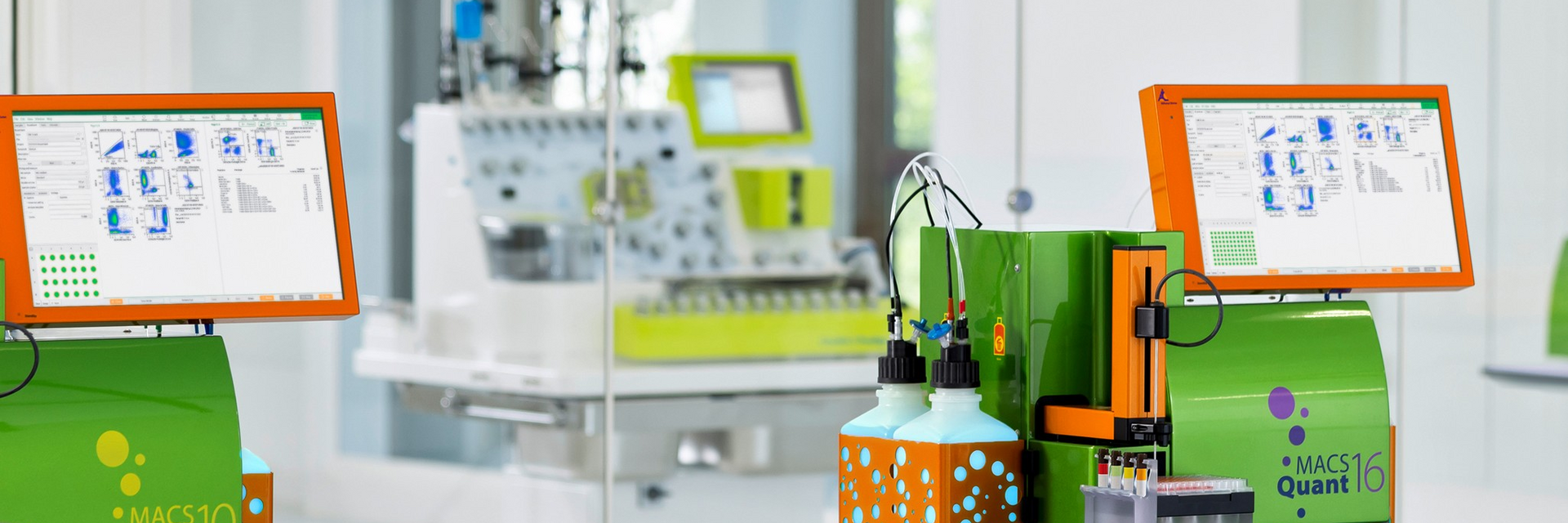
Two MACSQuant Analyzer flow cytometer in a clean room used for cell analysis during cell and gene therapy manufacturing on the CliniMACS Prodigy Platform in the background
Logo

Immunophenotyping in cancer research using flow cytometry

Flow cytometry is the preferred method for analysis and characterization of immune cells. Our flexible solutions for cancer research will help you unfolding the complex immune responses triggered by tumorigenesis.
Our innovative flow cytometry instruments and software, coupled with an extended selection of pre-tested antibody panels offer you a convenient and easy solution for your immunophenotyping workflow. While saving time and resources, our automated technology and recombinant antibody options ensure standardized results, also in a regulated environment.

Application overview

Infographic showing the cancer immunity cycle and involved immune cell subsets
Cancer immunity cycle and involved immune cell subsets.

Whether immuno-oncology research, basic drug discovery research, advanced-stage clinical studies, or disease diagnostic phenotyping, immune cells are routinely analyzed. Flow cytometry has become the technology of choice for this since it provides the possibility of analyzing a large number of parameters simultaneously, quickly, and for a reasonable cost.

Immuno-oncology research focuses heavily on immune cells implicated in the tolerance or rejection of cancer. In a cancer immunity cycle, cancer cells release inflammation markers that attract the attention of antigen-presenting cells, such as NK cells, dendritic cells, and macrophages, which in turn activate T cells. These activated T cells infiltrate the tumor, recognize tumor-specific antigens, and begin the process of killing tumor cells. Miltenyi Biotec offers pre-tested antibody panels for phenotyping of immune cells involved in the tumorigenesis process.

Flow cytometry solutions for immunophenotyping

Flow cytometry allows identification of cellular markers through surface or intracellular staining techniques. These markers can be used to identify different cell types, which is useful in developing cell-specific therapies.

Furthermore, flow cytometry’s ability to characterize, count, and sort fluorescently labeled cells based on their phenotype affords it yet another advantage in immuno-oncological applications. Quantification and characterization of specific subsets of cell populations allows us to better ascertain the immunogenicity of a therapy, and thereby enhance our understanding of complex immune responses.

Our new and advanced flow cytometry instruments, as well as an expanded range of antibodies and fluorochromes to accompany the technique, enable more accurate phenotyping of cells, which in turn enables enhanced identification of cellular distribution in the cancer environment.
Key features and advantages of flow cytometry include:

  • The ability to analyze single-cell suspensions, for example immunophenotyping directly from whole-blood samples
  • Easy analysis of rare cell events with statistical significance because of the ability to acquire in excess of 4,000,000 events
  • The ability of flow cytometers to perform high-content and complex phenotyping makes this the gold-standard for immunophenotyping and immune response profiling
  • High suitability for multiplexed detection of markers of interest (intracellular, surface markers, phosphoproteins) and compatibility with high throughput
  • Appropriateness for multiplexed detection of secreted biomarker molecules, e.g., cytokines, in a multitude of biological samples, such as supernatants, blood derivatives, and tissue homogenates

Video

Immunophenotyping made easy: streamline your bench

Designing and testing flow cytometry antibody panels can be laborious, with reproducible results often a challenge. Learn more about an easier and more reproducible method that: Eliminates assay design steps, reduces hands-on time at the flow cytometer and removes manual gating steps.

Immunophenotyping markers in immuno-oncology research

In this table you can find a common immunophenotyping markers to distinguish different cell types in immuno-oncology research. Click on the respective marker in order to find relevant antibodies for detection.


Cell typeSurface markersTranscription
factors
Secreted proteinsActivation markersExhaustion markersProliferation markersApoptosis markersCell signaling markers
T CellsCD3, CD4, CD8, CD27, CD45RA, CD62LT-bet, GATA3, FoxP3, RORγtIFNγ, IL-2, TNFα, IL-4, IL-5, IL-17, IL-10CD25, CD69, CD95, CD134, CD137, CD154PD-1, CTLA-4, LAG-3, TIM-3, TIGIT, CD244, CD272, CD278Ki-67, PCNA, Bcl-6pH2A.X, Caspase, Bcl-2p-Lck, p-ZAP70, p-PLCy2, p-ERK, p-NFκB, p-Akt, p-Syk, p-BLNK
B cellCD19, CD20, IgM, IgD, CD27, CD24Oct-2, PAX-5, Blimp-1
IL-12, IFNy, IL-6, IL-10, TNFαCD69, CD25, CD80, CD86    
NK cellCD45, CD56, CD16, absence of CD3E4BP4, Eomes, T-bet,
Id2
IFNy, TNFαCD161, NKp46, NKG2D,
NKG2C, 2B4, NKp30, NKp44, CD69
PD-1, TIM-3, TIGIT   
Dendritic cellsCD11c, HLA-DR, CD123, CD1c/BDCA-1BATF3, IRF4, IRF8IFNβ, IL-12, IL-6, TNFαCD80, CD86, CD40    
Macro-phagesCD16, CD64, CD68, CD71, CCR5iNOS, IRF4IL-18, IL-10, TGFβCD54 (ICAM1), CD69, CD206, CD163, CD80, CD86    
Tumor cellsEpCAM, E-cadherin, CD133, CD44, CD200, CD90, CD144, CD34, CD31Lineage-specific cytokeratin subtypes      

Standardizing flow cytometry assays for immunophenotyping

In a regulated environment, analysis of such complex phenotypes needs to be standardized in a reproducible fashion. You can learn more about how Miltenyi Biotec has standardized flow cytometry-based immunophenotyping using highly characterized REAfinity™ Recombinant Antibodies, immunophenotyping kits, software compatibility, and flexible flow cytometers.

Step-by-step protocols for convenient immunophenotyping of different cell subsets

Get acquainted with our antibody panels for the immunophenotyping with multicolor flow cytometry panels.

You have previously chosen International as your location.
What do you want to do?