Fms-related tyrosine kinase 3 ligand (Flt3-Ligand) is a growth factor that exerts pleiotropic and potent effects on the development of hematopoietic stem cells (HSCs) and the immune system. In synergy with other growth factors Flt3-Ligand promotes proliferation and development of HSCs, myeloid and lymphoid progenitor cells, dendritic cells, and natural killer cells.
MACS GMP Recombinant Human Flt3-Ligand is designed for ex vivo cell culture processing. No animal- or human-derived materials were used for the manufacture of this product, unless otherwise stated in the respective


Related products for MACS® GMP Recombinant Human Flt3-Ligand
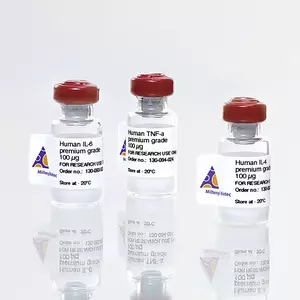
Fms-related tyrosine kinase 3 ligand (Flt3-Ligand) is a growth factor that exerts pleiotropic and potent effects on the development of hematopoietic stem cells (HSCs) and the immune system. In synergy with other growth factors Flt3-Ligand promotes proliferation and development of HSCs, myeloid and lymphoid progenitor cells, dendritic cells, and natural killer cells.
MACS GMP Recombinant Human Flt3-Ligand is designed for ex vivo cell culture processing. No animal- or human-derived materials were used for the manufacture of this product, unless otherwise stated in the respective Certificate of Origin. The product is lyophilized without carrier protein or preservatives.
Biological activity
Flt3-Ligand belongs to a small family of α-helical cytokines and is expressed by T lymphocytes and bone marrow stromal fibroblasts as a membrane-bound and a soluble isoform. Both isoforms signal through the tyrosine kinase receptor Flt3/Flk-2, which is restricted to cells of hematopoietic origin.
MACS GMP Recombinant Human Flt3-Ligand can be used for a variety of applications, including the expansion2,3 and the viral transduction4,5 of hematopoietic stem and progenitor cells derived from bone marrow, peripheral blood cells, and cord blood.
Technical specifications
- Identity/ Molecular mass: 17934 Da, determined by mass spectrometry. This corresponds to the mature form of human Flt3-Ligand (158 amino acids).
- Purity: ≥ 97 % as determined by chip electrophoresis.
- Endotoxin content: < 25 EU/mg, as determined by kinetic Limulus Amoebocyte Lysate (LAL) assay (Pharmacopoeia Europaea (Ph. Eur.)).
- Residual host cell DNA content: < 5 ng/mg, as determined by quantitative PCR specific for E. coli genomic DNA.
- Residual host cell protein content: < 5 µg/mg, as determined by E. coli HCP ELISA.
The product quality certificate of our MACS® GMP Recombinant Human GM-CSF has been adapted. Learn more here
MACS GMP Products are manufactured and tested under a quality management system (ISO 13485) and are in compliance with relevant GMP guidelines. They are designed following the recommendations of USP <1043> on ancillary materials.
MACS GMP Products are for ex vivo cell processing only, and are not intended for human in vivo applications. For regulatory status in the USA, please contact your local representative.
Mass spectrometry analysis (ESI-MS) of MACS GMP Recombinant Human Flt3-Ligand. The peak corresponds to the calculated molecular mass of 17934 Da.
MACS GMP Recombinant Human Flt3-Ligand biological activity. Activity of Human Flt3-Ligand, GMP grade, (blue bar) was compared to another commercially available product (black bar).
MACS GMP Recombinant Human Flt3-Ligand batch-to-batch variability. Activity of three different production batches of Human MACS GMP Flt3-Ligand.
Enter the lot number from your product label to access its Product Quality Certificated (PQC).
- Petzer, A. L. et al. (1996) Differential cytokine effects on primitive (CD34+CD38-) human hematopoietic cells: novel responses to Flt3-ligand and thrombopoietin. J. Exp. Med. 183 (6): 2551-2558
- Meyer, C. and Drexler, H. G. (1999) FLT3 ligand inhibits apoptosis and promotes survival of myeloid leukemia cell lines. Leuk Lymphoma 32: 577-581
- Gilliland, D. G. and Griffin, J. D. (2002) The roles of FLT3 in hematopoiesis and leukemia. Blood 100 (5): 1532-1542
- Uchida, N. et al. (2011) Optimal conditions for lentiviral transduction of engrafting human CD34+ cells. Gene Ther. 18 (11): 1078-1086
- Kiem, H. P. et al. (1998) Improved gene transfer into baboon marrow repopulating cells using recombinant human fibronectin fragment CH-296 in combination with interleukin-6, stem cell factor, FLT-3 ligand, and megakaryocyte growth and development factor. Blood 92 (6): 1878-1886
You have previously chosen International as your location.
What do you want to do?