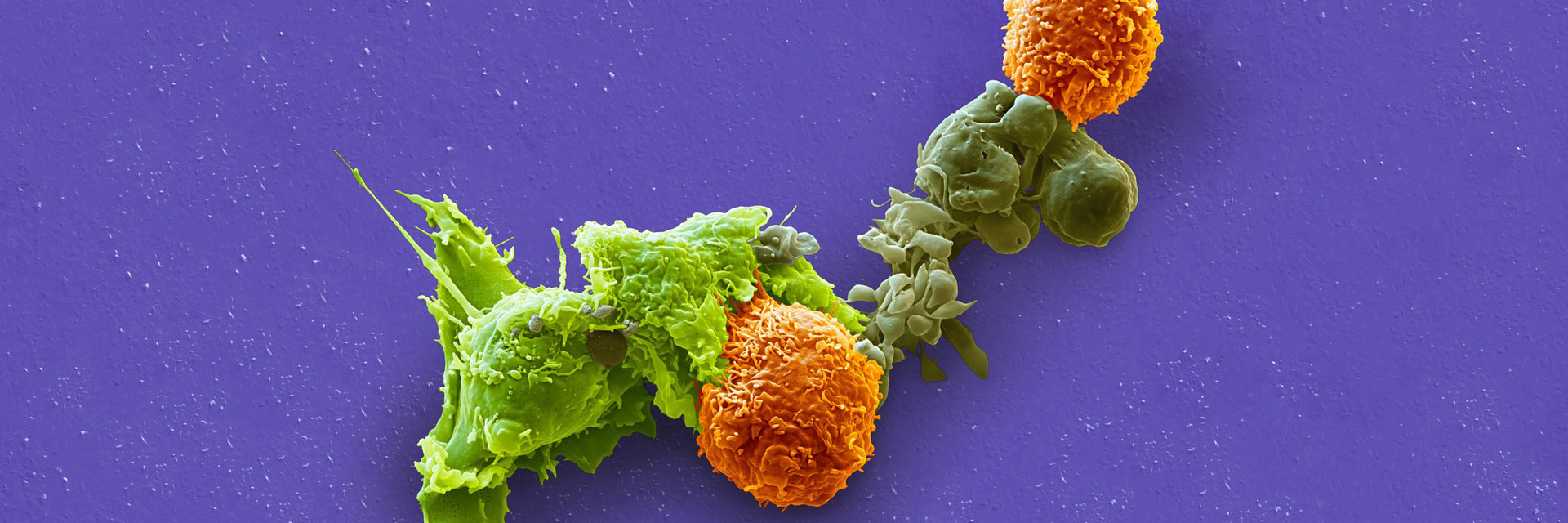
Microscopic image of CAR NK cells killing a cancer cell
Logo

CAR NK cells: a streamlined workflow for generation and analysis

Employing an efficient and reproducible method to engineer CAR NK cells is pivotal to research exploring their accessibility, function, and potential in therapeutic strategies. Miltenyi Biotec offers a streamlined CAR NK cell workflow and reliable solutions to develop effective cell products that are easily transitioned to translational applications.

A robust workflow to engineer CAR NK cells

Research on CAR-engineered NK cells and their allogeneic potential has grown in recent years.1,2 Miltenyi Biotec has contributed to advances from the beginning, with established experience in NK cell manufacturing and longstanding support of cell engineering research.

NK cells naturally eradicate abnormal cells through various mechanisms, including cytotoxic granule release, death-ligand expression, secretion of pro-inflammatory cytokines, and antibody-dependent cell-mediated cytotoxicity (ADCC).1,3 CAR engineering further enhances this cytotoxic potential. The CAR shifts the activation balance against target cells while preserving the natural cytotoxicity of NK cells in case of immune escape. Persistence can also be extended via further modifications such as IL-15 gene integration.4

Low abundance and persistence make NK cells difficult to expand. They are also challenging to transduce. Our tested workflow for CAR NK cell research is designed to overcome these hurdles, covering all manufacturing steps from the isolation of pure NK cells to their comprehensive characterization.5 We offer efficient solutions for activation, gene transfer6, and population expansion. Combined, our instruments, reagents, and software jumpstart your CAR NK cell research with consistent and reliable results.

Detailed protocols for these processing steps are listed at the bottom of this webpage.

Infographic of CAR NK cell workflow from cell isolation through activation, transduction, expansion, and product analysis

Our CAR NK cell workflow at a glance

Our workflow leverages Miltenyi Biotec’s expertise in CAR NK cell research and standardizes an engineering procedure that easily transitions to translational settings. Create a robust process from cell isolation through activation, transduction, expansion, and product analysis with tools designed for efficiency and reproducibility.

Webinar: Unlock the full potential of your CAR NK cells

This webinar shows you how to isolate fully functional NK cells directly from whole blood and other blood products, boost lentiviral transduction efficiency, easily activate and expand your NK cells, and set up streamlined quality control analytics.

CAR NK cells in four streamlined steps

From starting material to a fully characterized CAR NK cell product, each step of our workflow builds on high-quality solutions for the isolation and activation of NK cells, their transduction and expansion, and finally, the characterization of your CAR-engineered product. Those solutions are designed for high performance and consistency and to ease the transition to translational settings.

1. NK cell enrichment

Starting CAR engineering with a well-defined and enriched NK cell population is key to obtaining robust, standardized, and reproducible results. Depending on the starting material – PBMCs or blood products – MACS® MicroBeads and Isolation Kits or the innovative StraightFrom® Technology are used to purify viable NK cell populations. Moving forward, MACS MicroBeads in MACS GMP Quality enable a seamless transition into the clinical setting.

Dot plots showing flow cytometric analysis before and after respective magnetic cell separation steps to generate functional CAR NK cells
Enrichment of CD56+ NK cells with MACS Technology

NK cell enrichment from PBMCs increases reproducibility

Sequential isolation of NK cells using MACS MicroBeads results in a homogeneous starting cell population. First, magnetically labeled CD3+ T cells are depleted from PBMCs. Then, CD56+ NK cells are enriched by positive selection.

This two-step separation of NK cells minimizes donor variability, improves transduction efficiency, and avoids vector consumption by unwanted cells. Consequently, results are robust, standardized, and reproducible. Subsequent translational applications can also easily be deployed using GMP-grade MACS MicroBeads.

In the case that downstream magnetic sorting steps are required, untouched cell isolation with the MACS NK Cell Isolation Kit purifies unlabeled target cells via depletion of non-target cells.

Fast and easy NK cell separation directly from blood products

Increase your throughput and productivity by isolating NK cells directly from whole blood and blood products (buffy coat, LRSC, and Leukopak®). StraightFrom Technology enables fast and easy separation without density gradient centrifugation or red blood cell lysis.

Using the innovative StraightFrom MicroBead Technology obviates density gradient centrifugation to first generate PBMCs, saving processing time and reducing operator variability.

Comparing the isolation products of the NK Cell Isolation Kit, human, and the StraightFrom CD56 MicroBeads, human (positive selection), reveals that magnetic cell separation using MACS Technology preserves NK cell phenotype and functionality without pre-activation. Both approaches isolate NK cells (phenotype markers CD16 and CD56) that express the activation and functional markers CD69 and CD25. The products are fully compatible with downstream processes to generate CAR NK cells, and isolation can be automated on the MultiMACS™ Cell24 Separator Plus for higher throughput and productivity.

2. NK cell activation and expansion

Efficient NK cell transduction starts with physiological NK cell activation to induce cell proliferation and efficient gene transfer. Subsequently, cultivation in NK MACS Medium supplemented with human AB serum and premium-grade MACS Cytokines, like IL-2 and IL-15, creates conditions for optimal cell expansion. Furthermore, adding a cytokine of the IL-18 family, like IL-1β, during the initial 3 days of expansion can enhance transduction efficiency.6

Finally, NK MACS Medium as well as MACS Cytokines are available in MACS GMP Quality to enable a smooth transition from research to clinical-grade generation of CAR NK cell.

Diagram showing expansion of isolated NK cells with NK MACS Medium results in 3-times greater fold expansion of isolated NK cells compared to other media or TexMACS Medium for T cells
Superior expansion of isolated NK cells

Highly efficient human NK cell expansion with NK MACS Medium

NK cells were activated and cultured in either NK MACS Medium supplemented with 5% AB serum and 500 Ul/mL IL-2, TexMACS™ Medium designed for T cell expansion, or one of two competitor media. A comparison of cell count over 14 days shows a distinct advantage in using NK MACS Medium.

3. Gene delivery in NK cell transduction

The number of cells expressing a desired transgene depends on gene transfer efficiency. However, viral transduction of cells in suspension using retroviral or lentiviral vectors is often inefficient and requires transduction enhancers that can be toxic to cells or interfere with normal cell function. The synthetic, non-toxic soluble Vectofusin®-1 boosts the transduction efficiency of viral vectors in a simple and easy-to-follow protocol.

4. CAR NK cell characterization using flow cytometry analysis

Standardized characterization of CAR NK cells is crucial to anticipating their behavior and function. High-quality reagents, precise instruments, and well-designed software streamline the reliable analysis of phenotype, activation status, and function.

Reliable detection and enumeration of CAR NK cells

Infographic showing the detection of CAR-engineered cells using antigen-based CAR detection reagents
Mechanism of CAR NK cell detection

Our ready-to-use biotinylated CAR Detection Reagents were developed to detect cells engineered to express a specific CAR on their cell surface, be it CD19 CAR, CD22 CAR, or BCMA CAR. Each molecule of the CAR Detection Reagent is an antigen-based fusion protein that mimics the in vivo binding of CAR NK cells to the target tumor antigen.

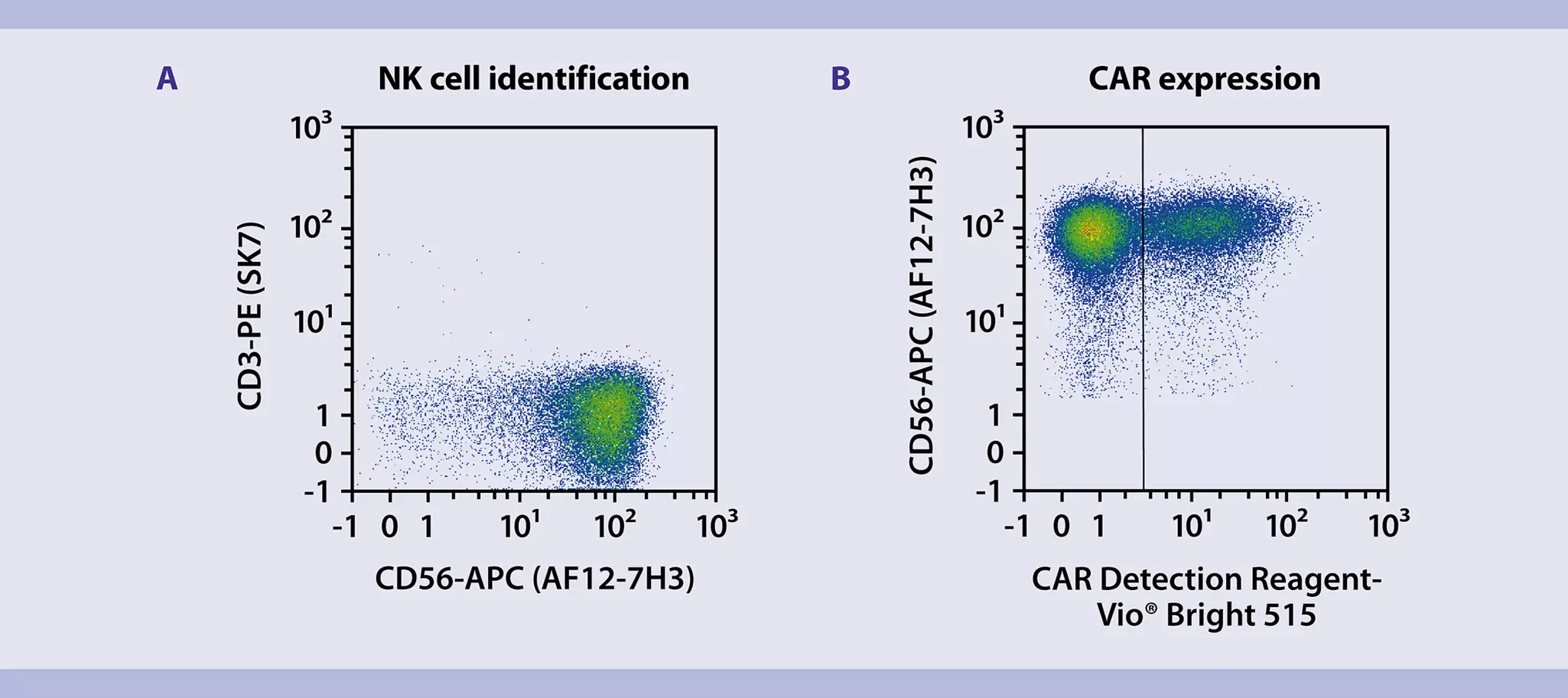
Dot plot showing flow cytometric analysis of CAR-engineered NK cells
Detection of viable transduced NK cells after expansion

The CAR Detection Reagents are optimized to enable background-free flow cytometry analysis without any additional FcR blocking steps, reliably identifying and enumerating transduced CAR-engineered NK cells.

Phenotypic characterization of CAR NK cells

Check the phenotype of your engineered CAR NK cells with suitable assays. Whether to analyze their activation status or detect the expression of your CAR construct, inject sensitivity into your analyses with our predefined and custom detection assays.

Validated panels for NK cell flow analysis

Setting up and validating multicolor flow cytometry assays is tedious but crucial for reliable NK cell phenotyping. Get a leg up with Miltenyi Biotec Tested Panels (MBTP). These sensitive panels combine fluorochrome-conjugated REAfinity® Recombinant Antibodies into optimized and validated assay panels with step-by-step protocols and gating strategies for fast and easy analysis.

PanelPurposeAntibodies includedStainingInput
MBTP 8Immunophenotype NK cells from human whole bloodCD56, KIR2D, CD159a (NKG2A), CD159c (NKG2C), CD314 (NKG2D)1 hProtocol is for up to 106 nucleated cells, but larger numbers can be processed
MBTP 20Determine activation status of NK cells from human PBMCsCD56, CD45, CD335 (NKp46), CD336 (NKp44), 7-AAD Staining Solution, CD3, CD14, CD337 (NKp30), CD314 (NKG2D), CD16< 1 hProtocol is for up to 106 nucleated cells, but larger numbers can be processed
MBTP 30Immunophenotyping KIR-expressing NK cells from human whole blood7-AAD Staining Solution, CD3, CD14, CD45, CD56, CD158a (KIR2DL1), CD158b (KIR2DL2/DL3), CD158e (KIR3DL1), CD159a (NKG2A)< 1hProtocol is for up to 106 nucleated cells, but larger numbers can be processed

Functional profiling of CAR NK cells

Miltenyi Biotec offers flow cytometry solutions that allow for the analysis of antigen-specific target cell killing plus intracellular and secreted cytokine levels of CAR NK cells. Designed for sensitive and standardized quantification, Miltenyi Biotec solutions emphasize reliability and comparability of results.

Diagram showing killing of specific tumor cell line by CAR NK cells in a ratio-dependent manner
Killing of specific tumor cell line by CAR NK cells in a ratio-dependent manner

Direct measure of antigen-specific killing activity

The cytotoxicity of CAR NK cells is measured by co-culturing them at various effector-to-target cell ratios with a tumor cell line expressing the antigen of interest. Cell viability in the tumor cell line is then determined by flow cytometry after exposure to the CAR-engineered NK cells. Comparing results to a culture using tumor cells that do not express the antigen of interest is a direct measure of the antigen-specific killing rate of your CAR NK cells.

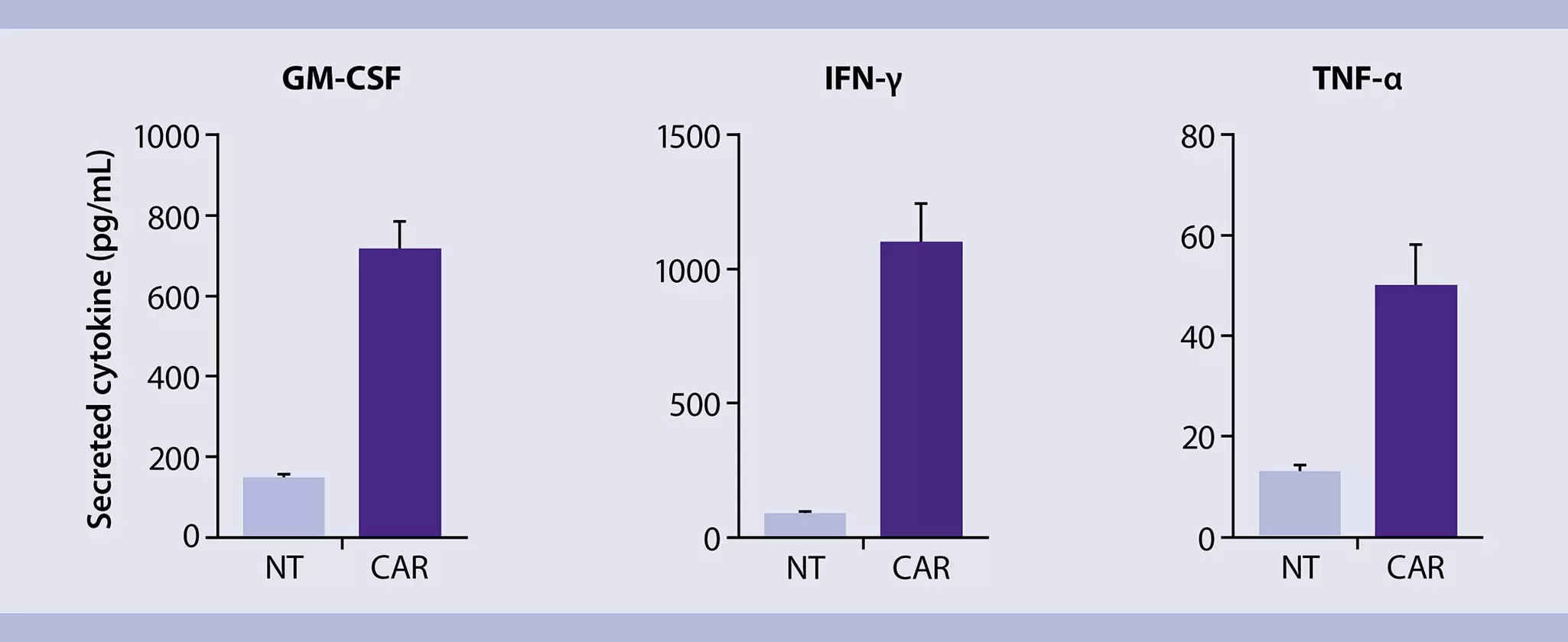
Bar chart showing cytokine analysis of supernatant from CAR NK cells co-cultured with target cells
Cytokine analysis of supernatant from CAR NK cells co-cultured with target cells using the MACSPlex Cytokine Kit

High-throughput and automated cytokine quantification

The accurate quantification of cytokines secreted into the supernatant of effector-target co-cultures is a detailed in vitro potency examination of CAR-engineered NK cells. MACSPlex Cytokine Kits are designed for this purpose, facilitating the analysis of up to 12 human cytokines in one sample using any multicolor flow cytometer.

Analyses with MACSPlex Cytokine Kits are furthermore automated using the MACSQuant Express Modes.

Researcher is starting an analysis on the flow cytometer MACSQuant Analyzer 16
Recorded talks

Expert discussions

The Miltenyi Biotec Cell Therapy Analytics Day in 2021 was an interactive virtual event dedicated to simplifying cell manufacturing analytics. Recordings of experts discussing challenges in analytics and cutting-edge technologies to achieve streamlined processes are available on demand.

Watch the recordings

Are you thinking about translation?

We support your path from benchtop to bedside

Step-by-step protocols for CAR NK cell engineering

Explore in detail our protocols for the engineering of CAR NK cells.