Lymphoma: CAR T and advanced cell therapies expand treatment options


Lymphoma: CAR T and advanced cell therapies expand treatment options
Challenges in lymphoma care
Lymphomas arise from the malignant proliferation of lymphoid cells and are classified into two main groups: Hodgkin's lymphoma (HL) – a malignancy of B cell origin characterized by a specific cellular phenotype, marker expression, and genetic signature – and non-Hodgkin's lymphomas (NHL) that affect B, T, or NK cells.1
Around 80% of HL patients have a good prognosis after radiotherapy or chemotherapy1–3, while over half of B-cell NHL cases treated with standard therapy achieve long-term remission4. Relapse or refractory (r/r) patients in both groups have options, like immunotherapy and autologous hematopoietic stem cell transplantation (HSCT), but the prognosis after further relapses is poor.4 T and NK-cell NHL patients have limited treatment options and a high risk of relapse.5
CAR T cell therapy for lymphoma
Cell therapies have debuted in the care of lymphoma patients. Anti-CD19 CAR T cell therapies are a valuable option for (r/r) B-cell NHL patients and have led to high response rates and prolonged remission.6 However, a significant number of treated B-cell NHL patients do not respond to the therapy or relapse6, and severe side effects such as cytokine release syndrome (CRS) can be life-threatening. Therefore, improved cell therapy options for B-cell NHL are under investigation.6 Clinicians are also exploring anti-CD30 CAR T cells to treat HL patients who don’t respond to standard therapy, and alternative cell therapy strategies for T and NK-cell lymphomas, which currently lack optimal target antigens.2,5
Extending cell therapy benefits and rethinking targets for lymphoma
Miltenyi Biotec offers products and services to support clinicians in exploring ways to improve treatment options for lymphomas. Innate cells like NK cells may be the key to creating additional treatment options for patients, while next-generation constructs and armoring of T cells can revamp efficacy. Combining cell therapies with HSCT may help enhance safety.7 Furthermore, early clinical studies have also shown that γδ T cells can provide potent anti-tumor activity as part of the defense response against lymphoid malignancies.8,9

Improving access to cell therapy for lymphoma
Beyond innovation in therapeutic concepts, clinicians use Miltenyi Biotec solutions to curtail the manufacturing and distribution costs of cell therapies. There is significant impetus to move cell manufacturing to the site of care, eliminating logistical complications.8,9



Miltenyi Biotec solutions in the field
Enabling highly standardized and automated manufacturing processes in a small footprint, the CliniMACS Prodigy® Platform facilitates the production of cell and gene therapy solutions in clinical settings. The following are a few examples of how the CliniMACS Prodigy Platform is used in lymphoma clinical research.
Recorded talk
Developing off-the-shelf CAR NK cells targeting CD70: Updates from preclinical studies to early clinical trials in an academic setting
In this talk, Dr. Sunil Acharya, Principal Research Scientist in the lab of Dr. Katy Rezvani at MD Anderson Cancer Center, presents the translational journey of CD70-targeting CAR-engineered natural killer (NK) cells from bench to bedside.
Dr. Acharya highlights key preclinical findings and shares early insights from ongoing Phase I/II clinical trials evaluating CD70 CAR NK cells in both hematologic malignancies and solid tumors. This presentation underscores the promise of allogeneic, off-the-shelf NK cell therapies as a next-generation cancer immunotherapy.
Would you like to hear more from your peers?
Publication
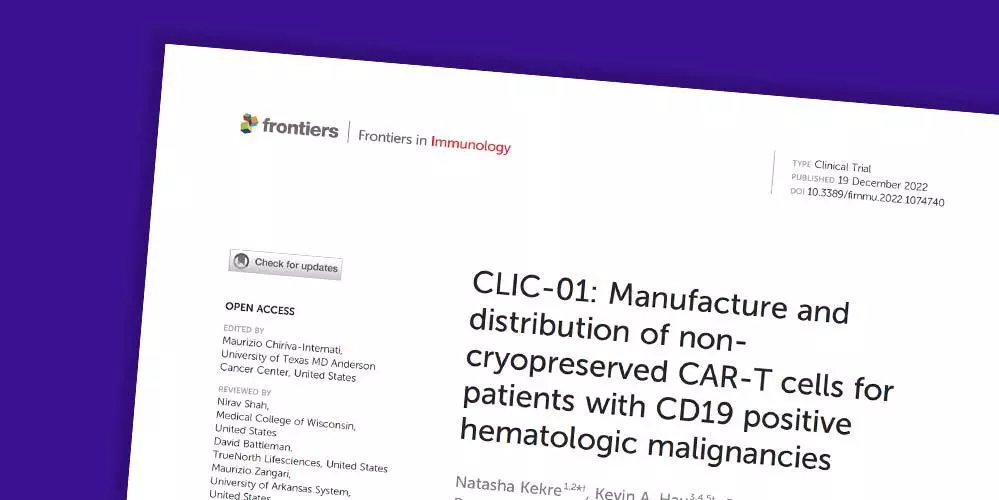
CLIC-01: Manufacture and distribution of non-cryopreserved CAR-T cells for patients with CD19-positive hematologic malignancies
Kekre, N. et al. (2022) Front. Immunol. 13: 1074740.
A GMP-compliant in-house process is examined in the Canadian healthcare system as a solution for sustainable cell therapy programs for acute lymphoblastic leukemia (ALL), chronic lymphocytic leukemia (CLL), and B-cell non-Hodgkin’s lymphoma (NHL).

Publication
Multiple site place-of-care manufactured anti-CD19 CAR-T cells induce high remission rates in B-cell malignancy patients
Maschan, M. et al. (2021) Nature Comm. 12: 7200.
Anti-CD19 CAR T cells manufactured at the point of care in two countries enabled product harvest in as little as 8 days to treat relapsed/refractory pediatric acute lymphocytic leukemia (ALL) and adult non-Hodgkin's lymphoma patients.
Additional publications
- Shah, N. N. et al. (2025) Phase I/II study of adaptive manufactured lentiviral anti-CD20/anti-CD19 chimeric antigen receptor T cells for relapsed, refractory mantle cell lymphoma. J. Clin. Oncol. 43: 2285–2295. | Read article
- Ghobadi, A. et al. (2025) Treatment of non-Hodgkin lymphoma with point-of-care manufactured CAR T cells: a dual institution, phase 1 trial. EClinicalMedicine 81: 103138. | Read article
- Luanpitpong, S. et al. (2024) Point-of-care manufacturing of anti-CD19 CAR-T cells using a closed production platform: Experiences of an academic in Thailand. Mol. Ther. Oncol. 32: 200889. | Read article
- Zhang, Y. et al. (2023) Safety and efficacy of a novel anti-CD19 chimeric antigen receptor T cell product targeting a membrane-proximal domain of CD19 with fast on- and off-rates against non-Hodgkin lymphoma: a first-in-human study. Mol. Cancer 22: 200. | Read article
- Bold, A. et al. (2023) Haploidentical γδ T cells induce complete remission in chemorefractory B-cell non-Hodgkin Lymphoma. J. Immunother. 46: 56–58. | Read article
- Ortíz-Maldonado, V. et al. (2021) CART19-BE-01: A multicenter trial of ARI-0001 cell therapy in patients with CD19+ relapsed/refractory malignancies. Mol. Ther. 29: 636–644. | Read article
- Jackson, Z. et al. (2020) Automated manufacture of autologous CD19 CAR-T cells for treatment of non-Hodgkin's lymphoma. Front. Immunol. 11: 01941. | Read article
- Castella, M. et al. (2020) Point-of-care CAR T-cell production (ARI-0001) using a closed semi-automatic bioreactor: experience from an academic phase I clinical trial. Front. Immunol. 11: 00482. | Read article
- Liu, E. et al. (2020) Use of CAR-transduced natural killer cells in CD19-positive lymphoid tumors. N. Engl. J. Med. 382: 545–553. | Read article

Interested in other indications? Have questions?
Unless otherwise specifically indicated, Miltenyi Biotec products and services are for research use only and not for therapeutic or diagnostic use. For complete regulatory notes, please click here.