Centralized or point-of-care manufacturing: choosing the right model

The therapeutic power and rapid progress of cell and gene therapy (CGT) are undeniable. However, clinical applications hinge on manufacturing systems that enable timely and safe patient access. You’ve heard of centralized production hubs and decentralized point-of-care (PoC) setups, but which is the better approach? Are those your only options, and how do you decide on a setup that ensures patient access to cutting-edge cell therapies? Miltenyi Biotec can help. Let’s explore.

Today's cell therapy manufacturing models

Today, scaled-out production of commercially available cell therapies approved by the U.S. Food & Drug Administration (U.S. FDA) happens at facilities of the pharmaceutical company that owns the product.1 This centralized production model ensures uniform product quality and optimizes per-dose costs through high production volume and the use of state-of-the-art equipment like the CliniMACS Prodigy® Platform. In fact, the CliniMACS Prodigy Instrument underpins the production of four FDA-approved commercial cell therapies.

The model has significant caveats. The setup strains the logistics of delivering cell products to patients. Production slots are not immediately available. Manufacturing can take several weeks. Shipping is complicated by the need to cryopreserve the product.3 As a result, patients can wait weeks to months for their dose. These logistics hurdles and a high financial investment have hindered the establishment of large cell manufacturing facilities in most of the world.3

In response, some healthcare systems have deployed cell manufacturing in academic and clinical settings. Many academic institutions have in-house production facilities for the PoC manufacturing of therapies used primarily in clinical trials.3 Cell products are generated onsite, eliminating the need for cryopreservation and lengthy shipping. Vein-to-vein times can be as short as seven days.4–6 Additionally, a PoC setup allows flexibility in timing and cell product type7 and has also been shown to slash costs by up to 90% of the price for commercial counterparts8,9. The CliniMACS Prodigy Platform powers PoC manufacturing of therapies in over 150 clinical trials, attesting to its technical fit for this setting.

PoC manufacturing has challenges too. A critical one is the complexity of a nascent regulatory space. Currently, the regulation of PoC production models occurs at four levels – GMP compliance, permission to treat patients via clinical trial applications, early access programs or hospital exemptions, reimbursement decisions, and lastly, defining the liable legal entity and intellectual property owner.

Clearly, the right manufacturing model will differ depending on clinical application and production circumstances. In fact, existing setups are often somewhere in between centralized and PoC.

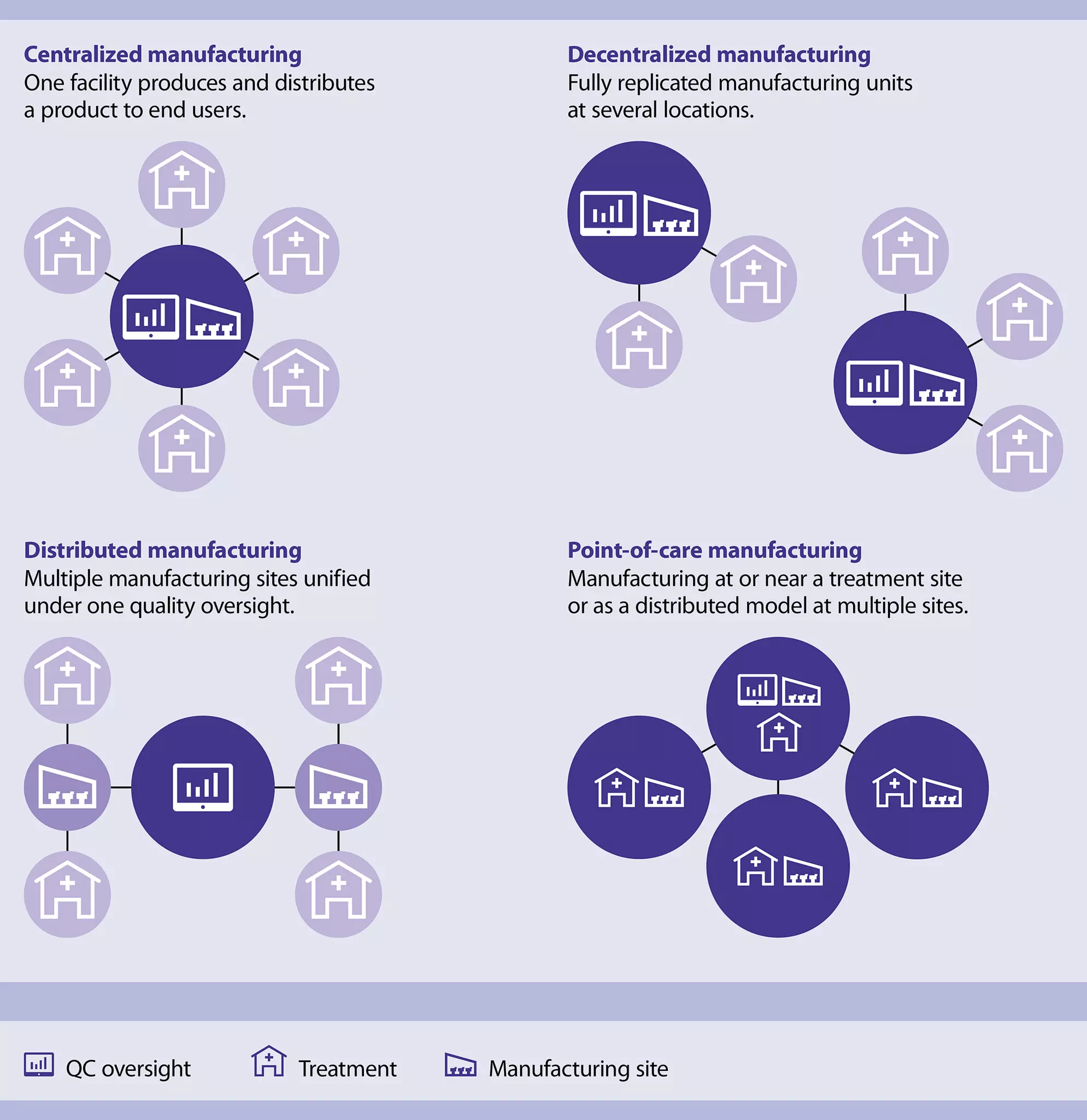
Overview of the current cell and gene therapy manufacturing models, partially adapted from definitions of the U.S. FDA.
Descriptions of CGT manufacturing models partially adapted from definitions of the U.S. FDA.2 These models should not be understood as mutually exclusive.

The reality is a spectrum

The distinction between centralized and PoC manufacturing is more complex than a dichotomy. In reality, manufacturing models often fit more than one definition and there is no universal agreement on the use of terms like “centralized” or “decentralized”. Usually, a PoC manufacturing site describes an operator who is not a conventional pharmaceutical manufacturer, such as a hospital or a cell manufacturing facility near a care center. The U.S. FDA offers definitions for distributed and PoC manufacturing2, but it is possible for PoC manufacturing to be distributed.

Currently, regulatory agencies in several countries are trying to define the regulatory and legal requirements for cell manufacturing that deviates from conventional centralized production. They aim to establish guidelines and foster alternative strategies that make cell therapies more broadly available. In this complex scenario, innovative approaches have emerged that address challenges at each end of the spectrum. Let’s briefly review the advantages and disadvantages of centralized and decentralized manufacturing.

Centralized versus decentralized cell therapy manufacturing models

Experts compare process and logistics features when discussing centralized and PoC manufacturing models. Centralized setups build on standardized processes and economies of scale to lower costs while concentrating product quality assessment into one control regimen. Decentralized production grants greater flexibility, faster turnaround times, and the ability to tailor therapies to patient needs.

Advantages and disadvantages of centralized versus point-of-care CGT manufacturing (partially adapted from Orentas et al. 2023)10

 Centralized manufacturingDecentralized manufacturing (including point-of-care)
AdvantagesEconomies of scale: Lowers manufacturing costs via high-quantity production (high number of runs under same setup, including certification, personnel training, etc.).

One-site standardization: Facilitates achieving consistent quality and product uniformity.

Advanced infrastructure: Accesses state-of-the-art equipment and expertise.
Reduced complexity: Slashes per-unit cost via simple logistics and agile production.

Faster and more access for patients: Establishes manufacturing hubs where regulations, reimbursement, or logistics hinder access.

Agile response: Accommodates individually tailored treatments.

Fosters innovation: Gives patients and clinicians more options via new vectors, combinations, or early access programs.

No cryopreservation needed: Avoids cold chain and potential reduction of viable cells in product.
DisadvantagesSupply chain complexities: Uses specialized couriers with cryopreservation equipment.

Limited flexibility: Builds on static workflows that allow coordinating multiple parties.

Longer lead times: Often rules out patients with rapidly progressing disease.

Need for bridging therapy: Patients commonly require therapy while waiting for their dose.
Potential product variability: Under scrutiny to maintain consistent outcomes across sites.

Low investment offset: Setup and maintenance costs may not be offset by complex production.

Regulatory complexities: Must ensure compliance with regulations at multiple sites and at multiple levels (GMP, permission to treat, reimbursement, IP ownership).

The merits of these models are not mutually exclusive. After all, the goal is the same – to offer patients timely and accessible cell therapies. But bringing cell manufacturing and patients closer together – i.e., transitioning from centralized to PoC manufacturing – does shift challenges from questions about process agility to demands of process consistency. Centralized manufacturing sites, on the one hand, seek solutions to minimize cleanroom requirements while offering a production pipeline that scales to demand and accommodates multiple simultaneous product campaigns. PoC setups, on the other hand, must demonstrate product reproducibility and irreproachable quality within and among sites.

CliniMACS Prodigy at the point of care and on the manufacturing floor

The CliniMACS Prodigy Platform is designed for manufacturing versatility. On the one hand, the CliniMACS Prodigy is a highly standardized building block of centralized setups for the parallel manufacturing of commercial cell products. On the other hand, it facilitates strict safety assurances and regulatory compliance in a PoC environment.

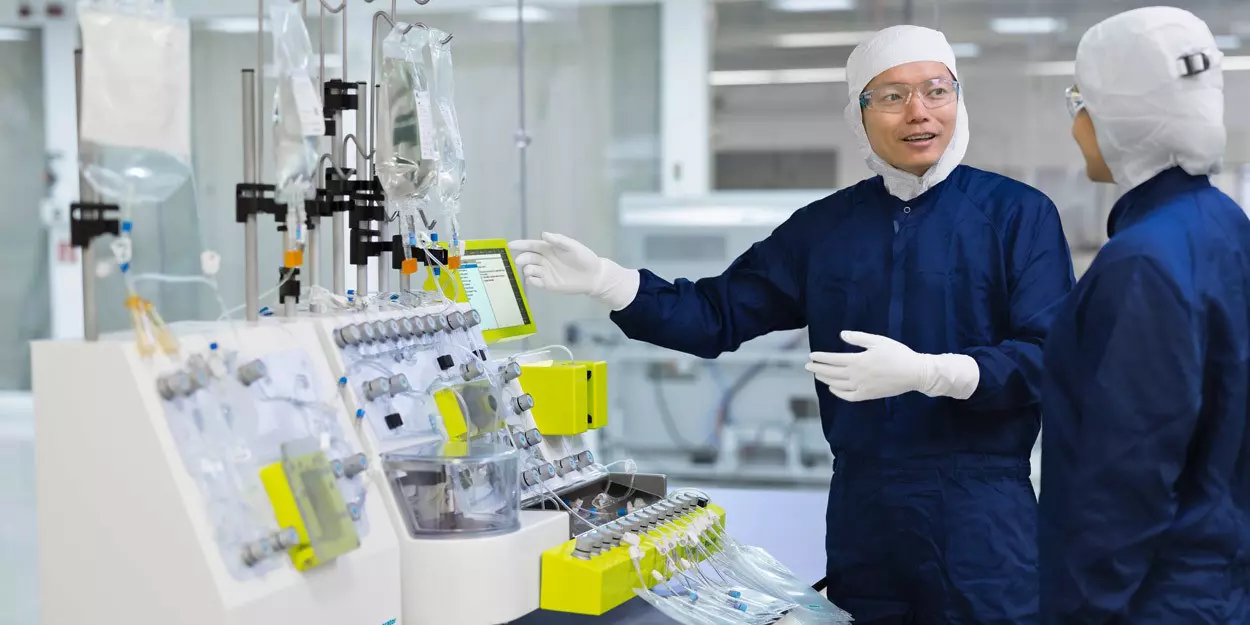
A person in a clean room operating the CliniMACS Prodigy cell manufacturing platform

Centralized, scaled-out setups

  • Automation allows fewer staff to oversee multiple manufacturing processes.

  • Processing within a single-use tubing set allows parallel manufacturing of cell products in a ballroom layout.

  • A small footprint enables efficient placement of instruments in a cleanroom.

  • Increases in production demand can be met flexibly by deploying more instruments.

  • In-process control checks and release testing across instruments are easily aligned on the MACSQuant® Analyzer Flow Cytometer.

  • Broad flexibility during process development promotes clinical innovation while avoiding expensive changes at later stages.

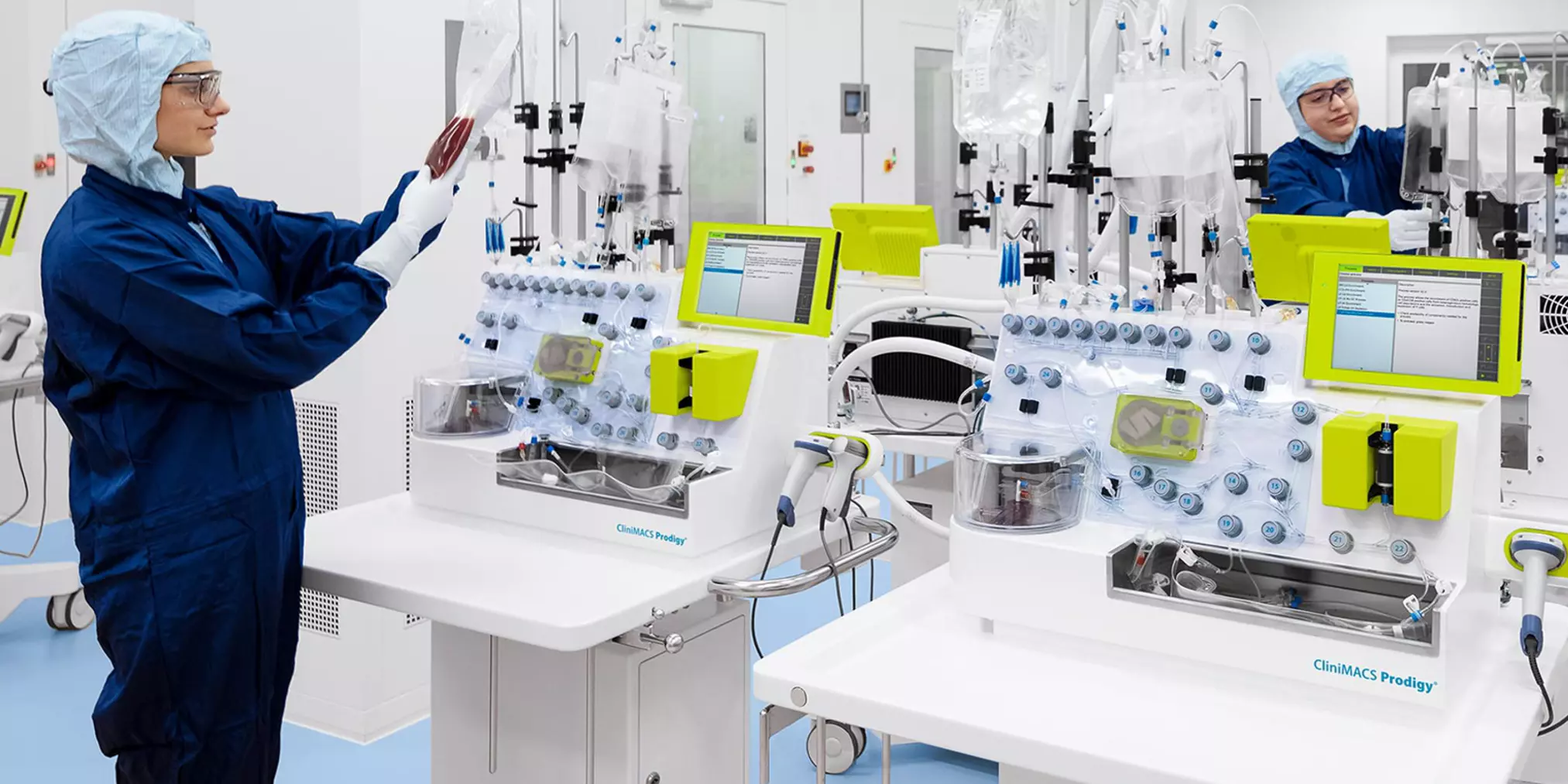
Two people operating the CliniMACS Prodigy in a clean room

Decentralized and PoC models

  • An all-in-one closed system, potentially suitable for class C cleanrooms and below, reduces complexity and investment compared to multiple manual steps and instruments.

  • A high degree of automation standardizes cell manufacturing.

  • The closed tubing set ensures product and staff safety.

  • Aligned trainings, protocols, and services ensure staff readiness and appropriate deployment.

  • The GMP and 21 CFR Part 11 supportive software is compliance-ready.

  • Sourcing reagents, buffers, and media from one provider ensures quality standards and reduces regulatory complexity.

Setting the benchmark in CAR T cell manufacturing at the point of care

Today's solutions in the field tackle region-specific challenges in bringing cell therapies to patients. Many US and European research hospitals deploy the CliniMACS Prodigy Platform to manufacture cell products for clinical trials. Its robust and consistent performance is perfect for today's multisite trial setups, like the recently reported CASE 2417 Phase I trial, where PoC manufacturing was done at two different locations.11 Other institutions leverage the all-in-one hallmark of the CliniMACS Prodigy Platform to address the gap between pricing structures of commercial cell therapies and buying power of developing countries. For example, the VELCART study in India demonstrated the feasibility and cost-savings of deploying PoC manufacturing in such settings.9,12 In this context, the closed operation of the CliniMACS Prodigy Platform allowed manufacturing cellular products in GMP without expensive, high-class cleanrooms. The following table lists examples of cell manufacturing sites that benefit from features of the CliniMACS Prodigy Platform in class C and D cleanrooms.

Examples of PoC clinical manufacturing sites using the CliniMACS Prodigy Platform in class C or D cleanrooms for trials or hospital exemptions.

LocationCleanroom levelType of cell therapyReference
Christian Medical College, Vellore, IndiaClass CCD19 CAR T cellsPalani et al. 202512
Hospital Clinic Barcelona, SpainClass CCD19 CAR T cellsUrbano-Ispizua et al. 202413
BC Cancer, Victoria, CanadaClass DCD19 CAR T cellsKekre et al. 202214
Siriraj Hospital, ThailandClass CCD19 CAR T cellsLuanpitpong et al. 202415
Children’s Hospital of Philadelphia, USAClass CCAR T cellsMachietto et al. 202316

Other solutions merge aspects of different production concepts to achieve goals. For example, ARI-0001 is a CAR T cell therapy targeting CD19 developed by the Hospital Clinic Barcelona in Spain.17 Manufactured on the CliniMACS Prodigy Platform, the cell product was fully academic-developed. It was tested in phase I and II clinical trials and approved under hospital exemption (HE) by the regulatory body of Spain to treat relapsed acute lymphoblastic lymphoma in patients above 25 years of age.18 As such, ARI-0001 is an example of PoC manufacturing. However, numerous hospitals are now participating in a multisite phase II trial with corresponding HE authorization, essentially operating as a nationwide distributed manufacturing and treatment network.3,19,20 Signalizing the next step toward marketing authorization at a European level, and thus a broadening of the distributed network, ARI-0001 was granted PRIME designation by the European Medicines Agency (EMA) in 2021.21

Currently, CAR T cell therapies dominate the cell manufacturing space, but that is changing. The option of PoC production has brought mesenchymal stem cells (MSCs) and natural killer (NK) cells into the picture. MSCs require rapid processing and expansion to preserve their immunomodulatory properties, which PoC manufacturing supports by reducing transit times and obviating cryopreservation.22,23 Similarly, NK cells benefit from the minimized handling delays of in-house manufacturing to maintain their cytotoxic potential and viability.24 Automated systems like the CliniMACS Prodigy Platform streamline isolation, expansion, and quality control for these cell types, ensuring higher product consistency and faster turnaround times. Plus, by enabling decentralized manufacturing, the CliniMACS Prodigy Platform effectively addresses unique logistical and regulatory challenges.25

Recorded talk

Point-of-care CAR T cell manufacturing in Canada

Dr. Natasha Kekre of The Ottawa Hospital presents how the CLIC research program launched a distributed PoC model that offers CAR T cell therapy to patients across Canada who may otherwise be out of options.

Tailored CGT insights for your area of care

The CliniMACS Prodigy Platform is already instrumental in over 200 cell therapy trials today. Learn more about the solutions and expertise that Miltenyi Biotec offers for CGT in clinical research settings.

Find my indication

Choosing the right cell manufacturing model: where to start?

Each cell therapy program has unique specifications and requirements, so choosing a reliable and future-proofed manufacturing model can be a complicated evaluation. Based on our experience and expert interviews, the following are important questions to consider.

A person in a clean room operating the CliniMACS Prodigy cell manufacturing platform

1. What space do we need?

Cleanroom requirements, instrument space, and staffing of a cell manufacturing site are critical concerns. Working with viral vectors adds obligations for biosafety. Not only is physical room needed, but also the appropriate maintenance and management infrastructure.

2. How will we train our team?

Especially in PoC operations where involvement in cell manufacturing may be limited, effective training is vital. Streamline onboarding staff and scaling out operations by seeking partnerships that offer end-to-end support for the equipment and the people behind your workflow.

3. Where do we get reagents and consumables?

A decisive criterion is the means to establish an efficient, safe, and uninterrupted production process. Your supply of reagents, consumables, and instrument maintenance must be reliable. Consider the benefits of a single provider for all your needs to ensure operation continuity.

Researcher is starting an analysis on the flow cytometer MACSQuant Analyzer 16

4. Can we ease technology transfers and QC?

Decentralized models must ensure site-to-site reproducibility. Thus, support technology transfers with meticulous protocols and well-defined equivalency criteria. Use the same care in quality control, regardless of model. Finally, adopt analytical systems that easily integrate into and align with your manufacturing workflow.

5. How do we ensure regulatory compliance?

Regulatory complexities can push the needle toward one or the other manufacturing setup. Especially as regulators explore new approval structures that impact future decisions, regulatory expertise to understand and navigate those complexities is essential.

The key is knowledge and an experienced partner

Selecting a manufacturing model is a complex decision influenced by logistical, financial, and regulatory factors. PoC approaches have demonstrated significant potential to improve patient access while fostering innovation in CGT. At the same time, supporting business models are emerging to enhance the financial viability and scalability of decentralized systems. Centralized facilities will continue to play a crucial role, particularly for therapies requiring the production of large numbers of runs.

Recent advances impact the feasibility of CGT manufacturing in general, regardless of model type. For example, chain-of-custody dashboards are streamlining product tracking and logistics.7 Also, integrated and harmonized systems, like the CliniMACS Prodigy Platform for cell processing with the MACSQuant Analyzers for flow cytometry, align manufacturing with automated in-process control and release testing to reduce production times and improve patient access. As the field evolves, the right manufacturing models will balance agility, scalability, and accessibility to meet the growing demand for life-saving cell therapies and reach patients swiftly and safely.

Your ideas are implementable.
Let’s make them happen.