Cell therapy and therapeutic apheresis in solid organ transplantation


Cell therapy and therapeutic apheresis in solid organ transplantation
Tools supporting research in transplantation
While solid organ transplantation (SOT) is a well-founded therapeutic option for patients in need of a new organ, it is also associated with severe complications.1
We offer a wide range of tools for generating and analyzing cell therapy products. These have been applied in research applications to address current challenges, and may support the development of alternative treatment strategies.2-17 This includes tools that support the development of T cell therapies for managing infections, cell therapy approaches that support graft tolerance, and apheresis platforms that selectively remove plasma components in transplant-related settings.
Clinical applications against infections
T cell–based strategies are already used to help treat or prevent opportunistic infections in immunocompromised patients. Get an overview of the clinical-grade tools used and the experience gained in hematopoietic stem cell transplantation (HSCT) and other settings involving immunocompromised individuals.2-11

Memory T cell enrichment
Donor-derived enriched memory T cells offer broad anti-pathogenic potential. They are used to help treat or prevent opportunistic infections in allogeneic HSCT and in patients with other forms of immune deficiency.2-6

Virus-specific T cell isolation
Virus-specific T cells, rapidly enriched using magnetic selection based on IFNγ-secretion, are used to counter opportunistic viral infections in immunocompromised patients.7-11
Cell therapy approaches to support graft tolerance
Graft rejection remains a major obstacle to achieving long-term success in SOT, as it can lead to damage or loss of the transplanted organ.12 Cell-based approaches aim to support immune tolerance while reducing the burden of systemic immunosuppression.
Clinical-grade regulatory T cell products
Administration of regulatory T cells (Tregs) shows promise in preventing rejection responses in SOT. By supporting tolerance, these cells may help reduce the need for long-term immunosuppressive therapy.13,14

Tandem SOT with HSCT from the same donor
This combination is intended to eliminate the need for lifelong immune suppression. To reduce the risk of alloreactivity in the HSCT graft, ex vivo T cell depletion has been performed as a treatment option.15
Therapeutic apheresis
Therapeutic apheresis selectively removes antibodies from a patient’s plasma. In SOT, it helps manage immunological risks, including donor–recipient incompatibility and rejection-related complications.16,17
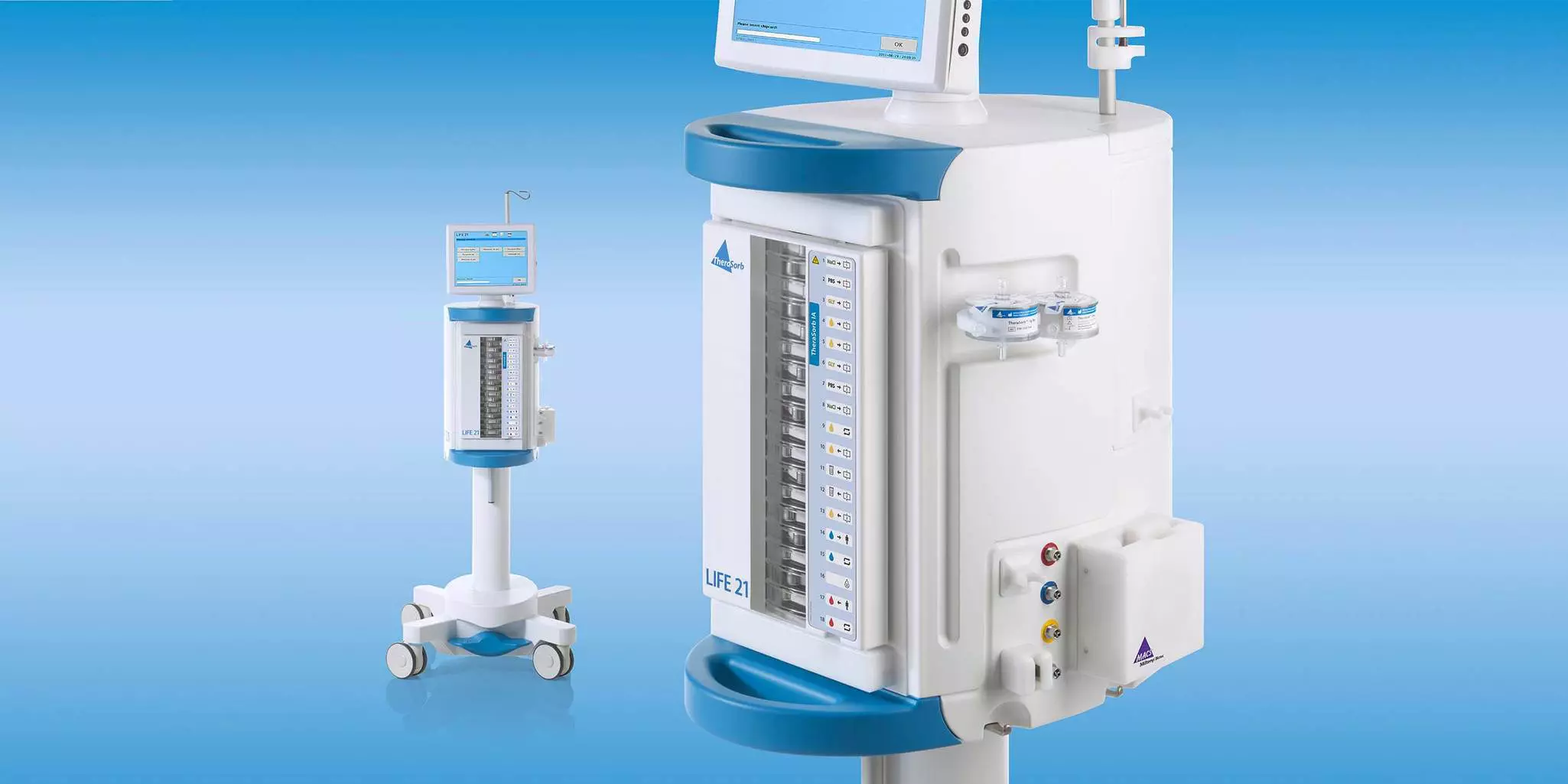
TheraSorb® therapeutic apheresis
The LIFE 21® – TheraSorb Therapeutic Apheresis Platform enables the removal of critical substances from the plasma of SOT patients. TheraSorb – Ig omni adsorbers are pan-Ig adsorbers that have been used in ABO-incompatible kidney transplantation and in preventing antibody-mediated rejection.16,17
Explore selected references on the use of TheraSorb – Ig omni adsorbers in transplantations.
Improving access to cell therapy for solid organ transplantation



- Sen, A. et al. (2019) Complications of solid organ transplantation: cardiovascular, neurologic, renal, and gastrointestinal. Crit. Care Clin. 35: 169–186. | Read article
- Al-Akioui Sanz, K. et al. (2023) Familial CD45RA– T cells to treat severe refractory infections in immunocompromised patients. Front. Med. 10: 1083215. | Read article
- Park, H. J. et al. (2020) Successful treatment of refractory CMV colitis after haploidentical HSCT with post-transplant cyclophosphamide using CD45RA+ depleted donor lymphocyte infusion. Bone Marrow Transplant. (2020) 55:1674–1676 | Read article
- Brodszki, N. et al. (2016) Novel treatment of severe combined immunodeficiency utilizing ex-vivo T-cell depleted haploidentical hematopoietic stem cell transplantation and CD45RA+ depleted donor lymphocyte infusions. Orphanet J. Rare Dis. 11:5. | Read article
- Zhang, M. et al. (2024) TCRαβ-depleted hematopoietic stem cell transplant and third-party CD45RA+ depleted adoptive cell therapy for treatment of post-transplant parvovirus B19 aplastic crisis. Int. J. Infect. Dis. 144: 107043. | Read article
- Yuste, J. R. et al. (2019) Adoptive T-cell therapy with CD45RA-depleted donor in the treatment of cytomegalovirus disease in immunocompromised non-transplant patients. Antivir. Ther. 24: 313–319. | Read article
- Qian, C. et al. (2017) Curative or pre-emptive adenovirus-specific T cell transfer from matched unrelated or third party haploidentical donors after HSCT, including UCB transplantations: a successful phase I/II multicenter clinical trial. J. Hematol. Oncol. 10: 102. | Read article
- Kállay, K. et al. (2018) Early experience with CliniMACS Prodigy CCS (IFN-gamma) System in selection of virus-specific T cells from third-party donors for pediatric patients with severe viral infections after hematopoietic stem cell transplantation. J. Immunother. 41: 158–163. | Read article
- Pello, O. M. et al. (2017) BKV-specific T-cells in the treatment of severe refractory haemorrhagic cystitis after HLA-haploidentical haematopoietic cell transplantation. Eur. J. Haematol. 98: 632–634. | Read article
- Zhao, X. Y. et al. (2020) First-line therapy with donor-derived human cytomegalovirus (HCMV)–specific T cells reduces persistent HCMV infection by promoting antiviral immunity after allogenic stem cell transplantation. Clin. Infect. Dis. 70: 1429–1437. | Read article
- Steinhardt, M. J. et al. (2020) Progressive multifocal leukoencephalopathy in a patient post allo‑HCT successfully treated with JC virus specific donor lymphocytes. J. Transl. Med. 18: 177. | Read article
- Kim, H. S. et al. (2025). Novel association between graft rejection and post-transplant malignancy in solid organ transplantation. World J. Transplant. 15: 102384. | Read article
- Garakani, R. and Saidi, R. F. (2017) Recent progress in cell therapy in solid organ transplantation. Int. J. Organ Transplant. Med. 8: 125–131. | Read article
- Zwang, N. A. and Leventhal, J. R. (2017) Cell therapy in kidney transplantation: Focus on regulatory T cells. J. Am. Soc. Nephrol. 28: 1960–1972. | Read article
- Bertaina, A. et al. (2022) Sequential stem cell-kidney transplantation in Schimke Immuno-osseous Dysplasia. N. Engl. J. Med. 386: 2295–2302. | Read article
- Morath, C. et al. (2012) ABO-incompatible kidney transplantation enabled by non-antigen-specific immunoadsorption. Transplantation 93: 827–834. | Read article
- Klein, K. et al. (2013) Living donor kidney transplantation in patients with donor-specific HLA antibodies enabled by anti-CD20 therapy and peritransplant apheresis. Atheroscler. Suppl. 14: 199–202. | Read article