

Synonyms: IGF1R, IGFIR, IGFR, JTK13
RECOMBINANT EXTENDED VALIDATION
- Clone:
- REA271 | 1H7
- Type of antibody:
- Primary antibodies, Recombinant antibodies
- Isotype:
- recombinant human IgG1
- Applications:
- FC Glossary
- Select a conjugate:
- Select a size:


Other sizes
Related products for CD221 (IGF-1R) Antibody, anti-human, REAfinity™

Flow cytometry applications
APC
Biotin
PE
PE-Vio 770
Recommended dilution:
1:50
Remark:
Cells should be stained prior to fixation, if formaldehyde is used as a fixative.
Data source:
Miltenyi Biotec
Conjugate:
APC
Used products:
130-130-340, 130-130-309
Description:
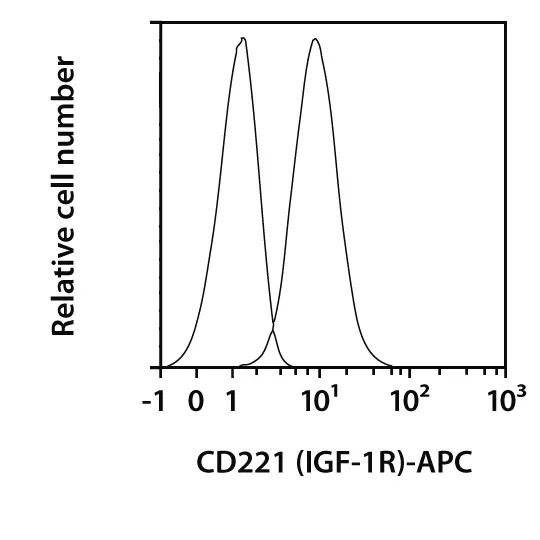
HeLa cells were stained with CD221 (IGF-1R) antibodies or with the corresponding isotype control antibodies (left peak) and analyzed by flow cytometry using the MACSQuant® Analyzer. Cell debris and dead cells were excluded from the analysis based on scatter signals and propidium iodide fluorescence.
Extended validation for CD221 (IGF-1R) Antibody, anti-human, REAfinity™
Specificity
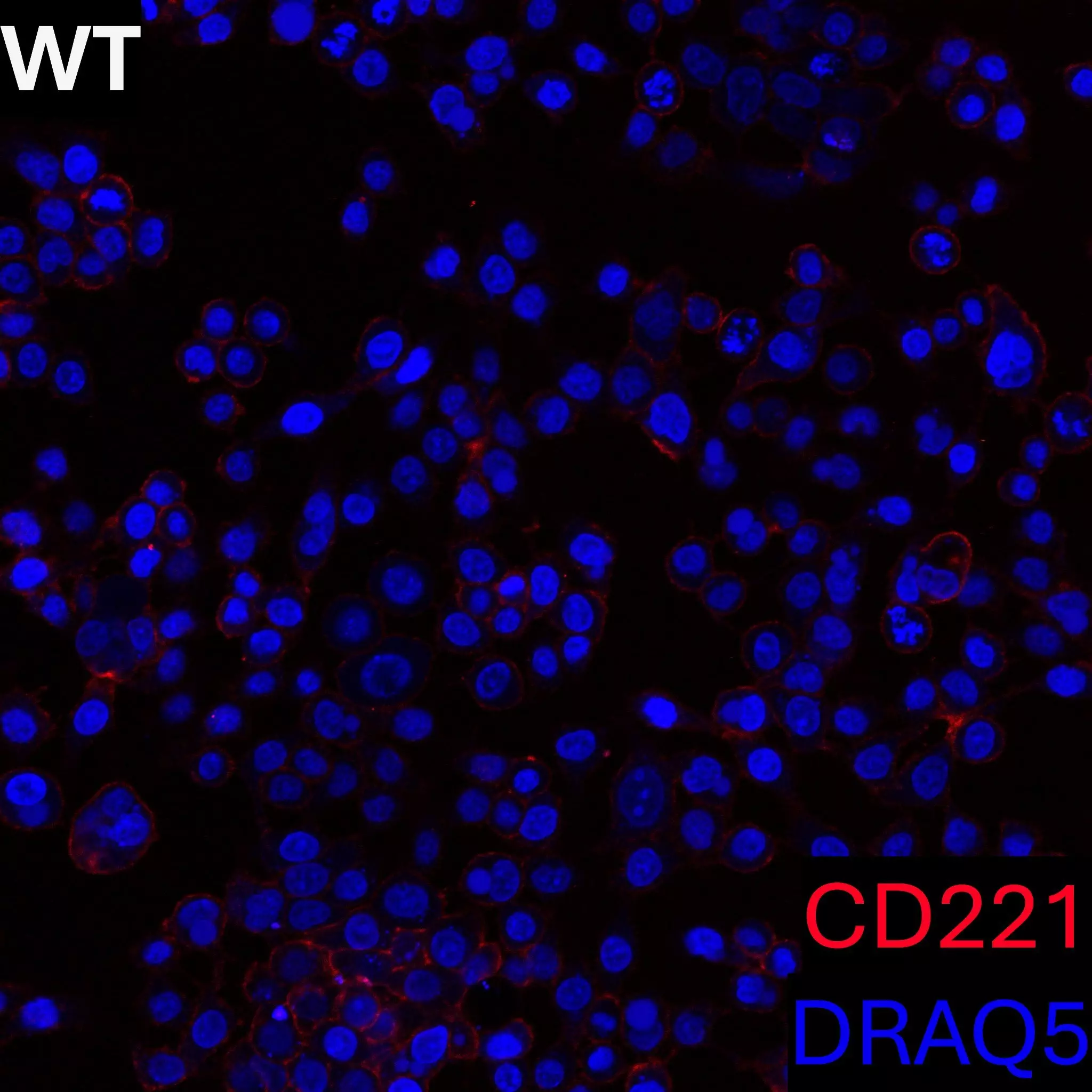
To ensure antibody specificity, the target gene is knocked out in a suitable cell line using the CRISPR/Cas9 system and the knockout is confirmed by sequencing of the target locus. The antibody is considered to bind specifically to the intended epitope if no antibody binding to the knockout cells can be detected. The antibody staining is controlled by fluorescence microscopy and/or flow cytometry.
WT
KO
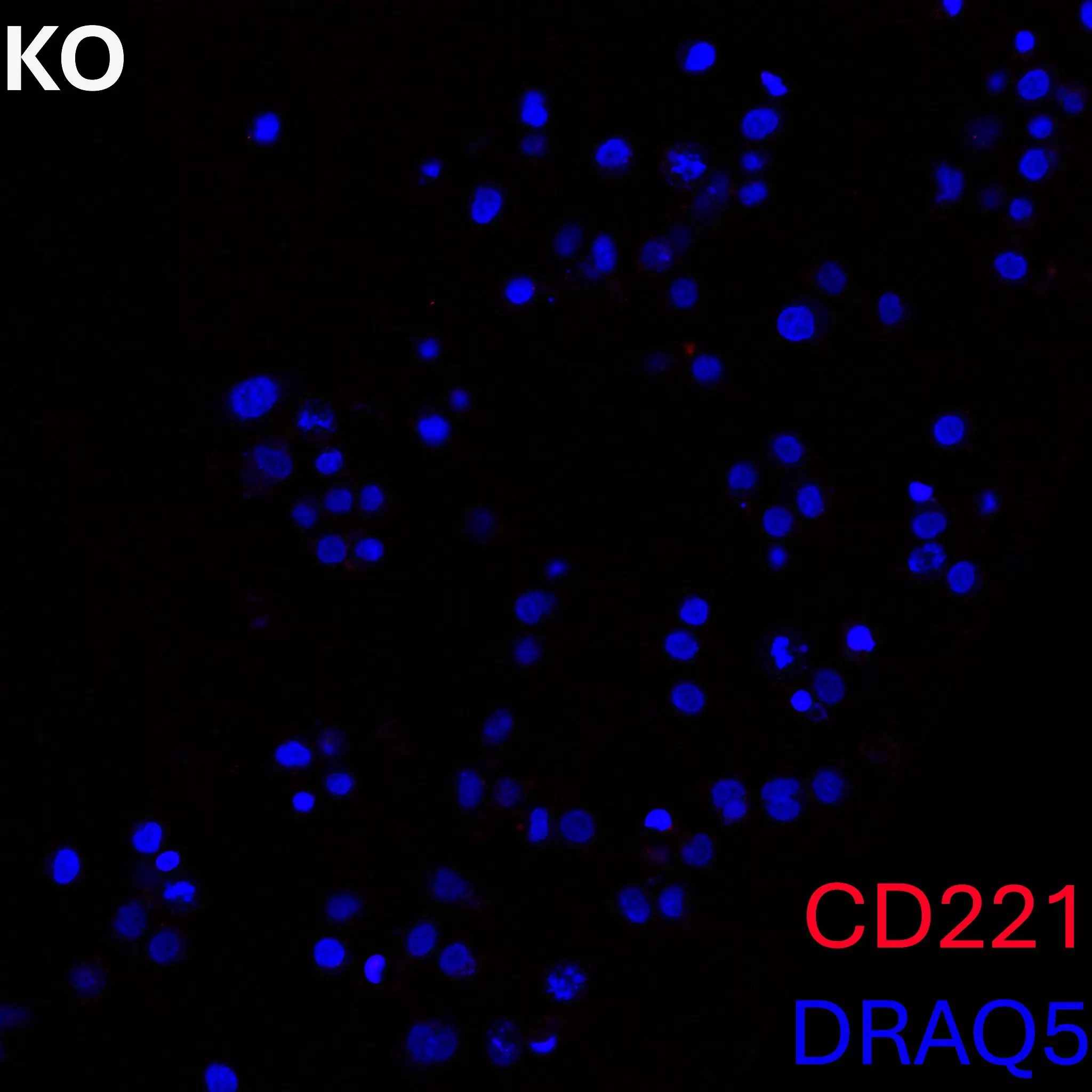
Fluorescence microscopy image of CD221 (IGF-1R) knockout cells. Wild type (WT, left) and knockout cells (KO, right) were stained with CD221 (IGF-1R)-PE (REA271, red) and counterstained with DRAQ5 (blue) as DNA stain.
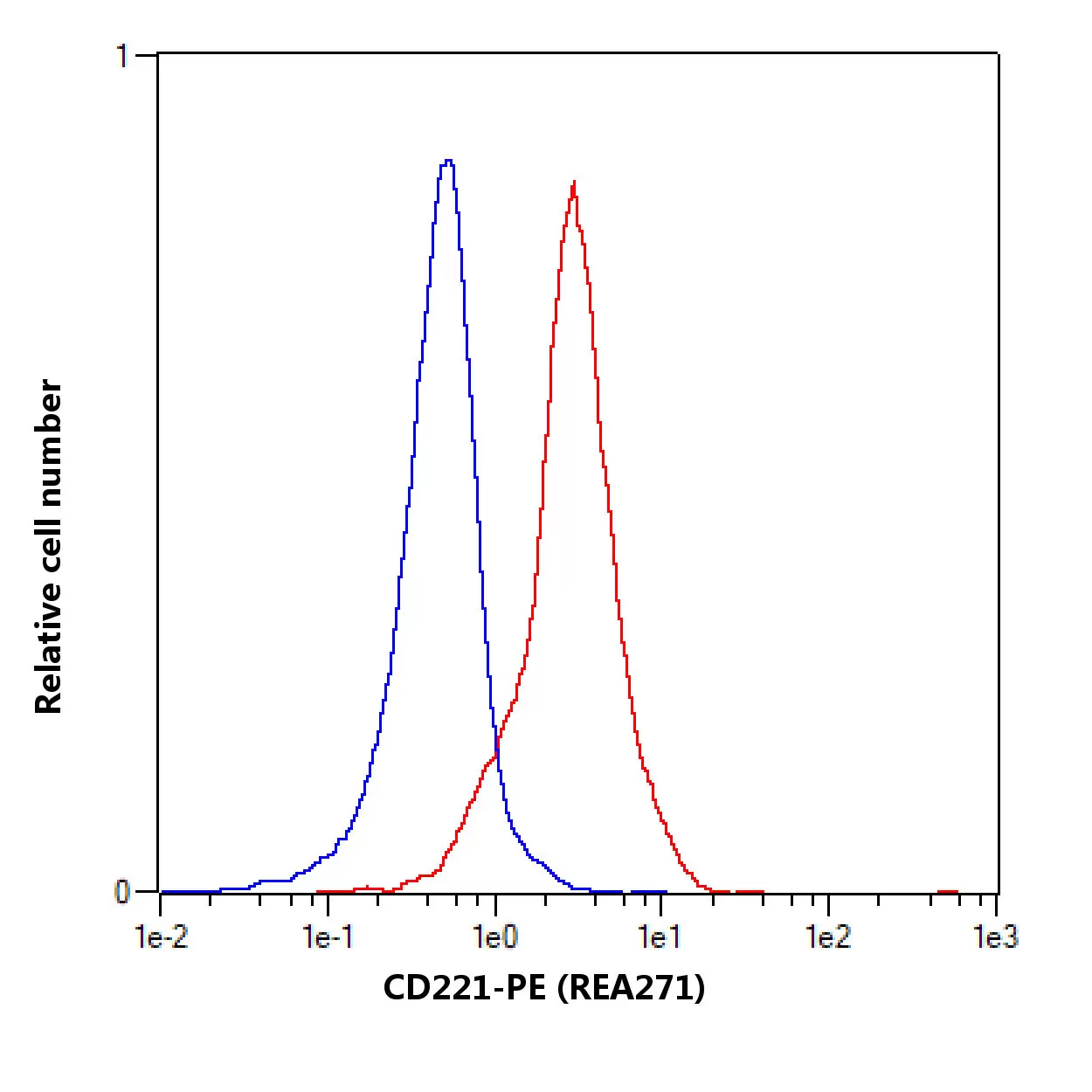
Overlay histogram showing flow cytometric analysis of CD221 knockout cells. Wild type (red) and knockout cells (blue) were stained with CD221-PE, clone (REA271). Flow cytometry was performed with the MACSQuant® Analyzer. Cell debris, dead cells and cell doublets were excluded from the analysis based on scatter signals and propidium iodide fluorescence.
Specifications for CD221 (IGF-1R) Antibody, anti-human, REAfinity™
Overview
Clone REA271 recognizes human CD221 (IGF-1R), a widely expressed cell-surface glycoprotein composed of two α subunits and two β subunits. Both the α and β subunits are synthesized from a single mRNA precursor. The precursor is then glycosylated, proteolytically cleaved, and crosslinked by cysteine bonds to form a functional transmembrane αβ chain. The α chains are located extracellularly, while the β subunits span the membrane and are responsible for intracellular signal transduction upon ligand stimulation. IGF-1R is activated by binding of its ligands insulin-like growth factor 1 (IGF-1), IGF-2, as well as insulin to the extracellular α subunits. Ligand binding leads to autophosphorylation of tyrosine residues in the cytoplasmic regions of the receptor β subunits and subsequent recruitment and phosphorylation of insulin receptor substrate (IRS) proteins. This finally results in activation of the PI3K/Akt and MAPK pathways, which mediate cell proliferation and survival. Many tumors and transformed cells exhibit altered IGF-1R expression.
Additional information: Clone REA271 displays negligible binding to Fc receptors.
IGF1R, IGFIR, IGFR, JTK13
Detailed product information
Technical specifications
Clone
REA271
Clonality
monoclonal
Isotype
recombinant human IgG1
Isotype control
REA Control Antibody (S), human IgG1
Host
human cell line
Type of antibody
Primary antibodies, Recombinant antibodies
Species reactivity
human
Antigen
CD221 (IGF-1R)
Molecular mass of antigen [kDa]
151, sum of molecular weights of subunits
Entrez Gene ID
RRID
AB_2928327, AB_2656390, AB_2656389, AB_2928326
Recombinant antibodies at Miltenyi Biotec
As an innovation-powered company with a commitment to quality and excellence, Miltenyi Biotec applies cutting-edge methods to discover and develop newer and better antibodies to satisfy both market demand and regulatory requirements.
The Miltenyi way of generating best-in-class antibodies and antibody conjugates
At Miltenyi Biotec, we opt for recombinant antibodies, which enable sequence verification and optimization for lot-to-lot consistency, making them superior to hybridoma-based antibodies.
Infusing our unique expertise
Recombinants are the result of combining genetic material from different immunized animals, and using display technologies to screen in-house antibody libraries for the best antibodies. Additional analyses on existing hybridoma-based antibodies can also give rise to sequences contributing to novel recombinants.
Maximizing value for your research
By further re-engineering these antibody sequences, we can precisely control their properties to achieve the following benefits:
reduce undesirable binding to Fc gamma receptors,
- eliminate destabilizing amino acid motifs,
- increase specific bonding affinity for stronger, more accurate targeting, and
- optimize fluorochrome conjugation for brighter and clearer signals.
In a final step, by synthesizing and cloning the resulting gene sequence, we achieve an expression vector that develops a cell line, which in turn produces a special recombinant antibody.
Better science with quality antibodies
Already in 2015, 100 of the world’s leading scientists collectively called for better standards and reproducibility in antibody production, proposing recombinant antibodies to circumvent variability (Baker, M. Reproducibility crisis: Blame it on the antibodies. Nature 521, 274–276 (2015). https://doi.org/10.1038/521274a). Moreover, by applying reverse engineering, which is encouraged by the EU Directive 2016/943 r, Miltenyi Biotec acts “[i]n the interest of innovation and fostering competition…” (§16).
Resources for CD221 (IGF-1R) Antibody, anti-human, REAfinity™
Certificates
To access a Certificate of Analysis (CoA) follow the link below and enter the specific lot of your product.
Should you wish to request additional documentation, such as a Safety Data Sheet (SDS) in other languages than English or Swedish, an SDS-replacement document, or a Certificate of Origin (CoO), please direct your inquiry to your local technical support team.
 Powered by Bioz