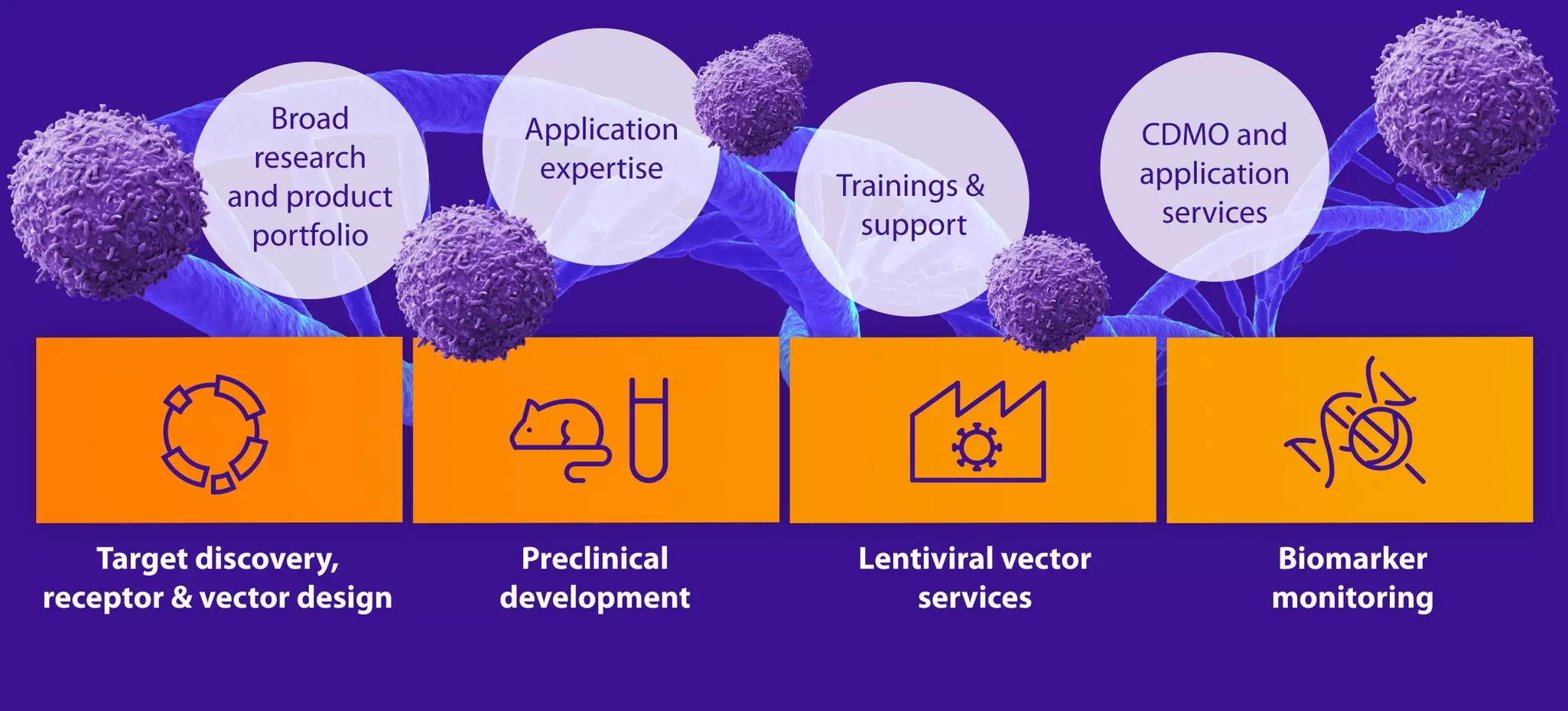
Target discovery, receptor and vector design
Preclinical development
Lentiviral vector services
Biomarker monitoring*
Content
- Target discovery, receptor and vector design
- Preclinical development
- Lentiviral vector services
- Biomarker monitoring*


By moving cell engineering from the lab into the body, in vivo gene therapy opens new opportunities in the development of cell therapies for multiple diseases, from hematological cancers to autoimmune disorders. Leading modalities like in vivo CAR T therapy reduce the complexity associated with manufacturing personalized ex vivo therapies, which can shorten treatment timelines, improve scalability, and expand patient access. The challenge of in vivo strategies, however, lies in verifying desired cell modifications that now occur in a biologically complex environment. That raises demands on your research tools.
The Miltenyi Biotec portfolio of products and services builds on more than 30 years of cell and gene therapy (CGT) expertise to support every stage of in vivo gene therapy development. Our high-quality solutions for sample preparation and cell separation, flow cytometry, molecular analysis, spatial biology, 2D and 3D imaging, and GMP vector manufacturing standardize your workflows, future-proof your early-stage development analytics, and de-risk your platform.
We bring decades of experience, proven technology, a global presence, and a commitment to advancing cell and gene therapies.
Years of experience in cell and gene therapy, from early development to commercial supply
Batches of GMP lentiviral vectors released, including commercial supply for TECELRA®
Clients supported worldwide, with regulatory submissions in 38 countries
Target discovery, receptor and vector design
Preclinical development
Lentiviral vector services
Biomarker monitoring*

In vivo gene therapy development starts with a disease-associated target, an optimized therapeutic construct, and a delivery platform. Use Miltenyi Biotec solutions to confidently identify disease-associated targets of real therapeutic relevance, characterize the target’s expression pattern, and select genetic domains with the desired performance profile.
Reliable and accurate target analysis relies on intact cells. Prepare samples with gentle enzymatic digestion and optimized storage to preserve cell viability and target biology, so you measure the target and not an artifact of handling.
Relevant products and solutions
Dissociate and store tissues with MACS® Sample Preparation
Our flow cytometers are a versatile platform for target selection and optimization. Using pretitrated antibodies, you can standardize marker screening across hundreds of candidates and quantify how well a candidate genetic domain recognizes its target and discriminates non-targets.
Relevant products and solutions
Target analysis in the context of tissue architecture reveals the location and type of cells expressing a target. That spatial profiling helps distinguish target-specific binding from off-target interactions. Choose the world’s largest antibody portfolio for spatial biology, and add RNA detection for same-section multiomics.
Relevant products and solutions
Assess your therapeutic gene in a translation-ready construct from the start. Miltenyi Bioindustry provides research-use lentiviral vector material with process development and manufacturing expertise to support vector evaluation, optimization, and translation from early research into development.
Relevant products and solutions
Evaluate vectors on Miltenyi Bioindustry’s lentiviral vector platform
Schäfer et al. used flow cytometry screening and spatial analysis on the MACSima Imaging Platform to identify and assess the distribution of target candidates in pancreatic cancer. They narrowed 371 antigens down to four target candidates and 32 CAR constructs and the spatial data helped confirm tumor specificity and informed subsequent preclinical validation.
Schäfer, D. et al. (2021) Nat. Commun. 12: 1453. | Read the article
Bethke et al. established a multistep workflow to identify binders of FOLR1-targeting CAR candidates with desirable specificity profiles prior to functional CAR T cell testing. The team screened specificity via flow cytometry and assessed on-target, off-target, and off-tumor reactivity with multiplexed tissue imaging.
Bethke, M. et al. (2024) Cells 13: 1880. | Read the article

Before clinical translation, in vivo gene therapies need rigorous preclinical validation of efficient and selective target cell transduction, the desired biological activity, and therapeutic efficacy. Biodistribution, pharmacokinetics, and safety profiles are defined to de-risk more advanced development stages. Our solutions generate the data to evaluate these parameters and inform decisions that progress candidates towards translation.
Transduction experiments in whole blood or PBMCs mimic physiological conditions more closely. Isolate the modified and non-modified cell populations you need for analyses directly from complex samples. Our StraightFrom® Technology preserves their integrity and function.
Relevant products and solutions
Transduced cell populations may be rare and easily masked in a heterogeneous sample. Combine our flow cytometers with antigen-based reagents, CAR linker antibodies, and CAR idiotype antibodies to detect, phenotype, and quantify cells in a single workflow.
Relevant products and solutions
Vector copy number (VCN) measures vector integration and helps assess the consistency and safety of a gene-modified product. Our qPCR and dPCR kits help reliably determine VCN and can confirm transduction efficiency as a molecular readout to corroborate flow cytometry results.
Relevant products and solutions
Determine VCN with MACS COPYcheck Kits
Test vector performance in the context of human biology. Our tools and resources simplify the generation of humanized mouse models and help you overcome setup and sample complexity to confidently evaluate therapeutic efficacy and safety.
Relevant products and solutions
Dissociate tissues into suspensions of highly viable single cells with preserved surface markers. Then, confidently enrich human T cells, T cell subsets, or other populations of interest from mixed-species suspension for downstream functional and molecular analyses.
Relevant products and solutions
Reliably discriminate human from murine cells and characterize transduced cell phenotype and treatment response in humanized mouse tissues and blood samples. Our recombinant antibodies and cytokine assays enable high-resolution profiling via multiparametric flow cytometry analyses.
Relevant products and solutions
Confirm the type and tissue location of transduced cells, as well as their ability to reach intended targets or accumulate in off-target tissues. Our spatial imaging portfolio generates detailed visualizations, from single-cell characteristics to tissue and whole-body biodistribution.
Relevant products and solutions

Miltenyi Biotec and collaborators developed a lentiviral vector derived from canine distemper virus (CDV). A single injection into humanized mice transduced CD4+ and CD8+ T cells efficiently, pointing toward scalable, off-the-shelf CAR T cell therapies.
Winter, N. et al. (2025) Mol. Ther. Methods Clin. Dev. 33: 101526. | Read the article

Chang et al. used engineered extracellular vesicles carrying modified RNA to generate CAR neutrophils in vivo. They tracked vesicle distribution in cleared mice using light sheet imaging and demonstrated their colocalization with the targeted neutrophils, down to single-cell resolution.
Chang, Y. et al. (2026) Nat. Biomed. Eng. Epub ahead of print, Apr. 24. | Read the article

Miltenyi Bioindustry offers end-to-end lentiviral vector development and manufacturing for in vivo gene therapy. Vector design, process development, GMP manufacturing and its scale-up come from one partner, taking your program from preclinical research to commercial supply without a handover.
Our proprietary pseudotyped lentiviral vector platform is derived from canine distemper virus (CDV) and designed for selective delivery with durable gene expression. It offers a pan-T cell variant with optional CD3 display technology for cell activation, plus custom targeting ligands and display proteins for specific cell populations, such as T cell subsets.
Relevant products and solutions
Produce your targeted vector on our lentiviral vector platform
Our lentiviral vector platform flexibly accommodates different development models. You can insert your transgene into our established CDV platform or transfer your existing pseudotype to us for optimization, GMP scale-up, and manufacturing. Alternatively, codevelop a custom CDV variant with your desired targeting and display functions.
Relevant products and solutions
Advance your in vivo program with our lentiviral vector services
Miltenyi Bioindustry offers expert process development from research to the commercial stage. It includes purification steps to minimize host cell DNA and process-related impurities, and GMP manufacturing at 50 and 200 L scales, with technology transfer, process optimization, and end-to-end Chemistry, Manufacturing, and Controls (CMC) support.
Relevant products and solutions
With a focus on residual host cell DNA analysis, vector particle characterization, and product-specific potency assays, our quality assessment of lentiviral vectors ensures reliable performance, demonstrates manufacturing consistency, and supports regulatory compliance.

In vivo gene therapies shift analytical focus from predosing release testing to the biological events that follow treatment. Performance is assessed by tracking where the vector distributes and how long it persists, which cells are targeted and modified, and how efficiently therapeutic cells are generated. Also important to assess is how well the therapeutic gene is expressed, and how transduced cells expand, function, persist, and drive biological responses. Biomarker analysis is thus integral to development, linking therapeutic product design to biological response and clinical outcome.
The same analytics that characterize a vector in development carry over into monitoring*. Vector quality, delivery efficiency, tissue distribution, and persistence tell you whether the therapy reached its target and stayed there.
Relevant products and solutions
Determine VCN and RCL with MACS COPYcheck and LENTIcheck Kits
Longitudinal testing for the therapeutic cells pinpoints their emergence, number, phenotype, and durability over time. Additionally, target cell engagement and transgene expression show whether the intended cells were modified and exhibit the desired behavior.
Relevant products and solutions
Pharmacodynamic markers connect treatment to outcome, while immunogenicity data show how the immune system responds to the therapy and its components. Longitudinal safety signals round out the picture across development and follow-up.
Relevant products and solutions
Our tools integrate analytical capabilities across development and biomarker monitoring* to transform complex biological data into actionable insights. Connecting therapy concept and vector design with biological response informs key development decisions.
| Aspect | In vivo | Ex vivo |
| Therapy characteristics | ||
| Therapeutic principle | Genetic modification of cells | Genetic modification of cells |
| Where cells are engineered | Inside the body, after vector administration | Outside the body, in a manufacturing facility |
| Starting material | No cell collection | Patient or donor cells, collected by apheresis |
| Delivery vehicles | Targeted lentiviral vectors, other viral vectors, or lipid nanoparticles | Lentiviral or gammaretroviral vectors, or non-viral editing tools |
| Treatment timeline | No wait for a manufacturing slot | Weeks between cell collection and infusion |
| Supply model | Off-the-shelf drug product | Mostly patient-specific batches with chain of identity |
| Research and development challenges | ||
| Finding the target | Two targets to pick: the disease target and the cell type the vector must enter | One target: the disease target on the tumor or tissue |
| Proving specificity | The vector must not transduce cells other than the intended population, anywhere in the body. | The engineered cells must not react against healthy tissue. |
| Measuring what happened | Transduction efficiency, VCN, transgene expression, measured in samples of treated organism | The same readouts, measured in the cell product before it is infused |
| Preclinical models | Humanized mouse models require highly sensitive and robust tools to effectively interrogate the complexity of this model. | Humanized mice and in vitro disease models |
| Made under GMP | The vector | The vector and the cell product |
* The term biomarker monitoring used throughout this webpage refers to longitudinal biomarker analysis during preclinical and clinical research, including investigations of immune responses and cellular dynamics, without any influence on treatment decisions.