
Synonyms: Ly78, RP105
EXTENDED VALIDATION
 93/100 Bioz rating
- Clone:
- RP/14
- Type of antibody:
- Primary antibodies
- Isotype:
- rat IgG2aκ
- Applications:
- FC, MICS, IF, IHC, FA Glossary
- Select a conjugate:
- Select a size:


Other sizes
Related products for CD180 (RP105) Antibody, anti-mouse

Flow cytometry applications
APC
Biotin
PE
PE-Vio 770
Recommended dilution:
1:10
Remark:
Cells should be stained prior to fixation, if formaldehyde is used as a fixative.
Data source:
Miltenyi Biotec
Conjugate:
APC
Used products:
130-103-100, 130-102-143
Description:
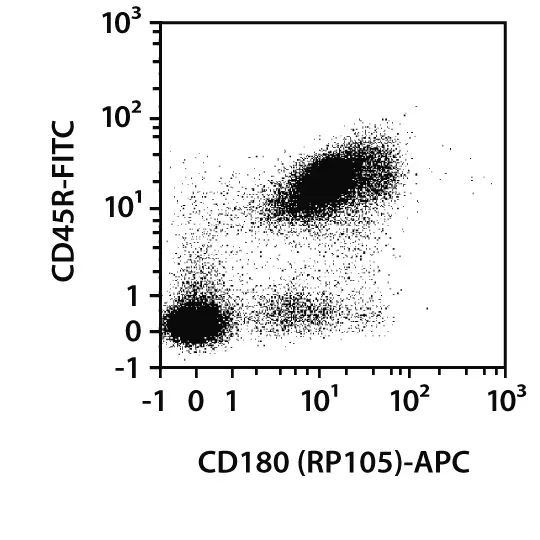
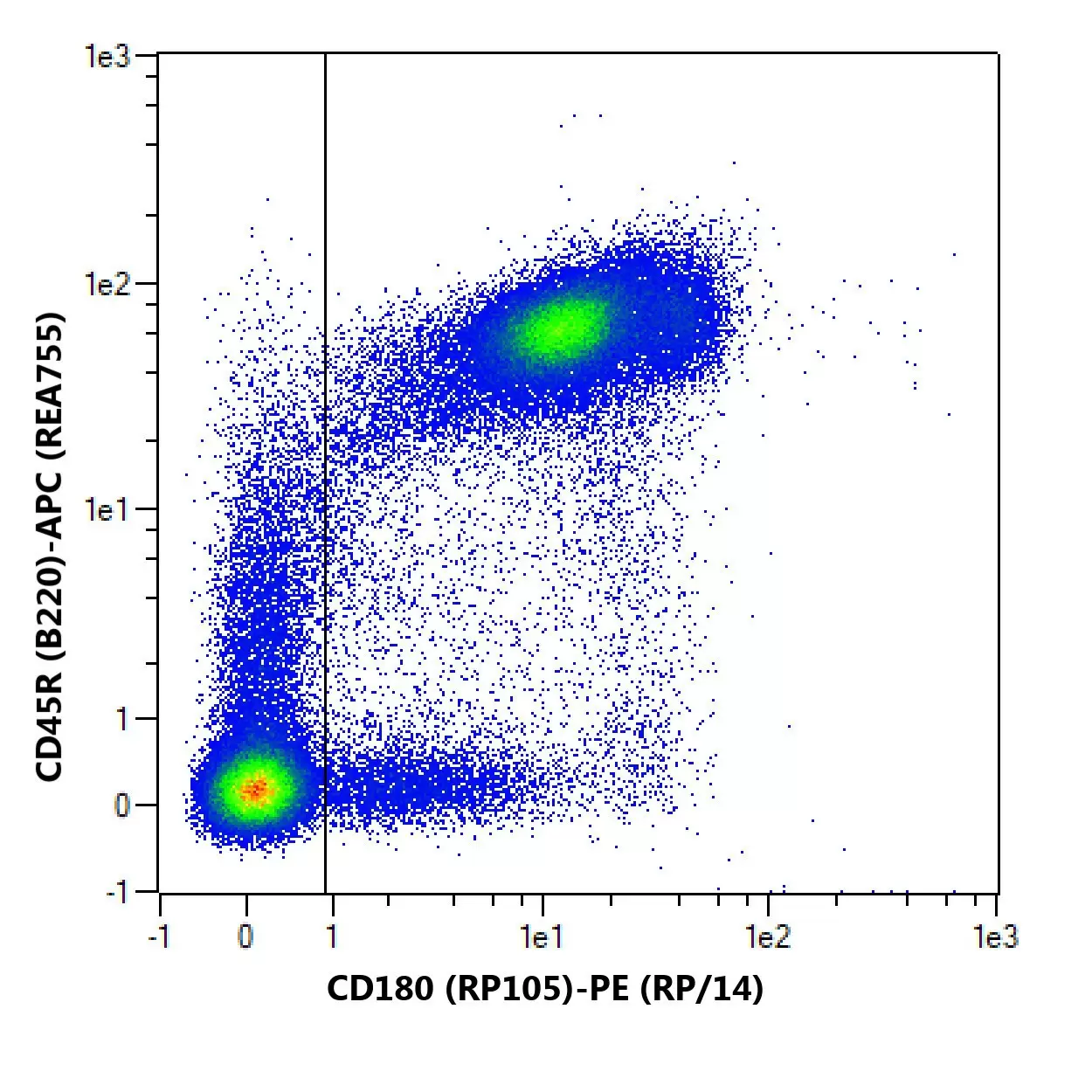
Spleen cells from C57/BL6 mice were stained with CD180 (RP105) antibodies as well as with CD45R (B220) antibodies and analyzed by flow cytometry using the MACSQuant® Analyzer. CD45.2+ cells were pre-gated for the analysis. Cell debris and dead cells were excluded from the analysis based on scatter signals and propidium iodide or DAPI fluorescence as in the case of tandem-conjugates.
MICS (MACSima Imaging Cyclic Staining) applications
APC
PE
Fixation:
frozen – PFA
Species tested:
mouse
Recommended dilution:
1:10
Data source:
Miltenyi Biotec
Compatible applications:
IF, IHC
Conjugate:
APC
Used products:
130-103-100, 130-102-143
Testing grade:
Fixation:
frozen – Acetone
Species tested:
mouse
Recommended dilution:
1:10
Data source:
Miltenyi Biotec
Compatible applications:
IF, IHC
Conjugate:
APC
Used products:
130-103-100, 130-102-143
Testing grade:
Functional assay applications
pure-functional grade
Data source:
Miltenyi Biotec
Conjugate:
pure-functional grade
Used products:
130-101-182
Extended validation for CD180 (RP105) Antibody, anti-mouse
Specificity
In order to compare the epitope specificity of an antibody, the clone being used is compared with other known clones recognizing the same antigen in a competition assay.
Other clones
Overlap in epitope recognition with RP/14
REA957
high
Cells were incubated with an excess of purified unconjugated CD180 (RP105) (RP/14) antibody followed by staining with fluorochrome-conjugated antibodies from other known clones targeting the same antigen. Fluorescence intensity was then used to assess epitope overlap: a minimal or absent signal indicated high epitope overlap, an intermediate signal suggested partial overlap, and a strong signal reflected low overlap.
Sensitivity
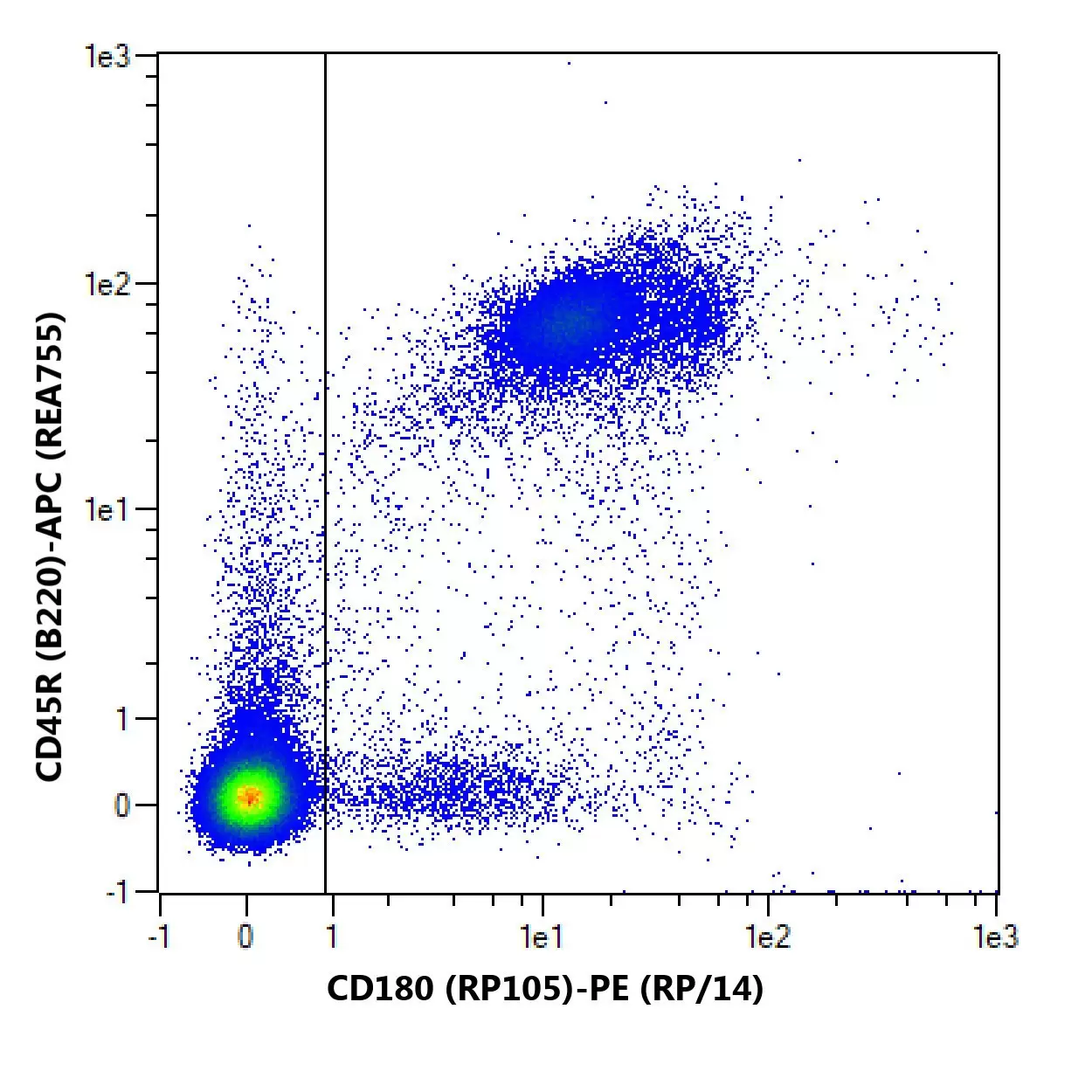
To provide an indication on how an antibody performs after fixation of cells, in-house data on staining results before and after fixation with 3.7% formaldehyde using Miltenyi Biotec antibodies are provided. Different experimental settings may lead to different results.
No fixation
Post fixation
Comparison of staining pattern on non-fixed and fixed cells using CD180 (RP105) (RP/14). The performance of the antibody after fixation was tested by comparing the staining pattern on fresh (no fixation) versus fixed (post fixation) cells.
Specifications for CD180 (RP105) Antibody, anti-mouse
Overview
Clone RP/14 recognizes CD180, a type I transmembrane protein structurally similar to Toll like receptors (TLRs), with the conserved features of TLRs, including a leucine-rich repeat extracellular domain and regions containing conserved cysteines. However, in contrast to TLRs, CD180 lacks a typical TIR domain, containing only 6 to 11 intracytoplasmic amino acids. Antibody mediated ligation of CD180 was shown to induce B cell proliferation and protection from subsequent radiation- or dexamethasone-induced apoptosis. Expression of CD180 is found on mature B cells, monocytes, macrophages, and dendritic cells. CD180 activity is dependent on physical association with a molecule called MD-1. In B cells, CD180, together with TLR4, has been shown to induce B cell proliferation in response to LPS. However, in primary myeloid cells and in vivo, CD180 acts as an inhibitor of TLR4 signaling.
Ly78, RP105
Detailed product information
Technical specifications
Clone
RP/14
Clonality
monoclonal
Isotype
rat IgG2aκ
Isotype control
Isotype Control Antibody, rat IgG2a
Host
rat
Type of antibody
Primary antibodies
Species reactivity
mouse
Antigen
CD180 (RP105)
Molecular mass of antigen [kDa]
72
Entrez Gene ID
RRID
AB_2655702, AB_2655699, AB_2661341, AB_2655696, AB_2655701, AB_2655698, AB_2655697, AB_2655695, AB_2655700
Resources for CD180 (RP105) Antibody, anti-mouse
Certificates
To access a Certificate of Analysis (CoA) follow the link below and enter the specific lot of your product.
Should you wish to request additional documentation, such as a Safety Data Sheet (SDS) in other languages than English or Swedish, an SDS-replacement document, or a Certificate of Origin (CoO), please direct your inquiry to your local technical support team.
 Powered by Bioz