
Synonyms: Notch 1, TAN-1, Motch A, mT14, p300, hN1
RECOMBINANT
- Clone:
- REA849 | MHN1-519
- Type of antibody:
- Primary antibodies, Recombinant antibodies
- Isotype:
- recombinant human IgG1
- Applications:
- FC Glossary
- Select a conjugate:
- Select a size:


Other sizes
Related products for Notch1 Antibody, anti-human, REAfinity™
Flow cytometry applications
APC
Biotin
PE
Vio Bright B515
Vio Bright V423
Recommended dilution:
1:50
Remark:
The antibody is suited for staining of formaldehyde-fixed cells.
Data source:
Miltenyi Biotec
Conjugate:
APC
Used products:
130-112-454, 130-112-526
Description:
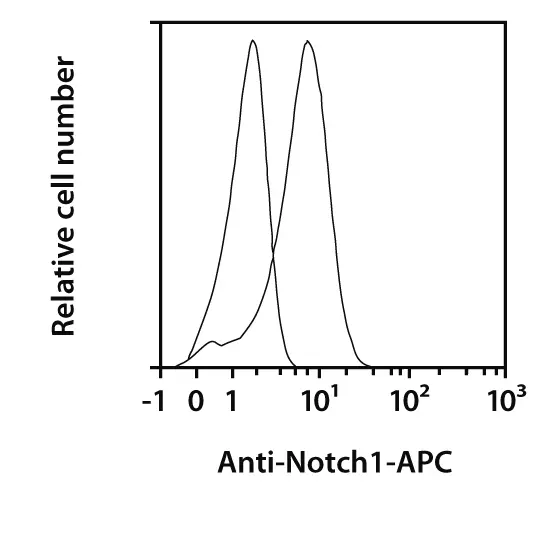
Human peripheral blood mononuclear cells (PBMCs) were either left unstimulated (left peak) or stimulated with 20 U/mL Human IL-2 IS, premium grade and 4 µg/mL PHA for 3 days. Cells were then stained with Anti-Notch1 antibodies. Flow cytometry was performed using the MACSQuant® Analyzer. Cell debris and dead cells were excluded from the analysis based on scatter signals and propidium iodide fluorescence.
Specifications for Notch1 Antibody, anti-human, REAfinity™
Overview
Clone REA849 recognizes the human neurogenic locus notch homolog protein 1 (Notch1) antigen, a 300 kDa single-pass type I membrane protein also known as translocation-associated notch protein (TAN-1). Following cleavage in the Golgi, notch forms a heterodimer composed of a 180–200 kDa disulfide-linked extracellular domain (Notch extracellular truncation (NEXT)), and a 120 kDa membrane-bound intracellular portion (Notch intracellular domain (NICD)). Upon ligand binding the latter is cleaved to form the notch intracellular domain transcription factor. Notch signaling controls cell fate decisions and is involved in multiple cellular differentiation steps during embryonic development and in adult organisms. In the immune system, Notch1 plays a non-redundant role for thymic T cell development. Notch1 is also expressed by peripheral T cells and upregulated upon T cell activation and also found on bone marrow hematopoietic stem cells, NK cells, B cells, and monocytes .
Additional information: Clone REA849 displays negligible binding to Fc receptors.
Notch 1, TAN-1, Motch A, mT14, p300, hN1
Detailed product information
Technical specifications
Clone
REA849
Clonality
monoclonal
Isotype
recombinant human IgG1
Isotype control
REA Control Antibody (S), human IgG1
Host
human cell line
Type of antibody
Primary antibodies, Recombinant antibodies
Species reactivity
human
Antigen
Notch1
Molecular mass of antigen [kDa]
269
Distribution of antigen
NK cells, T cells, B cells, stem cells, monocytes, bone marrow
Entrez Gene ID
RRID
AB_2653047, AB_2653043, AB_2653044, AB_2653042, AB_2653045, AB_2653049, AB_2653046, AB_2653048
Recombinant antibodies at Miltenyi Biotec
As an innovation-powered company with a commitment to quality and excellence, Miltenyi Biotec applies cutting-edge methods to discover and develop newer and better antibodies to satisfy both market demand and regulatory requirements.
The Miltenyi way of generating best-in-class antibodies and antibody conjugates
At Miltenyi Biotec, we opt for recombinant antibodies, which enable sequence verification and optimization for lot-to-lot consistency, making them superior to hybridoma-based antibodies.
Infusing our unique expertise
Recombinants are the result of combining genetic material from different immunized animals, and using display technologies to screen in-house antibody libraries for the best antibodies. Additional analyses on existing hybridoma-based antibodies can also give rise to sequences contributing to novel recombinants.
Maximizing value for your research
By further re-engineering these antibody sequences, we can precisely control their properties to achieve the following benefits:
reduce undesirable binding to Fc gamma receptors,
- eliminate destabilizing amino acid motifs,
- increase specific bonding affinity for stronger, more accurate targeting, and
- optimize fluorochrome conjugation for brighter and clearer signals.
In a final step, by synthesizing and cloning the resulting gene sequence, we achieve an expression vector that develops a cell line, which in turn produces a special recombinant antibody.
Better science with quality antibodies
Already in 2015, 100 of the world’s leading scientists collectively called for better standards and reproducibility in antibody production, proposing recombinant antibodies to circumvent variability (Baker, M. Reproducibility crisis: Blame it on the antibodies. Nature 521, 274–276 (2015). https://doi.org/10.1038/521274a). Moreover, by applying reverse engineering, which is encouraged by the EU Directive 2016/943 r, Miltenyi Biotec acts “[i]n the interest of innovation and fostering competition…” (§16).
Resources for Notch1 Antibody, anti-human, REAfinity™
Certificates
To access a Certificate of Analysis (CoA) follow the link below and enter the specific lot of your product.
Should you wish to request additional documentation, such as a Safety Data Sheet (SDS) in other languages than English or Swedish, an SDS-replacement document, or a Certificate of Origin (CoO), please direct your inquiry to your local technical support team.
Citations for Notch1 Antibody, anti-human, REAfinity™
Publications
- Weng, A. P. et al. (2004) Activating mutations of NOTCH1 in human T cell acute lymphoblastic leukemia. Science 306 (5694): 269-271
- Gray, G. E. et al. (1999) Human ligands of the Notch receptor. Am. J. Pathol. 154 (3): 785-794
- Arruga, F. et al. (2014) Functional impact of NOTCH1 mutations in chronic lymphocytic leukemia. Leukemia 28 (5): 1060-1070