Recombinant human IL-21 (interleukin 21) can promote differentiation of TH17 or T follicular helper (Tfh) cells, expansion of CD8+ T cells, as well as B and NK cell development. Thus, the pleiotropic cytokine regulates several aspects of lymphoid cell function and has central roles for humoral immunity. IL-21 has been associated with allergies, cancer, and viral infections. Recombinant protein human IL-21 was developed for use in various applications, such as cell culture, differentiation studies, and functional assays.


Related products for Human IL-21

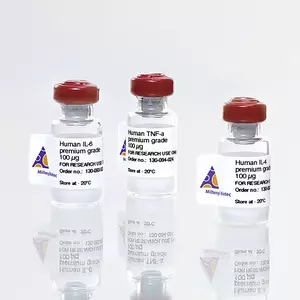

Recombinant human IL-21 (interleukin 21) can promote differentiation of TH17 or T follicular helper (Tfh) cells, expansion of CD8+ T cells, as well as B and NK cell development. Thus, the pleiotropic cytokine regulates several aspects of lymphoid cell function and has central roles for humoral immunity. IL-21 has been associated with allergies, cancer, and viral infections. Recombinant protein human IL-21 was developed for use in various applications, such as cell culture, differentiation studies, and functional assays.
Human IL-21 can be used for a variety of applications, including:
- In vitro differentiation of naive CD4+ T cells towards TH17 and Tfh cells.
- In vitro expansion of CD8+ T cells and enhancement of cytotoxic T cell function.
- Study of NK cell development and function.
- In vitro differentiation of plasma cells from naive B cells.
- Investigation of IL-21–mediated molecular signaling pathways.
Biological activity
Interleukin 21 (IL-21) is a four α-helix bundle cytokine and closely related to IL-2, IL-4, and IL-15. IL-21 expression is restricted to activated CD4+ T helper cells and NKT cells. Among T helper subsets, IL-21 is strongly produced by follicular T helper cells and TH17 cells, where IL-21 serves as an autocrine regulator and seems to sustain TH17 development. The functional receptor for IL-21, composed of the IL-21 receptor- and the common γ-chain, is expressed on various hematopoietic cells including T, B, NK, and dendritic cells. Accordingly, IL-21 exerts pleiotropic effects on both cellular and humoral immune responses, such as stimulation of lymphocyte proliferation, promotion of CD8+ T cell and NK cell cytotoxicity, and differentiation of B cells into plasma cells. Important roles for IL-21 have been proposed with regard to its anti-tumor activity and for the development of autoimmune diseases.
Research-grade cytokines are suitable for a wide variety of cell culture applications. They are sterile-filtered prior to lyophilization. Generally, endotoxin levels are <0.1 ng/μg (<1 EU/μg), and purities are >95%. The biological activity is tested in appropriate bioassays.
Premium-grade cytokines offer the convenience of high and well-defined biological activities and allow exact unit dosing for demanding applications. The biological activity is determined after lyophilization and reconstitution, and normalized to WHO/NIBSC standards whenever available. In general, endotoxin levels are <0.01 ng/μg (<0.1 EU/μg), and purities are >97%. Lot-specific activities are stated in the Certificate of Analysis (www. miltenyibiotec.com/certificates).
Human IL-21, activity assay. The biological activity of Human IL-21 is determined by proliferation assay using mouse B9 hybridoma cells.
SDS-PAGE of Human IL-21, premium grade under reducing (R) and non-reducing (NR) conditions.
Mass spectrometry analysis (ESI-MS) of Human IL-21, premium grade. The peak corresponds to the calculated molecular mass of 15460 Da.
To access a Certificate of Analysis (CoA) follow the link below and enter the specific lot of your product.
Should you wish to request additional documentation, such as a Safety Data Sheet (SDS) in other languages than English or Swedish, an SDS-replacement document, or a Certificate of Origin (CoO), please direct your inquiry to your local technical support team.
- Spolski, R. and Leonard, W. J. (2008) Interleukin-21: basic biology and implications for cancer and autoimmunity. Annu. Rev. Immunol. 26: 57-79
- van de Veen, W. et al. (2020) A novel proangiogenic B cell subset is increased in cancer and chronic inflammation. Sci Adv. 6 (20): eaaz3559
- Schmied, S. et al. (2015) Analysis of the functional WT1-specific T-cell repertoire in healthy donors reveals a discrepancy between CD4+ and CD8+ memory formation. Immunology 145 (4): 558-569
- Oberschmidt, O. et al. (2019) Development of Automated Separation, Expansion, and Quality Control Protocols for Clinical-Scale Manufacturing of Primary Human NK Cells and Alpharetroviral Chimeric Antigen Receptor Engineering. Hum Gene Ther Methods 30 (3): 102-120
- Olden, B. R. et al. (2018) Cationic polymers for non-viral gene delivery to human T cells. J Control Release. 282: 140-147
- Fuchs, S. et al. (2014) Patients with T+/low NK+ IL-2 receptor γ chain deficiency have differentially-impaired cytokine signaling resulting in severe combined immunodeficiency. Eur. J. Immunol. 44 (10): 3129-3140
- Jabara, H. H. et al. (2012) DOCK8 functions as an adaptor that links TLR-MyD88 signaling to B cell activation. Nat Immunol 13 (6): 612-620
- Nielsen, N. et al. (2012) Cytotoxicity of CD56(bright) NK cells towards autologous activated CD4+ T cells is mediated through NKG2D, LFA-1 and TRAIL and dampened via CD94/NKG2A. PLoS One 7 (2): e31959
- Polito, V. A. et al. (2019) Universal Ready-to-Use Immunotherapeutic Approach for the Treatment of Cancer: Expanded and Activated Polyclonal γδ Memory T Cells. Front Immunol 10: 2717
- Eccles, J. D. et al. (2020) T-bet+ Memory B Cells Link to Local Cross-Reactive IgG upon Human Rhinovirus Infection. Cell Rep 30 (2): 351-366
- Frumento, G. et al. (2019) CD117 (c-Kit) Is Expressed During CD8 + T Cell Priming and Stratifies Sensitivity to Apoptosis According to Strength of TCR Engagement. Front Immunol 10: 468
- Shu, R. et al. (2021) Engineered CAR-T cells targeting TAG-72 and CD47 in ovarian cancer. Mol Ther Oncolytics 20: 325-341