Recombinant human IL-6 (interleukin 6) can promote differentiation of B and T cells (Th17) and can stimulate proliferation of hematopoietic progenitor cells or hybridoma cells. The pleiotropic cytokine has crucial function, such as in the regulation of immune and inflammatory responses or hematopoiesis. Recombinant human IL-6 is specifically developed for use in cell culture, differentiation studies, and functional assays.


Related products for Human IL-6
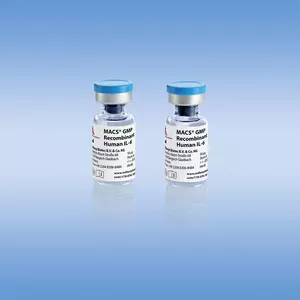
Recombinant human IL-6 (interleukin 6) can promote differentiation of B and T cells (Th17) and can stimulate proliferation of hematopoietic progenitor cells or hybridoma cells. The pleiotropic cytokine has crucial function, such as in the regulation of immune and inflammatory responses or hematopoiesis. Recombinant human IL-6 is specifically developed for use in cell culture, differentiation studies, and functional assays.
Human IL-6 can be used for a variety of applications, including:
- Induction of colony formation from hematopoietic progenitor cells in semi-solid medium.
- Replacement of feeder cells in the preparation of murine and human hybridomas.
- In vitro differentiation of TH17 cells.
Biological activity
IL-6, originally identified as a B cell differentiation factor, is a multifunctional cytokine, which regulates immune responses, hematopoiesis, acute phase responses, and inflammatory reactions. It induces, for instance, the terminal maturation of activated B cells into antibody-secreting plasma cells and acts in synergy with IL-3 to support the proliferation of hematopoietic stem cells. IL-6 is produced by many cell types, such as monocytes, fibroblasts, endothelial cells, T cells, etc. Disturbed IL-6 production has been associated with pathological processes including inflammatory autoimmune diseases, such as rheumatoid arthritis and cancer.
Research-grade cytokines are suitable for a wide variety of cell culture applications. They are sterile-filtered prior to lyophilization. Generally, endotoxin levels are <0.1 ng/μg (<1 EU/μg), and purities are >95%. The biological activity is tested in appropriate bioassays.
Premium-grade cytokines offer the convenience of high and well-defined biological activities and allow exact unit dosing for demanding applications. The biological activity is determined after lyophilization and reconstitution, and normalized to WHO/NIBSC standards whenever available. In general, endotoxin levels are <0.01 ng/μg (<0.1 EU/μg), and purities are >97%. Lot-specific activities are stated in the Certificate of Analysis (www. miltenyibiotec.com/certificates).
Human IL-6 activity assay. The biological activity of Human IL-6, premium grade was determined by proliferation assay using B9 hybridoma cells.
SDS-PAGE of Human IL-6, premium grade under reducing (R) and non-reducing (NR) conditions.
Mass spectrometry analysis (ESI-MS) of Human IL-6, premium grade. The peak corresponds to the calculated molecular mass of 20812 Da.
To access a Certificate of Analysis (CoA) follow the link below and enter the specific lot of your product.
Should you wish to request additional documentation, such as a Safety Data Sheet (SDS) in other languages than English or Swedish, an SDS-replacement document, or a Certificate of Origin (CoO), please direct your inquiry to your local technical support team.
- Gaines-Das, R. E. and Poole, S. (1993) The international standard for interleukin-6. Evaluation in an international collaborative study. J. Immunol. Methods 160: 147-153
- Laurenti, E. et al. (2015) CDK6 levels regulate quiescence exit in human hematopoietic stem cells. Cell Stem Cell 16 (3): 302-313
- Wright, C. et al. (2012) Detection of multiple autoantibodies in patients with ankylosing spondylitis using nucleic acid programmable protein arrays. Mol. Cell. Proteomics 11 (2): M9.00384
- Bosch, N. C. et al. (2019) NF-κB activation triggers NK-cell stimulation by monocyte-derived dendritic cells. Ther Adv Med Oncol 11: 1758835919891622
- Dighe, N. et al. (2014) Long-term reproducible expression in human fetal liver hematopoietic stem cells with a UCOE-based lentiviral vector. PLoS One 9 (8): e104805
- Ghirelli, C. et al. (2010) Systematic cytokine receptor profiling reveals GM-CSF as a novel TLR-independent activator of human plasmacytoid predendritic cells. Blood 115 (24): 5037-5040
- Tregnago, C. et al. (2021) NPM1 Mutational Status Underlines Different Biological Features in Pediatric AML. Cancers (Basel) 13 (14): 3457
- Kaebisch R. et al. (2014) Helicobacter pylori cytotoxin-associated gene A impairs human dendritic cell maturation and function through IL-10-mediated activation of STAT3. J Immunol 192: 316-323
- Meurer, T. et al. (2018) Dissecting Genetic Control of HLA-DPB1 Expression and Its Relation to Structural Mismatch Models in Hematopoietic Stem Cell Transplantation. Front Immunol 9: 2236
- Moras, M. et al. (2020) Downregulation of Mitochondrial TSPO Inhibits Mitophagy and Reduces Enucleation during Human Terminal Erythropoiesis. Int J Mol Sci 21 (23): 9066
- Brault, J. et al. (2014) Optimized generation of functional neutrophils and macrophages from patient-specific induced pluripotent stem cells: ex vivo models of X0-linked, AR220- and AR470- chronic granulomatous diseases. Biores Open Access 3 (6): 311-326
- Buks, R. et al. (2021) ABCG2 Is Overexpressed on Red Blood Cells in Ph-Negative Myeloproliferative Neoplasms and Potentiates Ruxolitinib-Induced Apoptosis. Int J Mol Sci 22 (7): 3530
- Xu, Y. et al. (2019) Ferumoxytol Attenuates the Function of MDSCs to Ameliorate LPS-Induced Immunosuppression in Sepsis. Nanoscale Res Lett 14 (1): 379
- Steinleitner, K. et al. (2012) EVI1 and MDS1/EVI1 expression during primary human hematopoietic progenitor cell differentiation into various myeloid lineages. Anticancer Res. 32 (11): 4883-4889
- Hoppenbrouwers, T. et al. (2020) Specific Polyunsaturated Fatty Acids Can Modulate in vitro Human moDC2s and Subsequent Th2 Cytokine Release. Front Immunol 11: 748
- Goepfert, K. et al. (2019) Rational Combination of Parvovirus H1 With CTLA-4 and PD-1 Checkpoint Inhibitors Dampens the Tumor Induced Immune Silencing. Front Oncol 9: 425