Human CD40-Ligand is a recombinant protein optimized for use in cell culture, differentiation studies, and functional assays.


Related products for Human CD40-Ligand
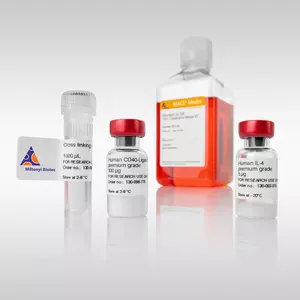
Human CD40-Ligand is a recombinant protein optimized for use in cell culture, differentiation studies, and functional assays.
Human CD40-Ligand can be used for a variety of applications, including:
- Stimulation of B cell activation and proliferation.
- Stimulation of dendritic cell maturation.
- Induction of cytokine production in peripheral blood monocytes and T cells.
TRAP, CD154, TNFSF5
Biological activity
CD40-Ligand, also known as CD40L, CD154, TRAP, or TNFSF5 is a member of the TNF superfamily transiently expressed on the surface of activated CD4+ T lymphocytes. It is either expressed membrane-bound or proteolytically released as a soluble form which comprises 2/3 of the extracellular domain. Its receptor CD40 is found on antigen-presenting cells such as B cells, dendritic cells, and macrophages. CD40L-CD40 interaction is important in T cell-APC (antigen-presenting cell) interaction and is e.g. involved in B cell differentiation and proliferation, isotype class-switching, and protection of B cells from apoptosis.
Premium-grade cytokines offer the convenience of high and well-defined biological activities and allow exact unit dosing for demanding applications. The biological activity is determined after lyophilization and reconstitution, and normalized to WHO/NIBSC standards whenever available. In general, endotoxin levels are <0.01 ng/μg (<0.1 EU/μg), and purities are >97%. Lot-specific activities are stated in the Certificate of Analysis (www.miltenyibiotec.com/certificates).
Human CD40-Ligand activity assay: The specific activity is determined by proliferation assay using enriched CD19+ B cells in the presence of the cross-linking antibody and of 50 IU/mL Interleukin 4. Activity of Human CD40-Ligand, premium grade (red line) was compared to another commercially available product (black line).
Human CD40-Ligand activity assay: The specific activity is determined by activation assay using enriched CD19+ B cells in the presence of the cross-linking antibody and of 50 IU/mL Interleukin 4. Activity of Human CD40-Ligand, premium grade (red line) was compared to another commercially available product (black line).
SDS-PAGE of Human CD40-ligand, premium grade under reducing (R) and non-reducing (NR) conditions.
Human CD40-Ligand biological activity. Activity of Human CD40-Ligand, premium grade, (red bar) was compared to another commercially available product (black bar).
Mass spectrometry analysis (ESI-MS) of Human CD40-Ligand, premium grade. The major peak corresponds to the calculated molecular mass of 23034 Da. The minor peaks correspond to gluconoylation derivatives as described in Geoghegan, K. F. et al. (1999).
To access a Certificate of Analysis (CoA) follow the link below and enter the specific lot of your product.
Should you wish to request additional documentation, such as a Safety Data Sheet (SDS) in other languages than English or Swedish, an SDS-replacement document, or a Certificate of Origin (CoO), please direct your inquiry to your local technical support team.
- Koliha, N. et al. (2016) Melanoma affects the composition of blood cell-derived extracellular vesicles. Front Immunol 7: 282
- Spriggs, M. K. et al. (1992) Recombinant human CD40 ligand stimulates B cell proliferation and immunoglobulin E secretion. J. Exp. Med. 176: 1543-1550
- De Keersmaecker, B. et al. (2020) TriMix and tumor antigen mRNA electroporated dendritic cell vaccination plus ipilimumab: link between T-cell activation and clinical responses in advanced melanoma. J Immunother Cancer 8 (1): e000329
- Kuen, J. et al. (2017) Pancreatic cancer cell/fibroblast co-culture induces M2 like macrophages that influence therapeutic response in a 3D model. PLoS One 12 (7): e0182039
- Monaghan, T. M. et al. (2013) Circulating antibody and memory B-Cell responses to C. difficile toxins A and B in patients with C. difficile-associated diarrhoea, inflammatory bowel disease and cystic fibrosis PLoS One 8 (9): e74452
- Horns, F. et al. (2016) Lineage tracing of human B cells reveals the in vivo landscape of human antibody class switching. Elife 5: e16578
- Johnson, M. J. et al. (2018) Transcriptional profiles of human islet and exocrine endothelial cells in subjects with or without impaired glucose metabolism. Sci Rep 8 (1): 12144
- Hou, G. et al. (2021) SLE non-coding genetic risk variant determines the epigenetic dysfunction of an immune cell specific enhancer that controls disease-critical microRNA expression. Nat Commun 12 (1): 135