Selected references - Regulatory T cell manufacturing on the CliniMACS® Instruments

3D graphic showing regulatory T cells
Logo

Selected references - Regulatory T cell manufacturing on the CliniMACS® Instruments

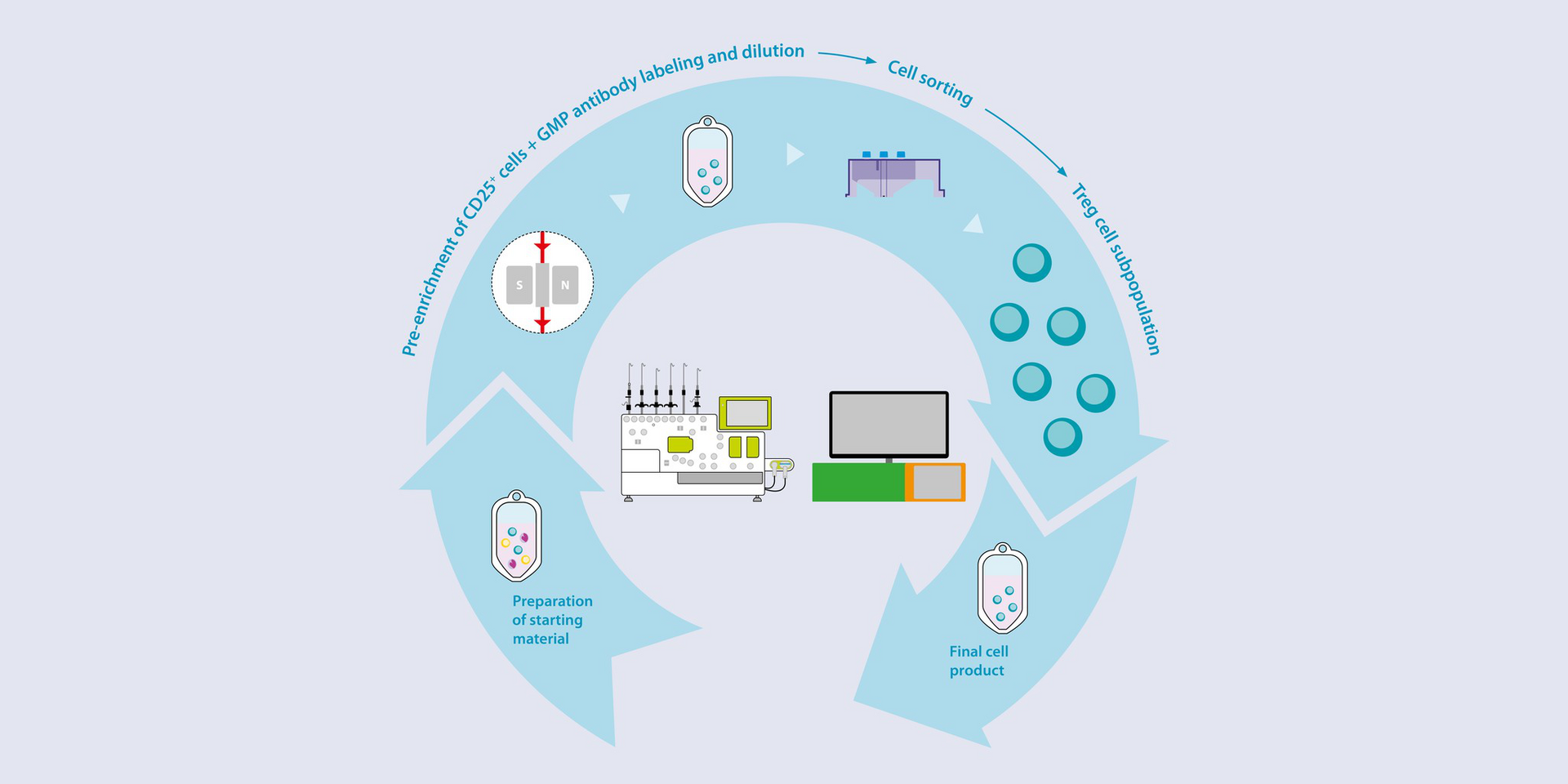
In recent years, regulatory T (Treg) cell applications have been crucial in immunotherapy. Successfully separating and manufacturing Treg subsets is essential for clinical treatment. We have gathered influential papers and reviews demonstrating the use of CliniMACS Instruments in the field and their broad range of clinical applications.

CD25+ cell enrichment

Reviews

  • Clinical manufacturing of regulatory T cell products for adoptive cell therapy and strategies to improve therapeutic efficacy
    Baron, K. J. et al. (2023) Organogenesis 19: 2164159. | Read article

  • Cell therapy in organ transplantation: Our experience on the clinical translation of regulatory T cells
    Safinia, N. et al. (2018) Front. Immunol. 9: 354. | Read article

  • Minimum information about T regulatory cells: A step toward reproducibility and standardization
    Fuchs, A. et al. (2018) Front. Immunol. 8: 1844. | Read article

Clinical study results – patient treatment with Treg cell products

  • First-in-human therapy with Treg produced from thymic tissue (thyTreg) in a heart transplant infant
    Bernaldo-de-Quirós, E. et al. (2023) J. Exp. Med. 220: e20231045. | Read article

  • Autologous regulatory T-cell transfer in refractory ulcerative colitis with concomitant primary sclerosing cholangitis
    Voskens, C. et al. (2023) Gut 72: 49–53. | Read article

  • Phase I/II clinical trials of donor-derived purified regulatory T cells for the treatment of steroid-refractory chronic graft versus host disease
    Soares, M. V. D. et al. (2022) Blood 140: 880–82. | Read article

  • A phase 1 study of donor regulatory T-cell infusion plus low-dose interleukin-2 for steroid-refractory chronic graft-vs-host disease
    Whangbo, J. S. et al. (2022) Blood Adv. 6: 5786–96. | Read article

  • Haploidentical age-adapted myeloablative transplant and regulatory and effector T cells for acute myeloid leukemia
    Pierini, A. et al. (2021) Blood Adv. 5: 1199–208. | Read article

  • Regulatory T cells for minimising immune suppression in kidney transplantation: phase I/IIa clinical trial
    Roemhild, A. et al. (2020) BMJ. 371: m3734. | Read article

  • Applicability, safety, and biological activity of regulatory T cell therapy in liver transplantation
    Sánchez-Fueyo, A. et al. (2019) Am. J. Transplant. 20: 1125–36. | Read article

  • Transplantation of donor grafts with defined ratio of conventional and regulatory T cells in HLA-matched recipients
    Meyer, E. H. et al. (2019) JCI Insight 4: e127244. | Read article

  • A Phase I clinical trial with ex vivo expanded recipient regulatory T cells in living donor kidney transplants
    Mathew, J. M. et al. (2018) Scientific Reports 8: 7428. | Read article

  • Treg-protected donor lymphocyte infusions: a new tool to address the graft-versus-leukemia effect in the absence of graft-versus-host disease in patients relapsed after HSCT
    Di Ianni, M. et al. (2017) Int. J. Hematol. 106: 860–64. | Read article

  • Optimization of cGMP purification and expansion of umbilical cord blood-derived T-regulatory cells in support of first-in-human clinical trials
    McKenna, D. H. et al. (2017) Cytotherapy 19: 250–262. | Read article

  • Umbilical cord blood-derived T regulatory cells to prevent GVHD: kinetics, toxicity profile and clinical effect
    Brunstein, C. G. et al. (2016) Blood 127: 1044–51. | Read article

  • Next generation HLA-haploidentical HSCT
    Martelli, M. F. et al. (2015) Bone Marrow Transplant. 50: 63–66. | Read article

  • Adoptive transfer of allogeneic regulatory T cells into patients with chronic graft-versus-host disease
    Theil, A. et al. (2015) Cytotherapy 17: 473–86. | Read article

  • HLA-haploidentical transplantation with regulatory and conventional T-cell adoptive immunotherapy prevents acute leukemia relapse
    Martelli, M. F. et al. (2014) Blood 124: 638–44. | Read article

  • Immunoselection and clinical use of T regulatory cells in HLA-haploidentical stem cell transplantation
    Di Ianni, M. et al. (2011) Best Pract. Res. Clin. Haematol. 24: 459–66. | Read article

  • Tregs prevent GvHD and promote immune reconsitution in HLA-haploidentical transplantation
    Di Ianni, M. et al. (2011) Blood 117: 3921–28. | Read article

  • Infusion of ex vivo expanded T regulatory cells in adults transplanted with umbilical cord blood: safety profile and detection kinetics
    Brunstein, C. G. et al. (2010) 117: 1061–70. | Read article

Technical performance – manufacturing and pre-clinical data

  • Clinical grade multiparametric cell sorting and gene-marking of regulatory T cells
    Ekwe, A. P. et al. (2024) Cytotherapy 26: 719–28. | Read article

  • A novel GMP protocol to produce high-quality Treg cells from the pediatric thymic tissue to be employed as cellular therapy
    Bernaldo-de-Quiros, E. et al. (2022) Front. Immunol. 13: 893576. | Read article

  • Strong expansion of human regulatory T cells for adoptive cell therapy results in epigenetic changes which may impact their survival and function
    Ou, K. et al. (2021) Front. Cell Dev. Biol. 9: 751590. | Read article

  • Clinical-grade expanded regulatory T cells are enriched with highly suppressive cells producing IL-10, granzyme B, and IL-35
    Ulbar, F. et al. (2021) Biol. Blood Marrow Transplant. 26: 2204–10. | Read article

  • mTOR inhibitor everolimus in regulatory T cell expansion for clinical application in transplantation
    Gedaly, R. et al. (2019) Transplant. 103: 705–15. | Read article

  • Automated clinical grade expansion of regulatory T cells in a fully closed system
    Morales, J. M. M. et al. (2019) Front. Immunol. 10: 38. | Read article

  • A rapamycin-based GMP compatible process for the isolation and expansion of regulatory T cells for clinical trials
    Fraser, H. et al. (2018) Mol. Ther. Methods Clin. Dev. 8: 198–209. | Read article

  • Good manufacturing practice-compliant production and lot-release of ex vivo expanded regulatory T cells as basis for treatment of patients with autoimmune and inflammatory disorders
    Wiesinger, M. et al. (2017) Front. Immunol. 8: 1371. | Read article

  • A robust, good manufacturing practice-compliant, clinical-scale procedure to generate regulatory T cells from patients with amyotrophic lateral sclerosis for adoptive cell therapy
    Alsuliman, A. et al. (2016) Cytotherapy 18: 1312–24. | Read article

  • Successful expansion of functional and stable regulatory T cells for immunotherapy in liver transplantation
    Safinia, N. et al. (2016) Oncotarget. 7: 7563–77. | Read article

  • An innovative method to generate a Good Manufacturing Practice-ready regulatory T-cell product from non-mobilized leukapheresis donors
    Zhang, W. et al. (2015) Cytotherapy 17: 1268–79. | Read article

  • Infusion of clinical-grade enriched regulatory T cells delays experimental xenogeneic graft-versus-host disease
    Hannon, M. et al. (2014) Transfusion 54: 353–63. | Read article

  • Robust and cost effective expansion of human regulatory T cells highly functional in a xenograft model of graft-versus-host disease.
    Chakraborty, R. et al. (2013) Haematologica 98: 533-37. | Read article

  • T regulatory cell separation for clinical application
    Di Ianni, M. et al. (2012) Transfus. Apher. Sci. 47: 213–36. | Read article

  • Immunomagnetic isolation of CD4+CD25+FoxP3+ natural T regulatory lymphocytes for clinical applications.
    Di Ianni, M. et al. (2009) Clin. Exp. Immunol. 156: 246–53. | Read article

  • Preparation of functionally preserved CD4+CD25highregulatory T cells from leukapheresis products from ulcerative colitis patients, applicable to regulatory T-cell transfer therapy.
    Sumida, Y. et al. (2008) Cytotherapy 10: 698–710. | Read article

  • Isolation of CD4+CD25+ regulatory T cells for clinical trials
    Hoffmann, P. et al. (2006) Biol. Blood Marrow Transplant. 12: 267–74 | Read article

CD25+ cell depletion

  • Immunotherapy with CD25/CD71-allodepleted T cells to improve T-cell reconstitution after matched unrelated donor hematopoietic stem cell transplant: a randomized trial
    Peggs, K. S. et al. (2023) Cytotherapy 25: 82–93. | Read article

  • Regulatory T-cell depletion in the setting of autologous stem cell transplantation for multiple myeloma: pilot study
    Derman, B. A. et al. (2020) J. Immunother. Cancer 8: e000286. | Read article

  • A phase I study of CD25/regulatory T-cell-depleted donor lymphocyte infusion for relapse after allogeneic stem cell transplantation.
    Nikiforow, S. et al. (2016) Haematologica 101: 1251–59. | Read article

  • Optimization of methodology for production of CD25/CD71 allodepleted donor T cells for clinical use
    Albon, S. J. et al. (2013) Cytotherapy 15: 109–21. | Read article

  • Large-scale depletion of CD25+ regulatory T cells from patient leukapheresis samples
    Powell, D. J. et al. (2005) J. Immunother. 28: 403–11. | Read article

  • CD4+CD25+ regulatory T cell depletion improves the graft-versus-tumor effect of donor lymphocytes after allogeneic hematopoietic stem cell transplantation
    Maury, S. et al. (2010) Sci. Transl. Med. 2: 41ra52. | Read article

  • Adoptive transfer of T(reg) depleted autologous T cells in advanced renal cell carcinoma
    Thistlethwaite, F. C. et al. (2008) Cancer Immunol. Immunother 57: 623–34. | Read article

  • Inability to mediate prolonged reduction of regulatory T cells after transfer of autologous CD25-depleted PBMC and interleukin-2 after lymphodepleting chemotherapy
    Powell, D. J. Jr. et al. (2007) J. Immunother. 30: 438–47. | Read article

Attention

The medical device and therapy related information on this website is intended for access by healthcare professionals only and their request.

By clicking "Accept" you are confirming that you are a healthcare professional and have read and agreed to the information above. If you are not a healthcare professional, please

click here

to be redirected to www.miltenyibiotec.com.