The Tandem Signal Enhancer, human increases binding specificity of tandem dye–conjugated antibodies and decreased background staining of negative cells in flow cytometric analyses.


Related products for Tandem Signal Enhancer, human
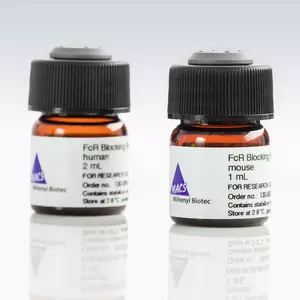
The Tandem Signal Enhancer, human increases binding specificity of tandem dye–conjugated antibodies and decreased background staining of negative cells in flow cytometric analyses.
Tandem dyes greatly expand the range of options for multicolor flow cytometry. However, tandem dye–conjugated antibodies often show non-specific binding to cells, in particular monocytes. Using the Tandem Signal Enhancer when staining with tandem-dye–conjugated antibodies, the non-specific binding is strongly reduced. This ready-to-use reagent increases binding specificity of tandem dye–conjugated antibodies to cells in human PBMCs or whole blood. The addition of FcR Blocking Reagent is not required.
- Blocking of Fc receptor–mediated antibody labeling.
- Blocking of tandem-dye–conjugated antibodies binding to monocytes and non-target cells. Suitable for tandem dyes, such as PerCP-Vio® 700, PerCP-Cy™5.5, PE-Cy5.5, PE-Vio770, PE-Cy7, APC-Vio770, APC-Cy7, and APC-H7, PE-Vio615, ECD, PE-Texas Red®, PE-CF594, PE/Dazzle™ 594, and PE-eFlour® 610.
To access a Certificate of Analysis (CoA) follow the link below and enter the specific lot of your product.
Should you wish to request additional documentation, such as a Safety Data Sheet (SDS) in other languages than English or Swedish, an SDS-replacement document, or a Certificate of Origin (CoO), please direct your inquiry to your local technical support team.
- Burton, O. T. et al. (2025) Optimization of the Blocking and Signal Preservation Protocol in High-Parameter Flow Cytometry. Curr Protoc : doi: 10.1002/cpz1.70214