The PSC-mDA Neuron Analysis Kit, anti-human, REAfinity has been developed as a flow cytometry-based quality control assay to evaluate purity and identity of midbrain dopaminergic (mDA) neurons differentiated from PSCs. The kit takes advantage of the fast approach that flow analysis provides and combines it with the high staining specificity and low background of REAfinity Antibodies. The qualitative and quantitative analysis allows to determine the overall success of the differentiation protocol and define minimal criteria for the differentiation performances to ensure consistency between r


Related products for PSC-mDA Neuron Analysis Kit, anti-human, REAfinity™

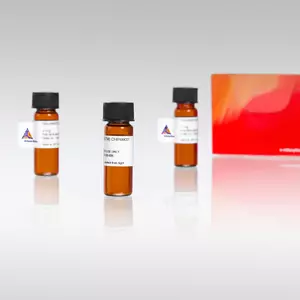
The PSC-mDA Neuron Analysis Kit, anti-human, REAfinity has been developed as a flow cytometry-based quality control assay to evaluate purity and identity of midbrain dopaminergic (mDA) neurons differentiated from PSCs. The kit takes advantage of the fast approach that flow analysis provides and combines it with the high staining specificity and low background of REAfinity Antibodies. The qualitative and quantitative analysis allows to determine the overall success of the differentiation protocol and define minimal criteria for the differentiation performances to ensure consistency between rounds of differentiations.
PSC-mDA Neuron Analysis Kit, anti-human, REAfinity™
Oct3/4 Antibody, anti-human/mouse, APC, REAfinity (clone: REA622)
FoxA2 Antibody, anti-human, APC, REAfinity (clone: REA506)
OTX2 Antibody, anti-human, Vio® B515, REAfinity (clone: REA1178)
PAX-6 Antibody, anti-human, PE, REAfinity (clone: REA507)
TTF-1 Antibody, anti-human, Vio B515, REAfinity (clone: REA1090)
Sox1 Antibody, anti-human, PE, REAfinity (clone: REA698)
Additionally
- Fixation/Permeabilization Solution 1
- Fixation/Permeabilization Solution 2
- Permeabilization Buffer (10×)
Instrument details
Flow cytometer equipped with a red (640 nm) and a blue (488 nm) laser.
Flow cytometry-based quality control kit for in vitro phenotyping of identity and purity of PSC-derived mDA neurons during differentiation.
During development expression of region-specific markers arises in response to different concentration gradients of key patterning molecules. Rostro-caudal and dorso-ventral patterning are driven by increasing CHIR99021 and human sonic hedgehog (hSHH) concentrations, respectively. This differential marker expression allows to distinguish between different cellular populations and provides the basis of the flow cytometry-based quality control assay for PSC-mDA neurons using the PSC-mDA Neurons Phenotyping Kit, human.
Example of immunofluorescent staining and analysis using the PSC-mDA Neuron Phenotyping Kit, human:
Combination of the markers included in the PSC-mDA Neurons Phenotyping Kit, human (FoxA2, OTX2, PAX-6, TTF-1, Sox1, and Oct3/4) allows to determine the identity and purity of the cell product in a flow cytometry assay. iPSC-derived mDA neurons were generated and analyzed after 16 days of differentiation. For the analysis, gates were defined using cellular controls. Staining 1 shows no measurable contamination of residual Oct3/4+ pluripotent stem cells. Staining 2 shows the purity of the target mDA neurons (FoxA2+OTX2+) as well as contamination by other cell populations. Specifically, the PAX-6-specific antibody detects cells of a dorsal phenotype, whereas a caudal phenotype is indicated by loss of OTX2 expression. Finally, staining 3 shows expression levels of SOX-1, a neural ectoderm marker that identifies contamination of different neural cell populations, and expression of TTF-1, which is a ventral forebrain marker but can be partially expressed by the target cells.
To access a Certificate of Analysis (CoA) follow the link below and enter the specific lot of your product.
Should you wish to request additional documentation, such as a Safety Data Sheet (SDS) in other languages than English or Swedish, an SDS-replacement document, or a Certificate of Origin (CoO), please direct your inquiry to your local technical support team.
To access a Safety Data Sheet for a hazardous product or component in English or Swedish language, follow the link below and enter the catalog number of the product.
Please note, that the Safety Data Sheet has a cover sheet only in English language.
Should you wish a Safety Data Sheet (SDS) in other languages than English or Swedish, please contact Technical Support.
- Kirkeby, A. et al. (2013) Generating regionalized neuronal cells from pluripotency, a step-by-step protocol. Front Cell Neurosci 6: 64
- Kirkeby, A. et al. (2017) Predictive Markers Guide Differentiation to Improve Graft Outcome in Clinical Translation of hESC-Based Therapy for Parkinson's Disease. Cell Stem Cell 20 (1): 135-148
- Kirkeby, A. et al. (2012) Generation of regionally specified neural progenitors and functional neurons from human embryonic stem cells under defined conditions. Cell Rep 1: 703-714