MACS GMP PepTivator EBV EBNA-1 is a peptide pool that consists mainly of 15-mer peptides with 11 amino acids overlap. It has been developed for efficient in vitro stimulation and subsequent isolation of EBV EBNA-1–specific CD4+ and CD8+ T cells.


Related products for MACS® GMP PepTivator® EBV EBNA-1
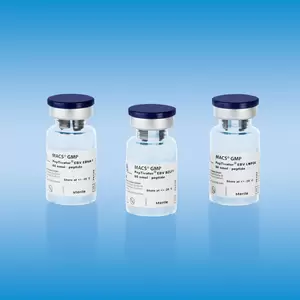

MACS GMP PepTivator EBV EBNA-1 is a peptide pool that consists mainly of 15-mer peptides with 11 amino acids overlap. It has been developed for efficient in vitro stimulation and subsequent isolation of EBV EBNA-1–specific CD4+ and CD8+ T cells.
Epstein-Barr virus (EBV) is a human γ-herpesvirus with B cell growth–transforming ability and carcinogenic potential. More than 90% of human adults are infected with EBV. In healthy individuals, EBV typically establishes a persistent latent infection, in which the virus can be detected in resting, non-proliferating peripheral B lymphocytes.
The Epstein-Barr nuclear antigen 1 (EBNA-1) protein is involved in the replication of viral episomes and therefore crucial for the persistence of the infection. Its expression is maintained in all latency cycles of infection and in all EBV-associated malignancies.
T cells are essential for the control of the outgrowth of EBV-infected B cells. EBNA-1–specific CD4+ and CD8+ T cells have been found in EBV-infected individuals.1-7
Adoptive transfer of EBNA-1–specific T cells may be an effective tool for the treatment of EBV-associated malignancies.
In vitro stimulation of EBNA-1–specific CD4+ and CD8+ T cells with MACS GMP PepTivator EBV EBNA-1 causes the production of the effector cytokine IFN-γ. The secretion of IFN-γ then permits the enrichment of EBNA-1–specific effector/memory T cells using the CliniMACS® Cytokine Capture System (IFN-gamma).8,9
MACS GMP Products are manufactured and tested under a quality management system (ISO 13485) and are in compliance with relevant GMP guidelines. They are designed following the recommendations of USP <1043> on ancillary materials.
MACS GMP Products are for ex vivo cell processing only, and are not intended for human in vivo applications. For regulatory status in the USA, please contact your local representative.
Enter the lot number from your product label to access its Product Quality Certificated (PQC).
- Hansen B. T. et al. (2021) Adoptive Cell Transfer of Allogeneic Epstein-Barr Virus-Specific T Lymphocytes for Treatment of Refractory EBV-Associated Posttransplant Smooth Muscle Tumors: A Case Report Front Immunol 3 (12): 727814
- Khanna, R. et al. (1995) Isolation of cytotoxic T lymphocytes from healthy seropositive individuals specific for peptide epitopes from Epstein-Barr virus nuclear antigen 1: implications for viral persistence and tumor surveillance. Virology 214: 633-637
- Paludan, C. et al. (2002) Epstein-Barr nuclear antigen 1-specific CD4(+) Th1 cells kill Burkitt's lymphoma cells. J Immunol 169: 1593-1603
- Long, H. M. et al. (2005) CD4+ T-cell responses to Epstein-Barr virus (EBV) latent-cycle antigens and the recognition of EBV-transformed lymphoblastoid cell lines. J. Virol. 79: 4896-4907
- Leen, A. et al. (2001) Differential immunogenicity of Epstein-Barr virus latent-cycle proteins for human CD4(+) T-helper 1 responses. J. Virol. 75: 8649-8659
- Blake, N. et al. (2000) The importance of exogenous antigen in priming the human CD8+ T cell response: lessons from the EBV nuclear antigen EBNA1. J Immunol 165: 7078-7087
- Kallay, K. et al. (2018) Early Experience With CliniMACS Prodigy CCS (IFN-gamma) System in Selection of Virus-specific T Cells From Third-party Donors for Pediatric Patients With Severe Viral Infections After Hematopoietic Stem Cell Transplantation. J Immunother 41 (3): 158-163
- Voo, K. S. et al. (2004) Evidence for the presentation of major histocompatibility complex class I-restricted Epstein-Barr virus nuclear antigen 1 peptides to CD8+ T lymphocytes. J. Exp. Med. 199: 459-470
- Voo, K. S. et al. (2002) Identification of HLA-DP3-restricted peptides from EBNA1 recognized by CD4+ T cells. Cancer Res. 62: 7195-7199