
Synonyms: ELK1
RECOMBINANT EXTENDED VALIDATION
- Clone:
- REA896 | M21-1721
- Type of antibody:
- Primary antibodies, Recombinant antibodies
- Isotype:
- recombinant human IgG1
- Applications:
- ICFC Glossary
- Select a conjugate:
- Select a size:


Other sizes
Related products for ELK-1 pS383 Antibody, anti-human, REAfinity™


Intracellular flow cytometry applications
APC
FITC
PE
Recommended dilution:
1:50
Remark:
The antibody is suited for staining of formaldehyde-fixed cells.
Data source:
Miltenyi Biotec
Conjugate:
APC
Used products:
130-114-898, 130-114-856
Description:
Human peripheral blood mononuclear cells (PBMCs) were either left unstimulated (left peak) or stimulated with 20 µg/mL PHA-P for three days at 37 °C and 50 ng/mL PMA for additionally 15 minutes at 37 °C. Cells were then fixed and permeabilizied using the Cell Signaling Buffer Set A and stained with Anti-ELK-1 pS383 antibodies. Flow cytometry was performed using the MACSQuant® Analyzer. Cell debris were excluded from the analysis based on scatter signals.
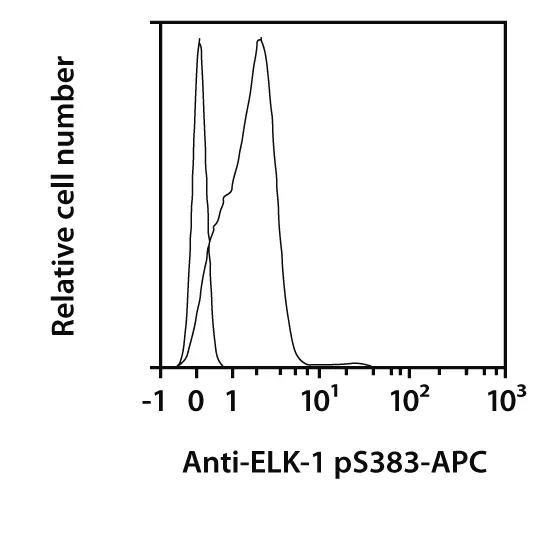
Extended validation for ELK-1 pS383 Antibody, anti-human, REAfinity™
Specificity
In order to compare the epitope specificity of an antibody, the clone being used is compared with other known clones recognizing the same antigen in a competition assay.
Other clones
Overlap in epitope recognition with REA896
M21-1721
high
Cells were incubated with an excess of purified unconjugated ELK-1 pS383 (REA896) antibody followed by staining with fluorochrome-conjugated antibodies from other known clones targeting the same antigen. Fluorescence intensity was then used to assess epitope overlap: a minimal or absent signal indicated high epitope overlap, an intermediate signal suggested partial overlap, and a strong signal reflected low overlap.
Specifications for ELK-1 pS383 Antibody, anti-human, REAfinity™
Overview
Clone REA896 recognizes the human transcription factor ELK-1, also known as ETS domain–containing protein ELK-1. ELK-1 is a member of the E twenty-six (Ets) oncogene family that consists of nuclear phosphoproteins, which are involved in many processes, e.g., differentiation, growth, and survival of cells, hematopoiesis, angiogenesis, wound healing, cancer, and inflammation. ELK-1 is a target of ERK1 and ERK2, which are both members of protein kinases, but also of JNK and p38 MAPK, which are all involved in diverse physiopathological forms of neuronal plasticity. ELK-1 is mainly found in brain, and it is strongly expressed in neurons.
Additional information: Clone REA896 displays negligible binding to Fc receptors.
ELK1
Detailed product information
Technical specifications
Clone
REA896
Clonality
monoclonal
Isotype
recombinant human IgG1
Isotype control
REA Control Antibody (I), human IgG1
Host
human cell line
Type of antibody
Primary antibodies, Recombinant antibodies
Species reactivity
human
Antigen
ELK-1 pS383
Molecular mass of antigen [kDa]
45
Distribution of antigen
neurons, brain
Entrez Gene ID
RRID
AB_2726839, AB_2726807, AB_2726838, AB_2726806, AB_2726808, AB_2726840
Recombinant antibodies at Miltenyi Biotec
As an innovation-powered company with a commitment to quality and excellence, Miltenyi Biotec applies cutting-edge methods to discover and develop newer and better antibodies to satisfy both market demand and regulatory requirements.
The Miltenyi way of generating best-in-class antibodies and antibody conjugates
At Miltenyi Biotec, we opt for recombinant antibodies, which enable sequence verification and optimization for lot-to-lot consistency, making them superior to hybridoma-based antibodies.
Infusing our unique expertise
Recombinants are the result of combining genetic material from different immunized animals, and using display technologies to screen in-house antibody libraries for the best antibodies. Additional analyses on existing hybridoma-based antibodies can also give rise to sequences contributing to novel recombinants.
Maximizing value for your research
By further re-engineering these antibody sequences, we can precisely control their properties to achieve the following benefits:
reduce undesirable binding to Fc gamma receptors,
- eliminate destabilizing amino acid motifs,
- increase specific bonding affinity for stronger, more accurate targeting, and
- optimize fluorochrome conjugation for brighter and clearer signals.
In a final step, by synthesizing and cloning the resulting gene sequence, we achieve an expression vector that develops a cell line, which in turn produces a special recombinant antibody.
Better science with quality antibodies
Already in 2015, 100 of the world’s leading scientists collectively called for better standards and reproducibility in antibody production, proposing recombinant antibodies to circumvent variability (Baker, M. Reproducibility crisis: Blame it on the antibodies. Nature 521, 274–276 (2015). https://doi.org/10.1038/521274a). Moreover, by applying reverse engineering, which is encouraged by the EU Directive 2016/943 r, Miltenyi Biotec acts “[i]n the interest of innovation and fostering competition…” (§16).
Resources for ELK-1 pS383 Antibody, anti-human, REAfinity™
Certificates
To access a Certificate of Analysis (CoA) follow the link below and enter the specific lot of your product.
Should you wish to request additional documentation, such as a Safety Data Sheet (SDS) in other languages than English or Swedish, an SDS-replacement document, or a Certificate of Origin (CoO), please direct your inquiry to your local technical support team.
Citations for ELK-1 pS383 Antibody, anti-human, REAfinity™
Publications
- Gille, H. et al. (1995) ERK phosphorylation potentiates Elk-1-mediated ternary complex formation and transactivation. EMBO J. 14 (5): 951-962
- Besnard, A. et al. (2011) Elk-1 a transcription factor with multiple facets in the brain. Front. Neurosci. 5: 35
- Sharrocks, A. D. (2001) The ETS-domain transcription factor family. Nat. Rev. Mol. Cell Biol. 2 (11): 827-837