
Synonyms: Ly-1, Ly-12, Ly-A, Lyt-1, T1, Tp67
RECOMBINANT
- Clone:
- REAL174
- Type of antibody:
- Releasable antibodies, Primary antibodies, Recombinant antibodies
- Applications:
- FC, MICS, IF, IHC Glossary
- Select a conjugate:
- Select a size:


Other sizes
Related products for CD5 Antibody, anti-mouse, REAlease®



Flow cytometry applications
PE
VioGreen
Recommended dilution:
1:50
Data source:
Miltenyi Biotec
Conjugate:
PE
Used products:
130-119-383, 130-122-703
Description:
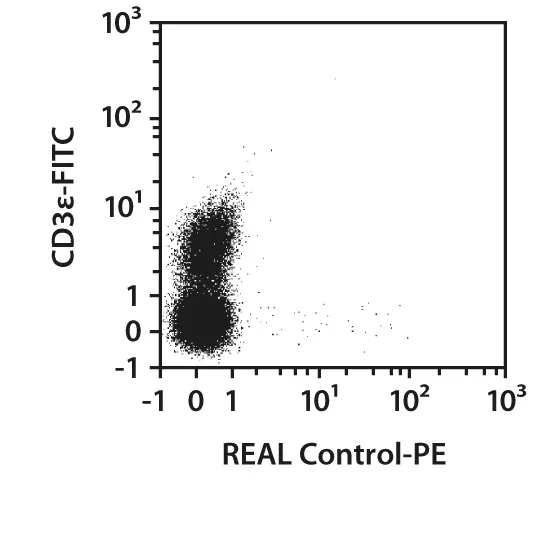
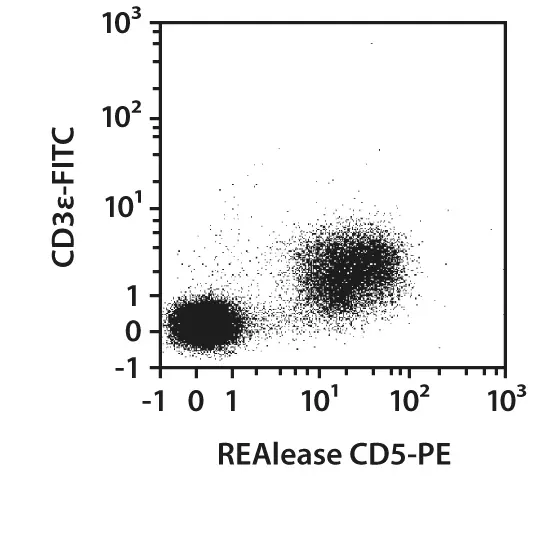
Splenocytes from Balb/c mice were stained with REAlease CD5 Complexes or with the corresponding REAL Control (left images) as well as with CD3ε antibodies and analyzed by flow cytometry using the MACSQuant® Analyzer. Cell debris and dead cells were excluded from the analysis based on scatter signals and propidium iodide (PI) fluorescence.
 view details
 view details
MICS (MACSima Imaging Cyclic Staining) applications
PE
Fixation:
frozen – PFA
Species tested:
mouse
Tissue used:
spleen
Recommended dilution:
1:12.5
Data source:
Miltenyi Biotec
Compatible applications:
IF, IHC
Conjugate:
PE
Used products:
130-119-383
Testing grade:
Description:
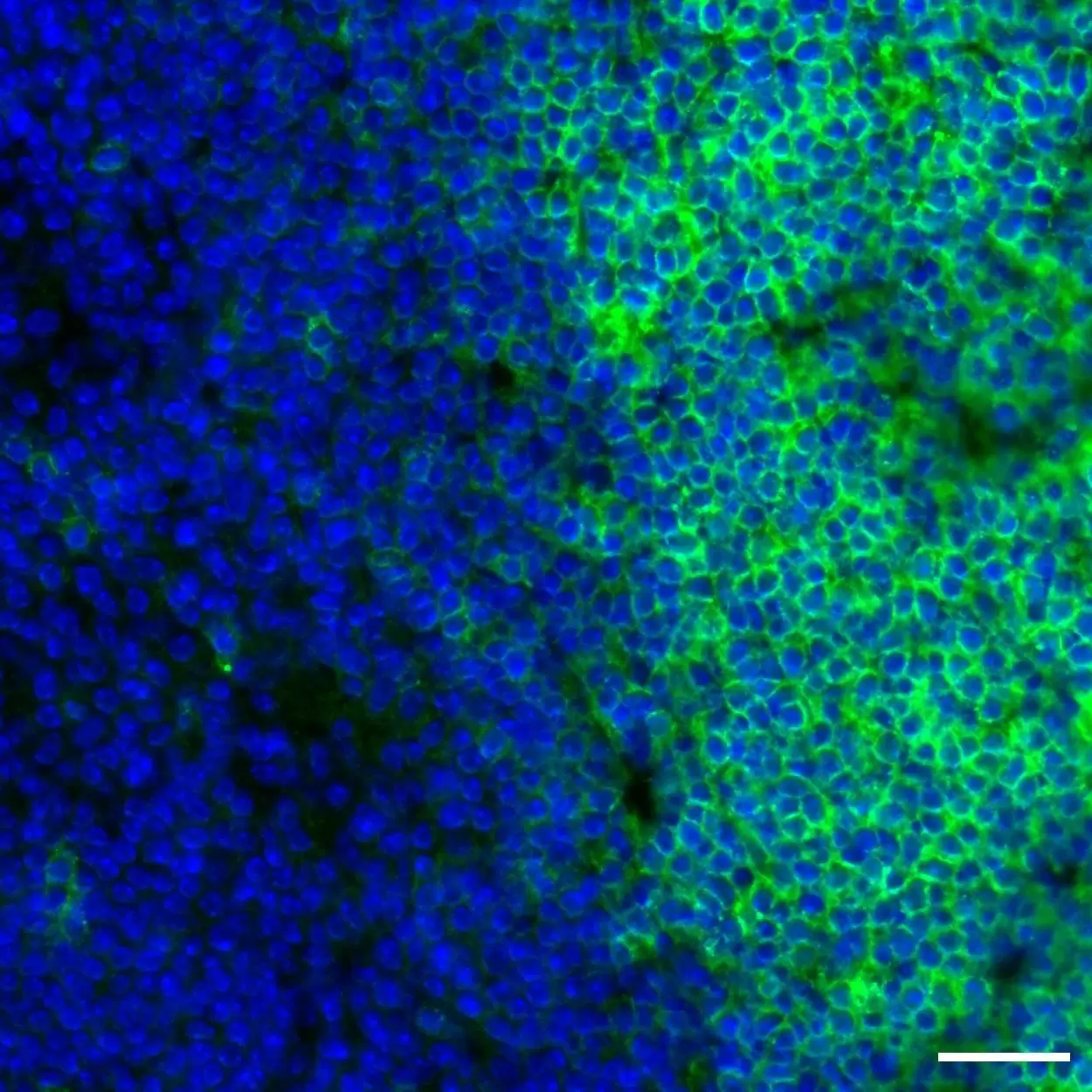
Immunofluorescence analysis of a mouse spleen cryosection fixed with 4% PFA. The section was stained using CD5 Antibody, anti-mouse, PE (green) for 10 min at room temperature. Nuclei were visualized with Hoechst™ (blue).Scale bar: 30 µm.
Specifications for CD5 Antibody, anti-mouse, REAlease®
Overview
Clone REAL174 is an antibody fragment derived from the full CD5 antibody molecule. It displays no binding to Fc receptors. The recombinantly engineered antibody fragments are multimerized to form the REAlease Complex to bind markers with high avidity.
Clone REAL174 recognizes the mouse CD5 antigen, a 67 kDa single-pass type I membrane protein which is also known as lymphocyte antigen 1 (Ly-1). CD5 is expressed by a majority of thymocytes, mature T cells, and a subset of B cells. The expression of CD5 by a small B cell subset characterizes a developmentally and functionally distinct lineage of B cells called B-1a cells. CD5 plays a role in the interaction of T and B cells and is a counter-receptor for CD72.
The REAlease Kits consist of the respective fluorochrome-conjugated REAlease Complexes and the REAlease Support Kit for removal of the REAlease Complexes and optional relabeling with different fluorochrome-conjugated REAlease Complexes.
Ly-1, Ly-12, Ly-A, Lyt-1, T1, Tp67
Detailed product information
Technical specifications
Clone
REAL174
Clonality
monoclonal
Isotype control
Control Antibody
Host
cell line
Type of antibody
Releasable antibodies, Primary antibodies, Recombinant antibodies
Species reactivity
mouse
Antigen
CD5
Distribution of antigen
thymic epithelial cells, T cells, B cells
RRID
AB_2784245, AB_2784244, AB_2751293, AB_2751690
Resources for CD5 Antibody, anti-mouse, REAlease®
Certificates
To access a Certificate of Analysis (CoA) follow the link below and enter the specific lot of your product.
Should you wish to request additional documentation, such as a Safety Data Sheet (SDS) in other languages than English or Swedish, an SDS-replacement document, or a Certificate of Origin (CoO), please direct your inquiry to your local technical support team.
Citations for CD5 Antibody, anti-mouse, REAlease®
Publications
- Lundy, S. K. et al. (2014) Characterization and activity of Fas ligand producing CD5+ B cells. Methods Mol. Biol. 1190: 81-102
- Tarakhovsky, A. et al. (1995) A role for CD5 in TCR-mediated signal transduction and thymocyte selection. Science 269 (5223): 535-537
- Efanov, A. et al. (2010) CD5+CD23+ leukemic cell populations in TCL1 transgenic mice show significantly increased proliferation and Akt phosphorylation. Leukemia 24 (5): 970-975