The Anti-MSCA-1 (W8B2) MicroBead Kit, based on the antibody clone W8B2, was developed for the positive selection of mesenchymal stromal cells (MSCs) with a high proliferative capacity, derived from bone marrow aspirates.


Related products for Anti-MSCA-1 (W8B2) MicroBead Kit, human

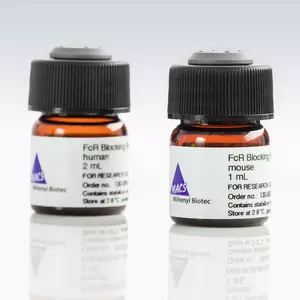

The Anti-MSCA-1 (W8B2) MicroBead Kit, based on the antibody clone W8B2, was developed for the positive selection of mesenchymal stromal cells (MSCs) with a high proliferative capacity, derived from bone marrow aspirates.
The Anti-MSCA-1 (W8B2) MicroBeads recognize the mesenchymal stromal cell antigen-1 (MSCA-1), which is identical to tissue non-specific alkaline phosphatase1.
MSCA-1 was shown to be restricted to MSCs in the CD271bright population in human bone marrow2. These CD271brightCD45dim MSCs have a much higher clonogenic capacity compared to the CD271+CD45+ fraction in bone marrow. Therefore, MSCA-1 is a highly specific marker to isolate MSCs with a high proliferative potential from bone marrow. MSCA-1 expression was not found on placenta-derived MSCs after culture3.
Antibodies against MSCA-1 show broad interspecies cross-reactivity, such as dog, pig, sheep, goat and monkey4.
MS, LS, XS, or autoMACS® Columns.
MSCA-1 (W8B2)+ cells were isolated from human bone marrow mononuclear cells (BM-MNCs) using the Anti-MSCA-1 MicroBead Kit, two MS Columns, and a MiniMACS™ Separator. Cells were stained with Anti-MSCA-1 (W8B2)-APC and CD45-FITC.
- Sobiesiak, M. et al. (2010) The mesenchymal stem cell antigen MSCA-1 is identical to tissue non-specific alkaline phosphatase. Stem Cells Dev. 19: 669-677
- Rozemuller, H. et al. (2010) Prospective isolation of mesenchymal stem cells from multiple mammalian species using cross-reacting anti-human monoclonal antibodies. Stem Cells Dev. 19: 1911-1921
- Bühring, H. J. et al. (2007) Novel markers for the prospective isolation of human MSC. Ann. N. Y. Acad. Sci. 1106: 262-271
- Battula, V. L. et al. (2007) Human placenta and bone marrow derived MSC cultured in serum-free, b-FGF-containing medium express cell surface frizzled-9 and SSEA-4 and give rise to multilineage differentiation. Differentiation 75: 279-291