3D graphic showing blood cells passing CD34 beads for enrichment of CD34+ cells in graft engineering
Logo

Fast and automated isolation of virus-specific IFN-γ–secreting T cells with CliniMACS Prodigy®

Use the CliniMACS Prodigy® Cytokine Capture System (IFN-gamma) System (CCS) to easily generate single- and multi-virus specific CD4+ and CD8+ T cells in a highly convenient and fast process. The fully integrated and standardized workflow takes place in a closed and sterile system to produce viable antigen-specific T cells with the potential to restore immunity against cytomegalovirus (CMV), adenovirus (AdV), Epstein-Barr virus (EBV), and other infections after hematopoietic stem cell transplantation.

Content overview

Content

  • Application overview
  • 1. Eligibility test of donor blood
  • 2. Antigen-specific T cell stimulation
  • 3. Cell labeling with CliniMACS Catchmatrix Reagent
  • 4. Cell labeling with CliniMACS Enrichment Reagent
  • 5. Enrichment of specific target cells
  • 6. Quality control
  • Selected references
  • Contact and support

The complete CCS workflow

Overview of the automated CliniMACS Cytokine Capture System (CCS) workflow steps on the CliniMACS Prodigy Instrument
Overview of the automated CCS workflow steps on the CliniMACS Prodigy Instrument

Viral or fungal infections are a major cause of morbidity and mortality in the period of immune recovery after hematopoietic stem cell transplantation (HSCT)1,2. Adoptively transferred antigen-specific T cells have been shown to restore protective immunity and control established AdV3,4,13, CMV5,6, and EBV7,8 infections after HSCT in both adults and children.

With the CCS, virus-specific T cells can be isolated in a fast and easy process.

Utilizing the CliniMACS Prodigy platform, this method allows automated and reproducible separation of viable antigen-specific CD4+ and CD8+ T cells, e.g., with specificity for HCMV9-12, EBV14, AdV14, BKV15, SARS-CoV-216, or multivirus-specificity14. The whole process is facilitated in a closed sterile system and only takes approximately 12 hours.

The CliniMACS Prodigy instrument integrates all critical steps of the CCS workflow from antigen-specific T cell stimulation to target cell labeling, magnetic isolation and final formulation within 12 hours. Importantly, all cell processing steps are automated enabling a convenient and highly standardized separation process.

Video

Automatic separation of antigen-specific T cells

CD4+ and CD8+ T cells stimulated in vitro with a specific antigen can be magnetically labeled with the CliniMACS® Cytokine Capture System (IFN-gamma). In combination with the CliniMACS Prodigy instrument, it allows fast and automated separation of antigen-specific T cells in a closed, sterile system.

1. Eligibility test of donor blood

Virus-specific T cells can be enriched by the CCS based on their secretion of IFN-γ after restimulation with the appropriate antigen. As this technology targets pre-existing virus-specific T cells from donor blood material (e.g., leukapheresis), it is recommended to validate the eligibility of each blood donor prior to performing the CCS. This can be done using our special protocol optimized for this test (blood donor eligibility test, research use only). The associated Express Mode on a MASCSQuant® Flow Cytometer simplifies the analysis and allows for an automated and standardized cell analysis.

2. Antigen-specific T cell stimulation

The second step of the automated process on the CliniMACS Prodigy is the stimulation of PBMCs with the antigen of interest. This can be performed, for example, with MACS GMP PepTivator Peptide Pools. Their unique structure of overlapping oligopeptides covers the complete sequence of an antigen and provides a number of benefits:

  • Efficient in vitro stimulation of CD4+ and CD8+ T cells
  • Targets multiple immunodominant epitopes
  • Available for many viral specificities including CMV, AdV, EBV, BKV, JCV, SARS-CoV-2, HPV-16, and for tumor antigens such as WT-1 and NY-ESO-1

3. Cell labeling with CliniMACS Catchmatrix Reagent

In the next step, CD45+ cells are being labeled with a bispecific antibody, the CliniMACS Catchmatrix Reagent. This antibody tandem is specific for CD45 and binds to the cell surface. It is also specific for IFN-γ, which is released by the stimulated target cells during the secretion period. Afterward, IFN-γ is captured by the CliniMACS Catchmatrix Reagent and thereby bound to the surface of the cytokine-secreting cells.

4. Cell labeling with CliniMACS Enrichment Reagent

The cell surface-bound IFN-γ is targeted by the CliniMACS Enrichment Reagent. This IFN-γ-specific antibody is conjugated to microbeads and allows for subsequent cell separation based on MACS Technology. Both the CliniMACS Catchmatrix Reagent and the CliniMACS Enrichment Reagent are components of the CCS.

5. Enrichment of specific target cells

In the fifth step, the microbead-labeled IFN-γ-secreting cells of interest are isolated using the built-in magnetic column of the CliniMACS Prodigy Tubing Set. While unlabeled cells pass through, microbead-labeled cells are retained in the magnetic field. These cells then are collected in the target cell bag, ready for analysis and downstream applications.

6. Quality control

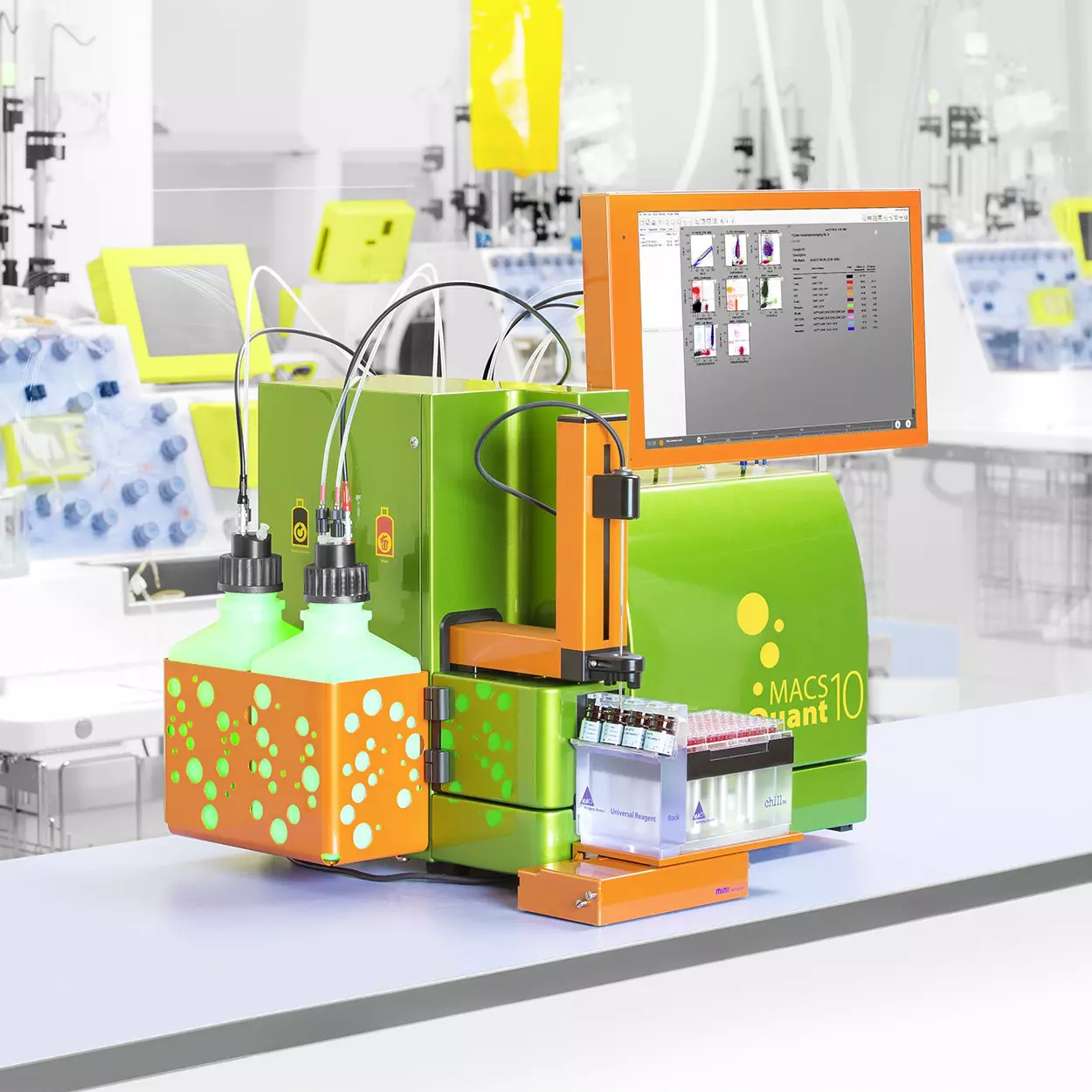
Flow cytometer MACSQuant Analyzer 10 in a laboratory setting
Express Modes of the MACSQuant® instruments allow for automated and standardized flow cytometry processes.

The last step is the analysis of the final cell product. Immune cell composition and target cell numbers are analyzed, as well as phenotype and frequency of the target cells. In addition, isolated IFN-γ–positive T cells are tested for activity (see special protocol for expansion and restimulation, research use only).

When using a MACSQuant Flow Cytometer, the Virus-Specific T Cell CCS Express Mode Package allows for automated workflows and standardized cell analysis. The package includes three optimized application-specific Express Modes and detailed special protocols (see related documents) for sample preparation and the use of the Express Modes.

Selected references: Learn how CliniMACS Instruments support graft engineering in HSCT

Icon selected references in turquoise

Stay up to date with influential publications across major graft engineering topics, from haploidentical and matched HSCT to stem cell boost, infections, and separation process performance.

Get personalized support for your manufacturing workflow on virus-specific T cells for immunotherapy

For the manufacture and use of the antigen-specific T cells, national and international legislation and regulations must be followed.

As the provider of the CliniMACS CCS-IFN System, Miltenyi Biotec makes no recommendations regarding the use of the cells manufactured for therapeutic purposes and makes no claims regarding clinical benefit. For complete regulatory notes, please click here.

You have previously chosen International as your location.
What do you want to do?