3D graphic showing blood cells passing CD34 beads for enrichment of CD34+ cells in graft engineering
Logo

Ex vivo T cell depletion in allogeneic hematopoietic stem cell transplantation (HSCT)

Design personalized HSCT grafts by actively removing TCRα/β+ T cells, naive T cells, and B cells. Dedicated depletion systems on the CliniMACS® Plus Instrument and CliniMACS Prodigy® Platform automate the modification of grafts in closed processing workflows, removing harmful cells while leaving potentially therapeutic cells in your final product. These precision grafts facilitate rapid engraftment, reduce the risk of graft-versus-host disease (GVHD), and provide immunological memory against multiple pathogenic invaders.

Benefits of precision grafts in allogeneic HSCT

For the manufacturing of precision grafts, stem cell sources like mobilized apheresis, is used in conjunction with ex vivo T cell depletion to define and optimize the cellular composition and volume.1 This modification is an option to improve the outcomes of HSCT2, where GVHD and poor graft function (PGF) remain a challenge.

Depending on the specific transplantation setting, different methods of ex vivo T cell depletion can be applied. CD34+ cell enrichment as a means of passive depletion of alloreactive T cells is widely used as a rescue option for patients suffering from PGF.3,4 Stem cell grafts based on CD34+ cell enrichment and depletion of CD45RA+ naive T cells have been studied in matched allogeneic HSCT.5 Active depletion of alloreactive TCRα/β+ cells is mainly used in haploidentical stem cell transplantation settings.

The automated processes on the CliniMACS Instruments can deplete alloreactive T cells (TCRα/β+, CD45RA+ ) and B cells (CD19+) from your initial cell sources. Stem cells and immune effector cells, such as natural killer (NK) cells and TCRγ/δ+ T cells, remain in the cell product. These two cell types are known to promote graft-versus-leukemia/tumor effects while potentially reducing the risk of GVHD.6,7

Numerous studies confirm the improved performance of grafts modified via CliniMACS TCRα/β+ and CD19+ depletion in different applications. This includes myeloablative and reduced intensity conditioning regimes, settings with reduced or no post-transplant immune suppression, and mismatched and haploidentical HSCT.8–15 The precision grafts are safe and effective.12 Reported performance observations include early expansion of donor-derived T lymphocytes, rapid engraftment, and excellent immune reconstitution rates.6, 8–15 Additionally, there are low occurrences of GVHD and infection-related complications observed.15

By depletion of TCRα/β+ T cells, CD19+ B cells, and CD45RA+ cells, the recipient also receives passively enriched CD45RA- memory T cells. This strategy has the potential to reduce the risk of post-transplant infections and GVHD.15–21 Read more about CD45RA+ cell depletion here.

Video

How to improve grafts for stem cell transplantation via TCRα/β⁺ T cell depletion

The innovative depletion strategy is automated, sterile, and leaves beneficial cell populations like NK cells and TCRγ/δ+T cells in the graft.

Active depletion of TCRα/β+, CD45RA+ T cells, and B cells using CliniMACS Technology

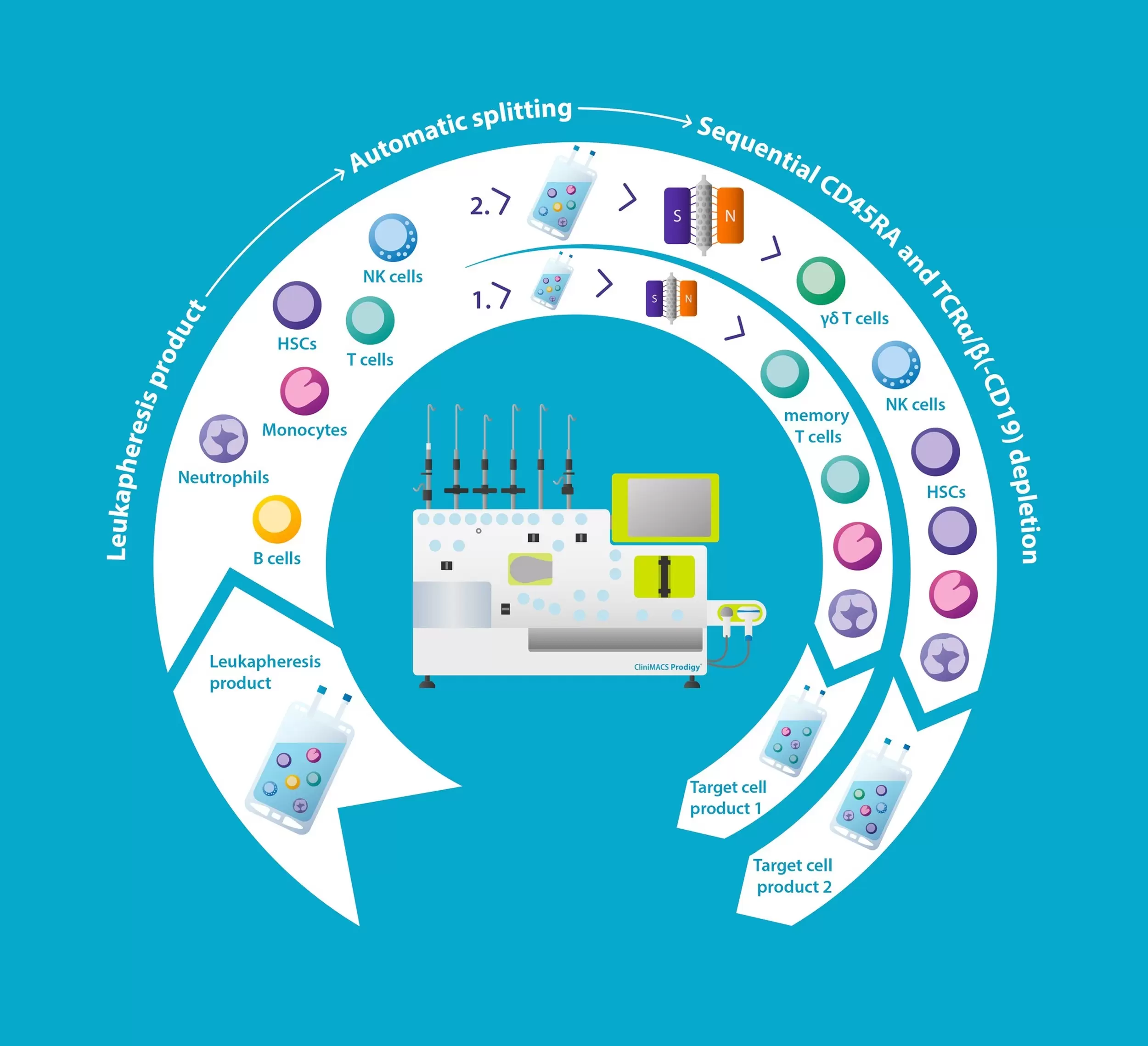
Automated workflow for the depletion of TCRα/β+ and CD45RA+ T cells and CD19+ B cells from leukapheresis products on the CliniMACS Prodigy.

Enjoy full flexibility in altering your HSCT grafts with the CliniMACS Plus System and the CliniMACS Prodigy Platform. All our depletion systems (CliniMACS TCRα/β-19-45RA System, CliniMACS TCRα/β-19 System, CliniMACS CD45RA System) are automated applications to generate precision grafts from leukapheresis products. Each workflow is a streamlined, highly reproducible, standardized process executed in a closed tubing system. Learn more about your options and the required materials in the next section.

Strategies for depleting TCRab+, CD19+ and CD45RA+ cells for HSCT on the CliniMACS Prodigy Platform
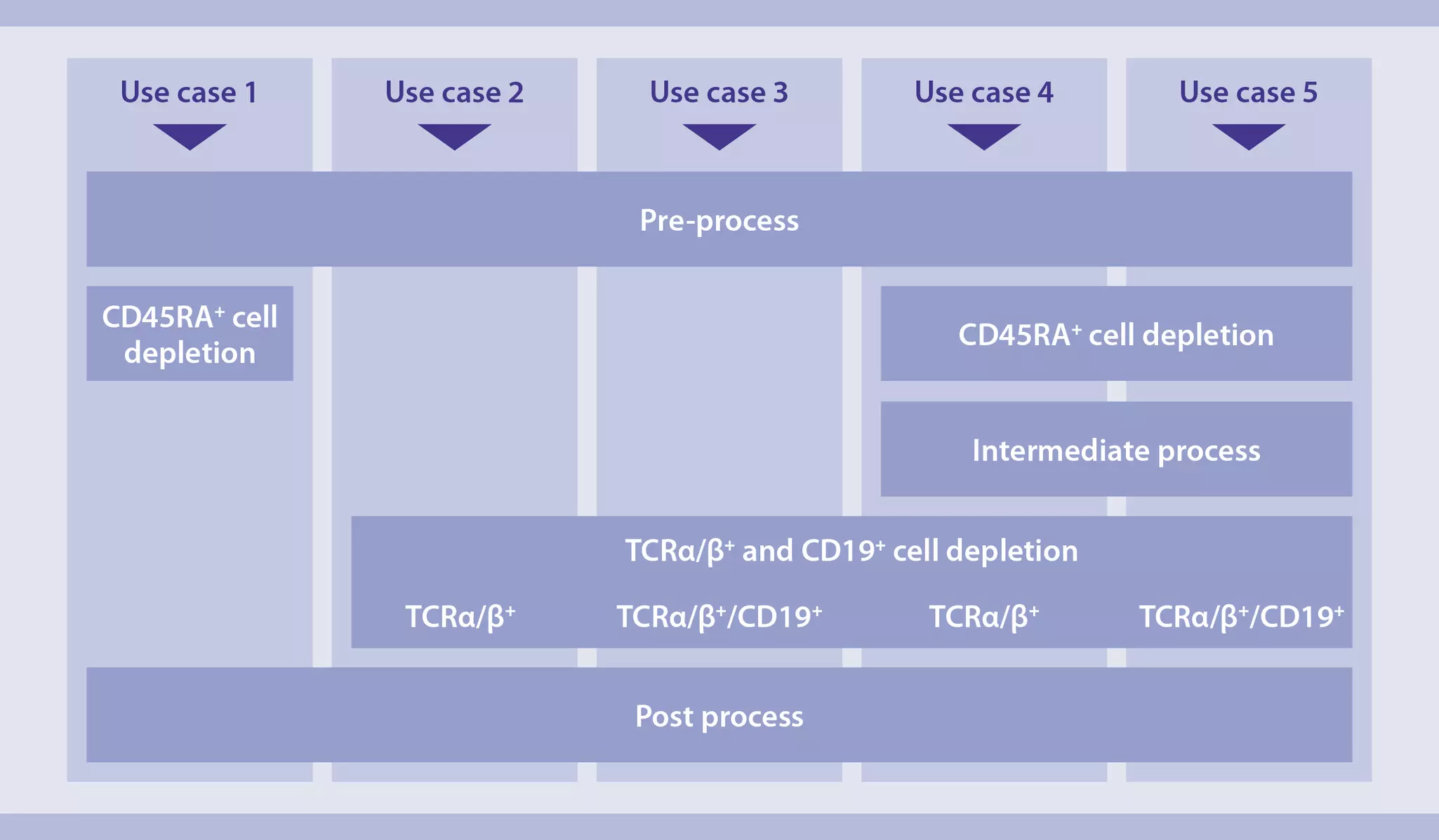
The five available cell depletion use cases offer the flexibility to design your graft according to your requirements.

Depletion strategies on the CliniMACS Prodigy Platform

Select your desired depletion strategy based on your specific requirements. The CliniMACS Prodigy TCRα/β-19-45RA Depletion Application provides the option to eliminate either a single cell subset from your mobilized apheresis product or to integrate multiple depletion processes – all within the same closed tubing set and in a single process. The figure demonstrates the various use cases along with the corresponding depletion sequences.

Use case 1 – CliniMACS Prodigy LP-45RA Depletion

This one-step depletion strategy removes CD45RA+ cells from a small leukapheresis aliquot and leaves memory T cells in the target cell product for donor lymphocyte infusions (DLI). This approach enhances immune reconstitution and serves as prophylaxis or treatment against opportunistic viral infections that do not respond to standard therapy.5,16–21

Use case 2 – CliniMACS Prodigy LP-TCRα/β Depletion

With this depletion strategy, TCRα/β+ T cells are removed while stem cells, NK cells, TCRγ/δ+ T cells, and other immune effector cells remain in the graft, important for the graft-versus-leukemia effect. This type of T cell depletion is the backbone of many haploidentical HSCT strategies, eliminating or minimizing the need for pharmaceutical immunosuppression.6,7

Use case 3 – CliniMACS Prodigy LP-TCRα/β-19 Depletion

In this case, TCRα/β+ T cells and CD19+ B cells are simultaneously depleted from the graft while important immune effector cells are retained (refer to use case 2). The additional depletion of B cells represents an effective preventive measure for post-transplant lymphoproliferative disease (PTLD). This depletion strategy has been widely studied in haploidentical pediatric HSCT.8–15

Use case 4 – CliniMACS Prodigy LP-TCRα/β-45RA Depletion

This option initially depletes CD45RA+ cells from a small leukapheresis aliquot and then removes TCRα/β+ T cells from the remaining starting material. With this strategy memory T cells are added to the TCRα/β+ depletion backbone. The introduction of memory T cells may improve immune reconstitution and provide additional protection against infectious complications after allogeneic HSCT.18,21

Use case 5 – CliniMACS Prodigy LP-TCRα/β-19-45RA

In this case, all three cell depletion options are combined. In a first step, CD45RA+ T cells are removed from a small leukapheresis aliquot, leaving memory T cells in the target cell product. In a sesond step, the remaining starting material is simultaneously depleted of TCRα/β+ T cells and CD19+ B cells. This allows for the individual combination of two cell products: CD34+ HSCs and immune effector cells described for TCRα/β+ depletion (use case 2), and enriched memory T cells. Thus, this use case may be well suited for a TCRα/β+ and CD19-depleted HSCT, followed by memory T cell DLI.12,18

Individual depletion strategies on the CliniMACS Plus Instrument

T cell depletion

T cell depletion can also be performed on the CliniMACS Plus System. The CliniMACS TCRα/β Product Line is a harmonized reagent group for the depletion of αβ T cells from leukapheresis products. This product line includes an anti-TCRα/β antibody that targets a common determinant of the TCRα/β-CD3 complex. This can be combined with the CliniMACS CD19 Product Line to remove B cells as well.

CD45RA+ cell depletion

Donor-derived memory T cells provide immunologic memory against numerous invaders but are less alloreactive than naive T cells. The CD45RA marker is an isoform of the CD45 family that is present on naive T cells but not on CD45RO+ central and effector memory T cells.22,23­ This one-step process can be performed on the CliniMACS Plus Instrument using the CliniMACS CD45RA Reagent. Read more.

Analytical monitoring (QC) by clinical flow cytometry

MACSQuant Analyzer 16 Flow Cytometer for automated flow cytometry
The MACSQuant Analyzers are the perfect match for cell analysis in graft engineering.

Implementing reliable and standardized quality controls is essential for safe and consistent graft engineering. Our comprehensive MACSQuant® Flow Cytometry Platform performs automated data acquisition and analysis via Express Modes, specific for precision-graft cell products. The audit-ready software and a broad portfolio of REAfinity® Recombinant Antibodies with superior specificity and reproducibility complete our quality control solutions.

Express Modes are add-on features of the MACSQuantify™ Software. They are specifically designed to automate flow cytometric analyses through established experiment settings, acquisition processes, and automated gating. In the context of graft engineering cell products, the staining and analysis strategy is meticulously optimized to determine TCRγ/δ+, CD45RO+, and CD34+ cells in the depleted graft, as well as the extremely low percentages of residual CD45RA+ and TCRα/β+ cells.

The TCRαβ/CD45RA Express Mode Package contains two optimized application-specific Express Modes.

Express modePurposeV1 VioBlue®V2 VioGreen™B1
FITC
B2
PE
B3
7AAD Per CP-Vio® 700
B4
PE-Vio 770
R1 APCR2
APC-Vio 770
TCRαβ/CD45RA depletionDetermination of TCRαβ+, CD45RA+, and CD34+ cell frequenciesCD34CD45CD45RACD37-AAD, CD14, and CD15TCRγ/δ
TCRα/β
CD45RO
TCRαβ immune cell compositionDetermination of WBC concentration, viability, and immune cell composition incl. B cells
CD45CD4CD3CD16/ CD56
7-AAD
CD20CD14CD8

Selected references: Learn how CliniMACS Instruments support graft engineering in HSCT

Icon selected references in turquoise

Stay up to date with influential publications across major graft engineering topics, from haploidentical and matched HSCT to stem cell boost, infections, and separation process performance.

Get personalized support on T cell depletion in graft engineering

Unless otherwise specifically indicated, Miltenyi Biotec products and services are for research use only and not for therapeutic or diagnostic use. For complete regulatory notes, please click here.

You have previously chosen International as your location.
What do you want to do?