EGF stands for epidermal growth factor. Human EGF is a recombinant protein optimized for use in cell culture, differentiation studies, and functional assays.


Related products for Human EGF
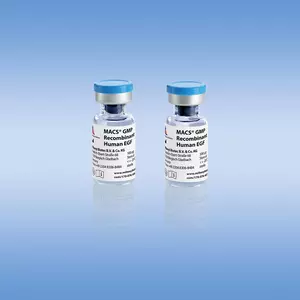
EGF stands for epidermal growth factor. Human EGF is a recombinant protein optimized for use in cell culture, differentiation studies, and functional assays.
Human EGF can be used for a variety of applications, including:
- Proliferation and differentiation of a wide variety of cell types deriving from ectoderm and mesoderm.
HOMG4, URG
Biological activity
Epidermal growth factor (EGF) is the prototype of the large family of EGF-like proteins with a common structural motif comprising three intramolecular disulfide bonds. EGF is produced by various cell types like mammary gland cells, gut epithelial cells, and cells in the nervous system and the kidney. Production of EGF is induced by testosterone and inhibited by estrogens. EGF stimulates the proliferation and differentiation of mesenchymal cells, acts as a mitogen for fibroblasts, epithelial and endothelial cells, and promotes colony formation of epidermal cells.
Research-grade cytokines are suitable for a wide variety of cell culture applications. They are sterile-filtered prior to lyophilization. Generally, endotoxin levels are <0.1 ng/μg (<1 EU/μg), and purities are >95%. The biological activity is tested in appropriate bioassays.
Premium-grade cytokines offer the convenience of high and well-defined biological activities and allow exact unit dosing for demanding applications. The biological activity is determined after lyophilization and reconstitution, and normalized to WHO/NIBSC standards whenever available. In general, endotoxin levels are <0.01 ng/μg (<0.1 EU/μg), and purities are >97%. Lot-specific activities are stated in the Certificate of Analysis (www. miltenyibiotec.com/certificates).
In vitro generation of primary mouse neurospheres. A single-cell suspension was prepared from mouse brain using the Neural Tissue Dissociation Kit (P) and the gentleMACS™ Dissociator. Isolated Prominin-1+ cells were cultivated for 7 days in MACS NeuroMedium containing MACS NeuroBrew, Human FGF-2 (20 ng/mL), and Human EGF (20 ng/mL).
Human EGF activity assay. The biological activity of Human EGF is determined by proliferation assay using 3T3 cells. Activity of Human EGF, premium grade, (red line) was compared to another commercially available product (black line).
SDS-PAGE of Human EGF, premium grade under reducing (R) and non-reducing (NR) conditions.
Human EGF biological activity. Activity of Human EGF, premium grade, (red bar) was compared to another commercially available product (black bar).
Mass spectrometry analysis (ESI-MS) of Human EGF, premium grade. The peak corresponds to the calculated molecular mass of 6347 Da.
To access a Certificate of Analysis (CoA) follow the link below and enter the specific lot of your product.
Should you wish to request additional documentation, such as a Safety Data Sheet (SDS) in other languages than English or Swedish, an SDS-replacement document, or a Certificate of Origin (CoO), please direct your inquiry to your local technical support team.
- Noonan, J. J. et al. (2019) Implementing Patient-Derived Xenografts to Assess the Effectiveness of Cyclin-Dependent Kinase Inhibitors in Glioblastoma. Cancers (Basel) 11 (12): 2005
- Roswag, S. et al. (2021) Functional Characterization of Circulating Tumor Cells (CTCs) from Metastatic ER+/HER2- Breast Cancer Reveals Dependence on HER2 and FOXM1 for Endocrine Therapy Resistance and Tumor Cell Survival: Implications for Treatment of ER+/HER2- Breast Cancer. Cancers (Basel) 13 (8): 1810
- Tyciakova, S. et al. (2021) Overexpression of TNFα induces senescence, autophagy and mitochondrial dysfunctions in melanoma cells. BMC Cancer 21 (1): 507
- Kucerova, L. et al. (2013) Altered features and increased chemosensitivity of human breast cancer cells mediated by adipose tissue-derived mesenchymal stromal cells. BMC Cancer 13: 535
- Goikuria, H. et al. (2018) Characterization of Carotid Smooth Muscle Cells during Phenotypic Transition. Cells 7 (3): 23
- Cilibrasi, C. et al. (2016) Pioglitazone Effect on Glioma Stem Cell Lines: Really a Promising Drug Therapy for Glioblastoma? PPAR Res 2016: 7175067
- Brawanski, K. et al. (2018) Efficacy of D,L-methadone in the treatment of glioblastoma in vitro. CNS Oncol 7 (3): CNS18
- Hagmann, S. et al. (2013) Different culture media affect growth characteristics, surface marker distribution and chondrogenic differentiation of human bone marrow-derived mesenchymal stromal cells. BMC Musculoskelet Disord 14: 223
- Diaz-Guerra, E. et al. (2012) Intrinsic cues and hormones control mouse mammary epithelial tree size. FASEB J. 26 (9): 3844-3853
- Robinson, C. J. and Gaines-Das, R. (1996) The international standard for epidermal growth factor (EGF): comparison of candidate preparations by in vitro bioassays and immunoassays. National Institute for Biological Standards and Control. Growth Factors 13: 163-170
- Giambra, M. et al. (2021) Characterizing the Genomic Profile in High-Grade Gliomas: From Tumor Core to Peritumoral Brain Zone, Passing through Glioma-Derived Tumorspheres. Biology (Basel) 10 (11): 1157
- Gray, K. M. et al. (2018) Self-oligomerization regulates stability of survival motor neuron protein isoforms by sequestering an SCF Slmb degron. Mol. Biol. Cell 29 (2): 96-110
- Ac Kar, L. et al. (2021) Blood-based detection of lung cancer using cysteine-rich angiogenic inducer 61 (CYR61) as a circulating protein biomarker: a pilot study. Mol Oncol. 15 (11): 2877-2890
- Smit, D. J. et al. (2020) High Sensitivity of Circulating Tumor Cells Derived from a Colorectal Cancer Patient for Dual Inhibition with AKT and mTOR Inhibitors. Cells 9 (9): 2129
- Witte, K. E. et al. (2021) Nanopore Sequencing Reveals Global Transcriptome Signatures of Mitochondrial and Ribosomal Gene Expressions in Various Human Cancer Stem-like Cell Populations. Cancers (Basel) 13 (5): 1136
You have previously chosen International as your location.
What do you want to do?