New look, same trusted quality! Check out the newest addition to our UltraPure portfolio, CD4 MicroBeads Ultrapure, human
CD4 MicroBeads were developed for the positive selection or depletion of CD4+ cells by direct magnetic labeling. The most commonly used cell sources are peripheral blood, leukapheresis1, and cord blood. In addition, T helper cells have also been isolated from lymph nodes, thymus, spleen, skin biopsies2, synovia


Related products for CD4 MicroBeads, human

New look, same trusted quality! Check out the newest addition to our UltraPure portfolio, CD4 MicroBeads Ultrapure, human
CD4 MicroBeads were developed for the positive selection or depletion of CD4+ cells by direct magnetic labeling. The most commonly used cell sources are peripheral blood, leukapheresis1, and cord blood. In addition, T helper cells have also been isolated from lymph nodes, thymus, spleen, skin biopsies2, synovial fluids, and cell cultures.
CD4 is an accessory molecule in the recognition of MHC class II/peptide complexes by the TCR heterodimers on CD4+ T helper cells. CD4 is expressed on T helper cells and at a lower level on monocytes and dendritic cells. The CD4 molecule is the receptor for the human immunodeficiency virus. The CD4 antibody recognizes most thymocytes and about 65% of all peripheral blood T cells.
Isolation or depletion of CD4+ T helper cells is performed in many different fields of research, such as infectious diseases, autoimmune diseases, allergy, asthma, and tumor immunology. T helper cells isolated by MACS® Technology remain viable and functional. Therefore, they can be used for further functional studies, such as proliferation assays10 and cytotoxicity assays3, as well as for the generation of T cell lines9. CD4+ T cells purified with CD4 MicroBeads have also been cultured and analyzed for in vitro cytokine production.4 Furthermore, they have been used in co‑culture experiments, e.g., for allogeneic stimulation by dendritic cells1 or for B cell activation2.
T helper cells isolated by MACS® Technology were also used for studies on viral infections, e.g., for in vitro infections of cells with HIV5, to determine the infectivity of HIV-infected follicular dendritic cells6, immune reconstitution after anti-viral therapy7, and for monitoring of immune abnormalities in children of HIV-infected mothers8.
For positive selection: MS, LS, XS, or autoMACS® Columns. For depletion: LD, D, or autoMACS Columns.
Isolation of CD4+ cells from PBMCs using CD4 MicroBeads, an MS Column, and a MiniMACS™ Separator.
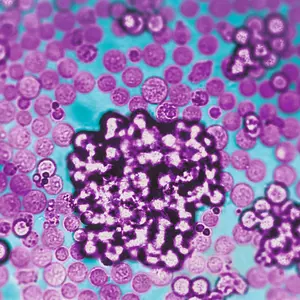
CD4+ T helper cells isolated from PBMCs using CD4 MicroBeads. Cells were stained with CD4-FITC in parallel to magnetic labeling.
- Akdis, M. et al. (1999) Skin homing (cutaneous lymphocyte-associated antigen-positive) CD8+ T cells respond to superantigen and contribute to eosinophilia and IgE production in atopic dermatitis. J Immunol 163: 466-475
- Engedal, N. et al. (2006) All-trans retinoic acid stimulates IL-2-mediated proliferation of human T lymphocytes: early induction of cyclin D3. J Immunol 177: 2851-2861
- Jonuleit, H. et al. (2000) Induction of interleukin 10-producing, nonproliferating CD4+ T cells with regulatory properties by repetitive stimulation with allogeneic immature human dendritic cells. J. Exp. Med. 192: 1213-1222
- Akdis, A. C. et al. (1995) Cytokine immunotrapping: an assay to study the kinetics of production and consumption or degradation of human interferon-gamma. J. Immunol. Methods 182: 251-261
- Kim, J. Y. et al. (2004) BH3-only protein Noxa is a mediator of hypoxic cell death induced by hypoxia-inducible factor 1alpha. J. Exp. Med. 199: 113-1142
- Douek, D. C. et al. (1998) Changes in thymic function with age and during the treatment of HIV infection. Nature 396: 690-695
- Parra, E. et al. (1997) The role of B7-1 and LFA-3 in costimulation of CD8+ T cells. J Immunol 158: 637-642
- Heath, S. L. et al. (1995) Follicular dendritic cells and human immunodeficiency virus infectivity. Nature 377: 740-744
- Nielsen, S. D. et al. (2001) Impaired progenitor cell function in HIV-negative infants of HIV-positive mothers results in decreased thymic output and low CD4 counts. Blood 98: 398-404
- Ennen, J. et al. (1994) CD8+ T lymphocytes of African green monkeys secrete an immunodeficiency virus-suppressing lymphokine. Proc. Natl. Acad. Sci. U.S.A. 91: 7207-7211
You have previously chosen International as your location.
What do you want to do?