Unveiling the MACSima® Platform through users’ eyes
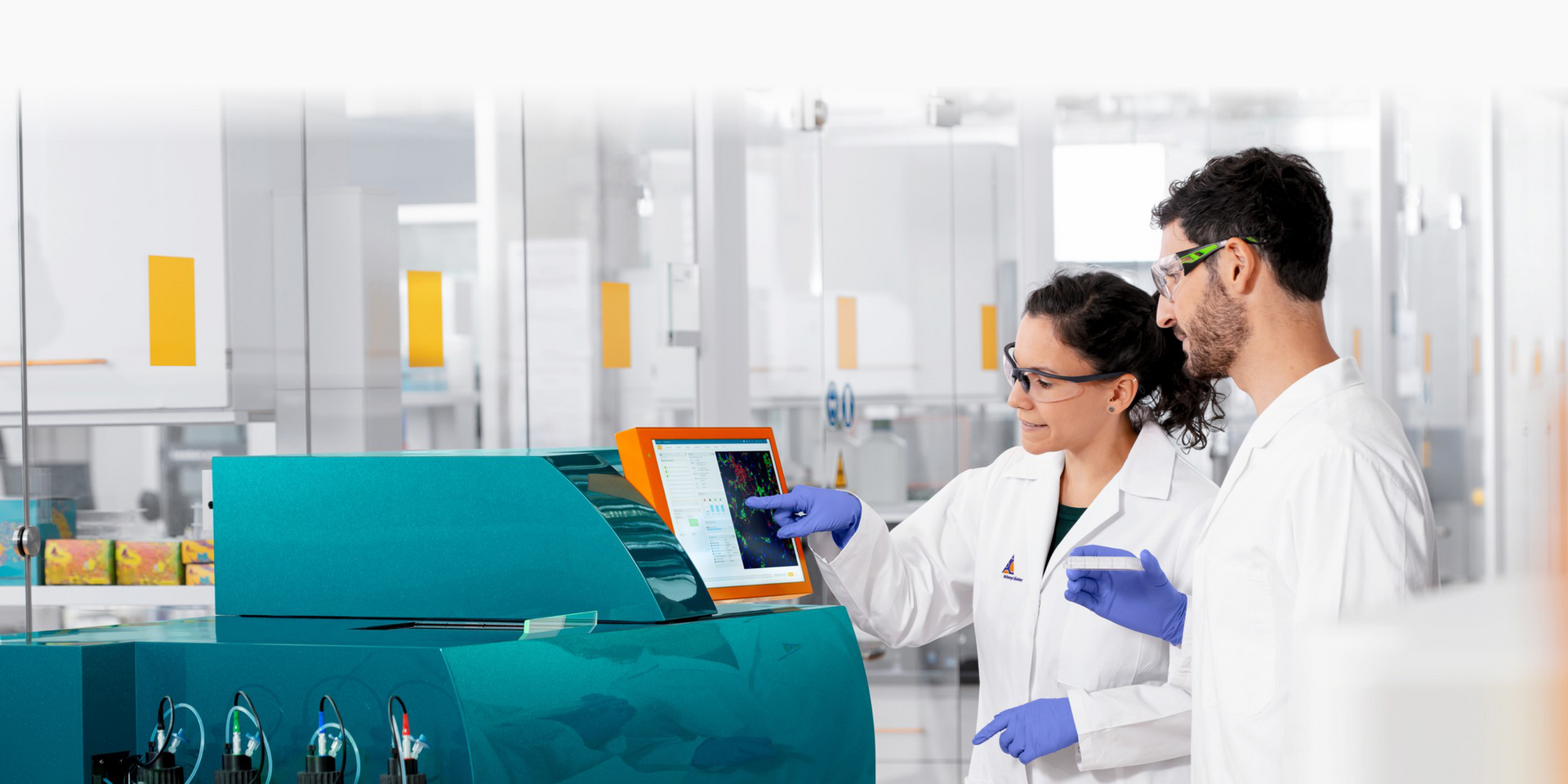

Unveiling the MACSima® Platform through users’ eyes
Dive into the world of spatial biology through the eyes of users who have already embraced the power of the MACSima Platform. Discover firsthand stories as these spatial pioneers share their personal experiences. Explore how the MACSima Platform has transformed their research, unlocked new insights, and accelerated breakthroughs.
Interview with Annelies Van Hemelryk MD, PhD
Spatial investigation of neuroblastoma for preclinical applications
As a clinician, Annelies Van Hemelryk has a special perspective on the importance of research for the future of patient care. With her focus on macrophage niches in neuroblastoma tumors, she is getting closer to making discoveries that could change treatment options for patients in the future.
"I think at some point it would really help in finding new biomarkers, helping us to stratify
patients or to predict a treatment resistance."
Annelies Van Hemelryk MD, PhD
Postdoctoral Researcher
Flanders Institute for Biotechnology (VIB)
UGent Center for Inflammation Research
Ghent, Belgium
Interview with Asst. Prof. Xiang Zheng, PhD
A wide variety of tissues and a plethora of discoveries
Asst. Prof. Xiang Zheng has been using spatial proteomics to study a wide variety of tissue types ranging from tonsil cancer to colorectal cancer. Discovering the hidden stories in the tissue architecture and revealing disease-specific mechanisms has been a highlight for him in his work.
"Usually the tissues are delicate and heterogeneous and MACSima ensures the minimal artefacts and also the minimal protein loss which is very critical to ensure the reliability of the downstream proteome profiling."
Asst. Prof. Xiang Zheng, PhD
Group Leader in Spatial Proteomics
Aarhus University
Aarhus, Denmark
Interview with Marie Laviron, PhD
Spatial multiomics and target discovery
Marie Laviron, PhD has been interested in immunology since she was a teenager. Her passion has led her to discovering niches of macrophages in liver mestases. What an incredible journey she is on applying multiomic imaging to not only see incredible things, but make important discoveries that could bring new strategies for target discovery and patient stratification.
"I work in liver metastases, and you have different growth patterns, so really being able to see the accumulation of some fibroblasts and macrophages that is specific to a growth pattern and getting closer to the clinic, I would say has been really an exciting application for the spatial technology."
Marie Laviron, PhD
Postdoctoral Researcher
Flanders Institute for Biotechnology (VIB)
UGent Center for Inflammation Research
Ghent, Belgium
Interview with Prof. Dr. Giuseppe Castellano
Incredible possibilities for kidney disease research
Prof. Dr. Giuseppe Castellano has seen a lot in his career. He and his team are excited for all the possibilities that spatial biology bring to their kidney research. Especially for drug discovery and RNA detection, the MACSima Platform and RNAsky® Technology open new doors for them.
Prof. Dr. Castellano speaks on the enthusiasm that the MACSima Platform brought his team and how the results were exciting.
"All this is important to have a paper with good quantification, good correlation, so you can make statistics in the easy way. So, I think as first users, we are satisfied by that.”
Prof. Dr. Giuseppe Castellano
Director of Nephrology, Dialysis, and Renal Transplant Unit
Department of Clinical Sciences and Community Health
University of Milan
Milan, Italy
Interview with Dr. Artur Kibler
An immunologist’s important work benefits from a robust system
As a Research Associate at the Institute of Cell Biology (Cancer Research), University Clinic Essen, Dr. Artur Kibler works with the MACSima Platform and MACS® iQ View Software to visualize and learn about cell composition and interactions in the human spleen. Dr. Kibler finds quality of data to be of high importance to his research and gives his opinion on how the MACSima Platform has helped in this.
"Data quality is crucial in order to really make the biological conclusions that we are looking for. And actually Miltenyi has the right systems for this."
Dr. Artur Kibler
Research Associate at the Institute of Cell Biology
University Clinic Essen
Essen, Germany
Interview with Bethany Hunter
A core facility's journey to excellence in spatial biology
Bethany Hunter works as a Research Technician at the core facility within the Medical School of the University of Newcastle, UK. In the laboratory of the core facility, she is responsible for, among other things, the MACSima Platform, which is accessible to various groups within the university environment.
Bethany plays a crucial role in supporting researchers examining diverse human tissues and disease states, building antibody panels, and conducting spatial proteome analyses.
"The images are fantastic - the resolution for such a high-plex instrument is great.
And I just like the accessibility of the machine and how easy it is to use."
Bethany Hunter
Research Technician at Core Facility
The Medical School, Newcastle University
Newcastle, UK
Interview with Birthe Haest
The future is about multiomics
Birthe Haest is a PhD student in the Laboratory of Myeloid Cell Biology in Tissue Homeostasis and Regeneration, led by Prof. Martin Guilliams at the Flanders Institute for Biotechnology (VIB)-UGent Center for Inflammation Research. In 2019, she earned her Master's degree in Biochemistry and Biotechnology from Ghent University. For her master's thesis, she conducted research on macrophage activation in Maynooth, Ireland.
Currently, she is focused on investigating the cell-cell interactions that promote liver regeneration.
“What I love the most about MACSima is the fact that you can combine so many antibodies on one slide.
You can detect so much more, even more than you knew you wanted to know. You can keep exploring the data, looking for new questions.”
Birthe Haest
PhD student
Flanders Institute for Biotechnology (VIB)
UGent Center for Inflammation Research
Ghent, Belgium
Interview with Céline Méhats, PhD
Breaking boundaries with the MACSima Platform
Céline Méhats, PhD, is a senior scientist in the team "From Gametes to Birth", led by Daniel Vaiman at the Institut Cochin, Inserm in Paris, France. Her work focuses on human pregnancy physiology and pathophysiologies. Projects include understanding the interactions between fetal and maternal cells within the human placenta and fetal membranes, deciphering the local, paracrine, and autocrine regulations involved in tolerance at the maternal-fetal interface and in pregnancy outcomes, and investigating epigenetic regulation in the placenta and fetal membranes in normal and pathological pregnancies.
Her ultimate goals are to propose novel avenues in the prevention and/or management of preterm labor, preeclampsia, and other pregnancy-associated pathologies.
“You really helped us to set up an experiment to try on our tissue, on our question, and it was really great.”
Céline Méhats, PhD
Senior Researcher
Institut Cochin, Inserm
Paris, France
Interview with Stefan Eulitz, PhD
No barriers, no limits
Stefan Eulitz, PhD, is Marketing Manager for Spatial Biology at Miltenyi Biotec. With over 10 years of experience in spatial biology in both industry and academia, Stefan seamlessly integrates bench and business knowledge. He acquired extensive expertise in various imaging technologies, as well as in drug target and biomarker discovery.
Stefan joined Miltenyi Biotec in 2015 to contribute to the development of the MACSima Platform as the Deputy Development Program Leader. Currently, he provides support to researchers in adopting Miltenyi Biotec’s spatial biology technologies, spanning from basic research and development to commercial research strategies.
You have previously chosen International as your location.
What do you want to do?