Content overview
Benefits
Compliance
Sterility
Potency
Transparent QC results
Translatability
Further readings
Content
- Benefits
- Compliance
- Sterility
- Potency
- Transparent QC results
- Translatability
- Further readings
Cell therapies such as CAR T cells have not only revolutionized the treatment of oncological diseases, but have also shown great potential in the treatment of autoimmune diseases. As a new generation of cellular therapies is being developed, the demand for high-quality ancillary materials such as cytokines is growing, and regulatory requirements for such raw materials are increasing.
For complete regulatory notes click here.
Content overview
Benefits
Compliance
Sterility
Potency
Transparent QC results
Translatability
Further readings
When choosing ancillary materials for your cellular therapy, there are several things to consider. Ideally, the cytokine of choice should not only have high biological activity and low batch-to-batch variability, but should also be safe and comply with all relevant regulatory guidelines to ensure a smooth license application process. Find more information below on the factors to consider:
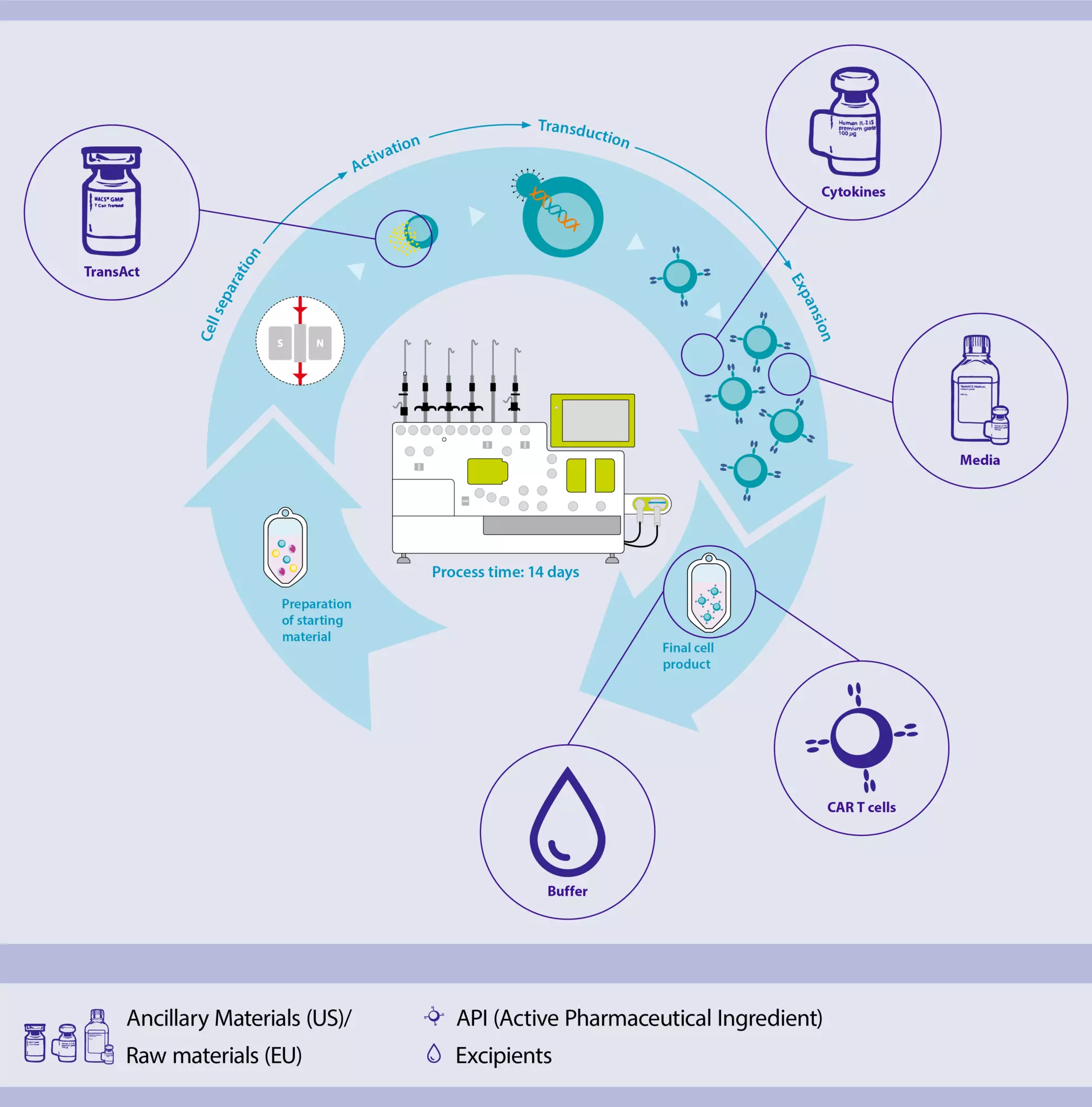
In the context of cell manufacturing, cytokines belong to a group of reagents called ancillary materials (in the US) or raw materials (in the EU). This group of reagents is characterized by the fact that they are not intended to be part of the final product and are only used during production.
The regulatory framework for ancillary materials is defined in the USP <1043> and the Eu. Phr. chapter 5.2.12, and is often complemented by regulations that would usually apply to medicinal products, such as the ICH Q5a for viral safety.
Most regulatory bodies evaluate these reagents on a risk-based approach, and it's ultimately the responsibility of the cell therapy manufacturer to select appropriate ancillary materials.
MACS GMP Cytokines have been developed not only in accordance with the guidelines for ancillary materials, but also in adherence to much stricter guidelines intended for drug products, such as the ICH Q5a (see below). This ensures that cytokines will smoothly pass regulatory review.
Guidelines on ancillary materials
• < USP1043> : Ancillary materials
• EU. PHR. 5.2.12 Raw materials
• ISO20399: Biotechnology - Ancillary materials
Quality management systems
• ISO 9001:2015: Quality management systems
• ISO13485: Medical devices - Quality management systems -
Guidelines for medicinal products
• cGMP guidelines
• ICHQ5A: Viral safety evaluation of biotechnology products derived from cell
• ICHQ5D: Cell substrates used for production of biotechnological/biological products
We put safety first! Learn more about our MACS GMP policy.
Regarding sterility, there is no definitive ruling on ancillary materials. However, both the ISO 20399 and the Phr. Eu 5.2.12 recommend that ancillary materials should be sterile. Otherwise, justification must be provided as to why the risk of non-sterility is acceptable.
To achieve regulatory sterility, an ancillary material must meet two requirements:
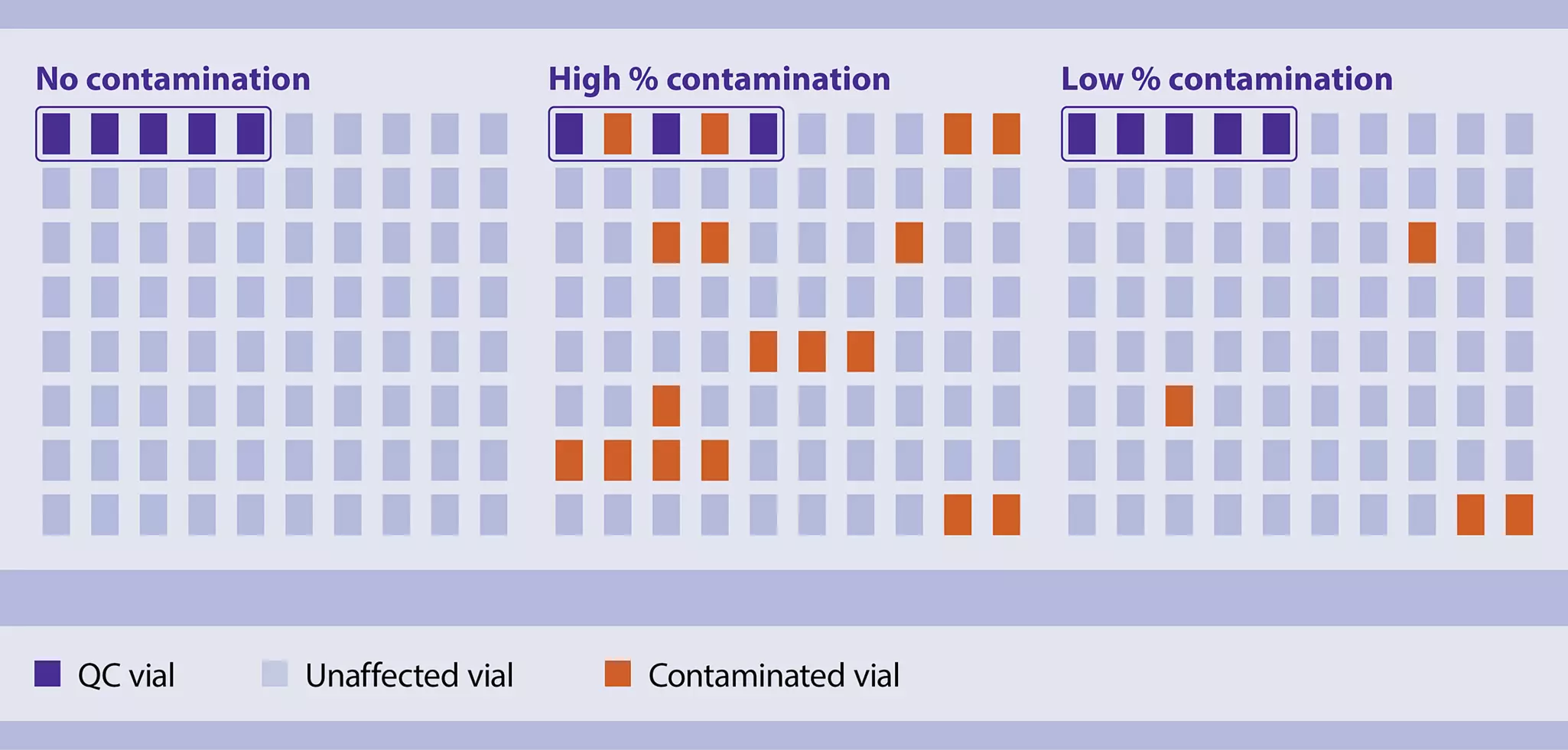
Sterility testing alone is not sufficient because it does not ensure sterility. Tests cover only a small portion of the batch. The frequency of contamination and the size of the QC sample determine how likely it is that contaminations are detected or pass the test unnoticed.
Sterility must be explicitly stated on the respective Certificate of Analysis (CoA) or Product Quality Certificate (PQC) of the ancillary material. A simple bioburden test reported as “no growth” or “sterility (USP71) pass” does not indicate sterility, but only that the sterility or bioburden test was passed.
Watch the webinar below from minute 18:10 for more details on sterility.
Choosing the most suitable clinical-grade cytokines for a particular process is a challenging task, and you should be aware of a number of caveats. In this webinar, you will learn what to look for when translating to GMP-grade cytokines and how to avoid common mistakes.
When measuring the potency of a cytokine, biological activity is the specification of choice. The biological activity of a cytokine reflects its potency to induce a desired biological effect. It is important to note that biological activity varies between different cytokine batches and can only be compared when determined by a calibrated bioassay.
Applying cytokines based on their biological activity rather than their weight offers significant benefits. It will:
1. Increase the reproducibility of cellular manufacturing procedures
2. Prevent cytokine overdosing
Failure to do so can be detrimental to the health of the cells and lead to unnecessarily high project costs.
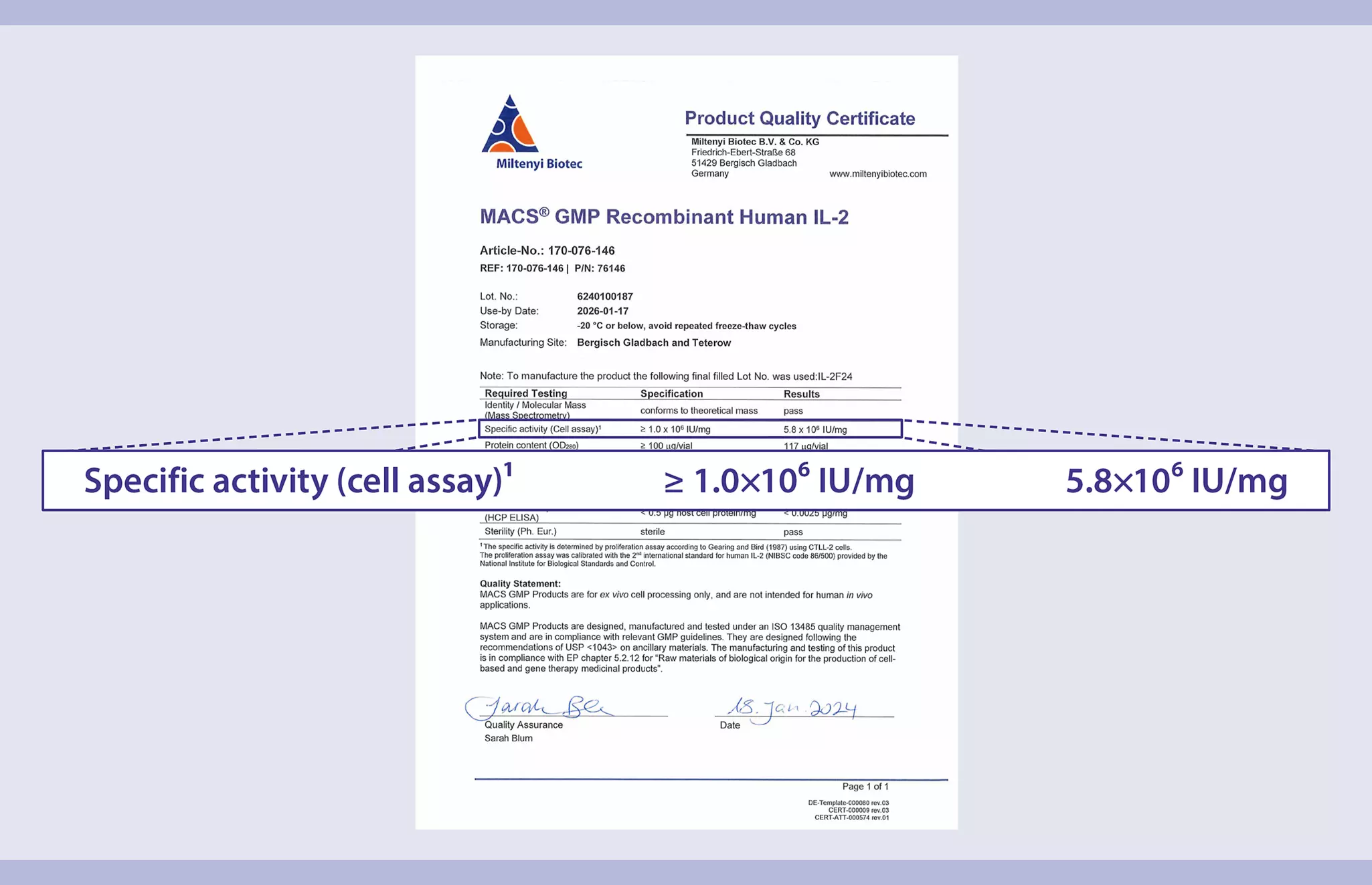
For all MACS GMP Cytokines, the specific biological activity is determined and calibrated with WHO standards for each single production batch. You can easily find it on the PQC in a clear and unambiguous way. There's no need for complicated calculations to convert ED50 values into activities as required by other competitors' products.
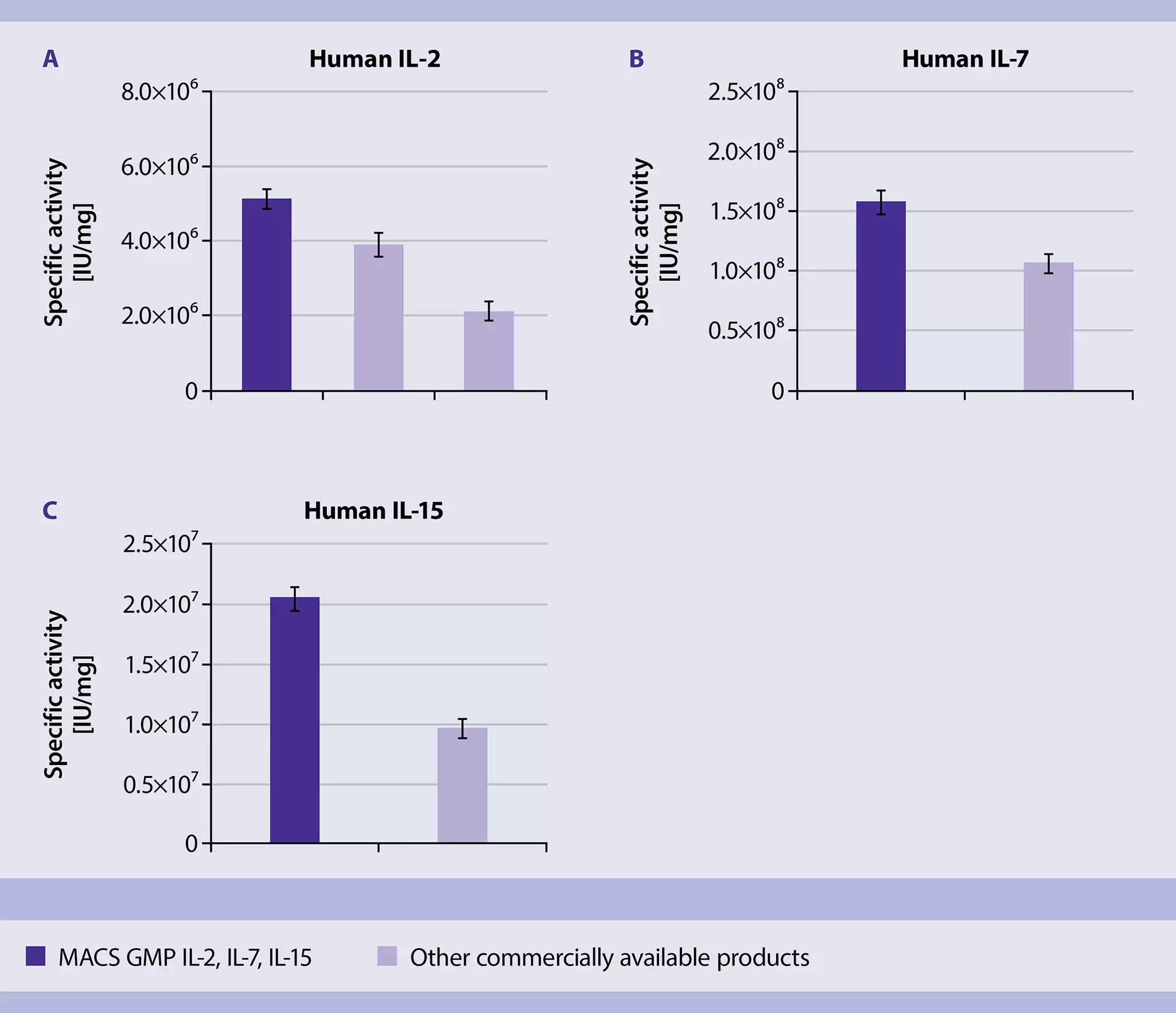
MACS GMP Cytokines show a high potency as demonstrated by various side-by-side tests. Such data can usually be found on the respective product page of the cytokine of interest.
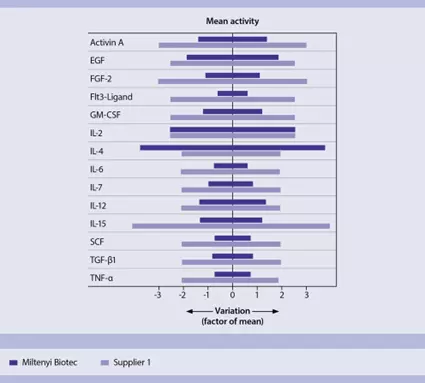
Even more important than high activity, however, is often the consistency of this activity over multiple batches. MACS GMP Cytokines offer a consistently low batch-to-batch variation compared to other commercial products. The graph gives an overview for selected cytokines.
In addition to consistent activity across multiple batches, it is of the utmost importance that the values provided by the respective supplier are accurate.
Read more about reliability of cytokine activity and its potential consequences.
While lot-specific QC results may appear optional, they are, in fact, indispensable. The specifications typically displayed on the PQCs are only upper limits for impurities such as endotoxin or host cell components.
Knowing the exact amount of impurities in different batches can be essential, especially during process development when the critical parameters of a manufacturing process are unknown, or during troubleshooting when each component must be carefully analyzed.
Watch our webinar on clinical-grade cytokines for an in-depth understanding of the relevance of transparent QC results. Skip to minute 24:50 for more.
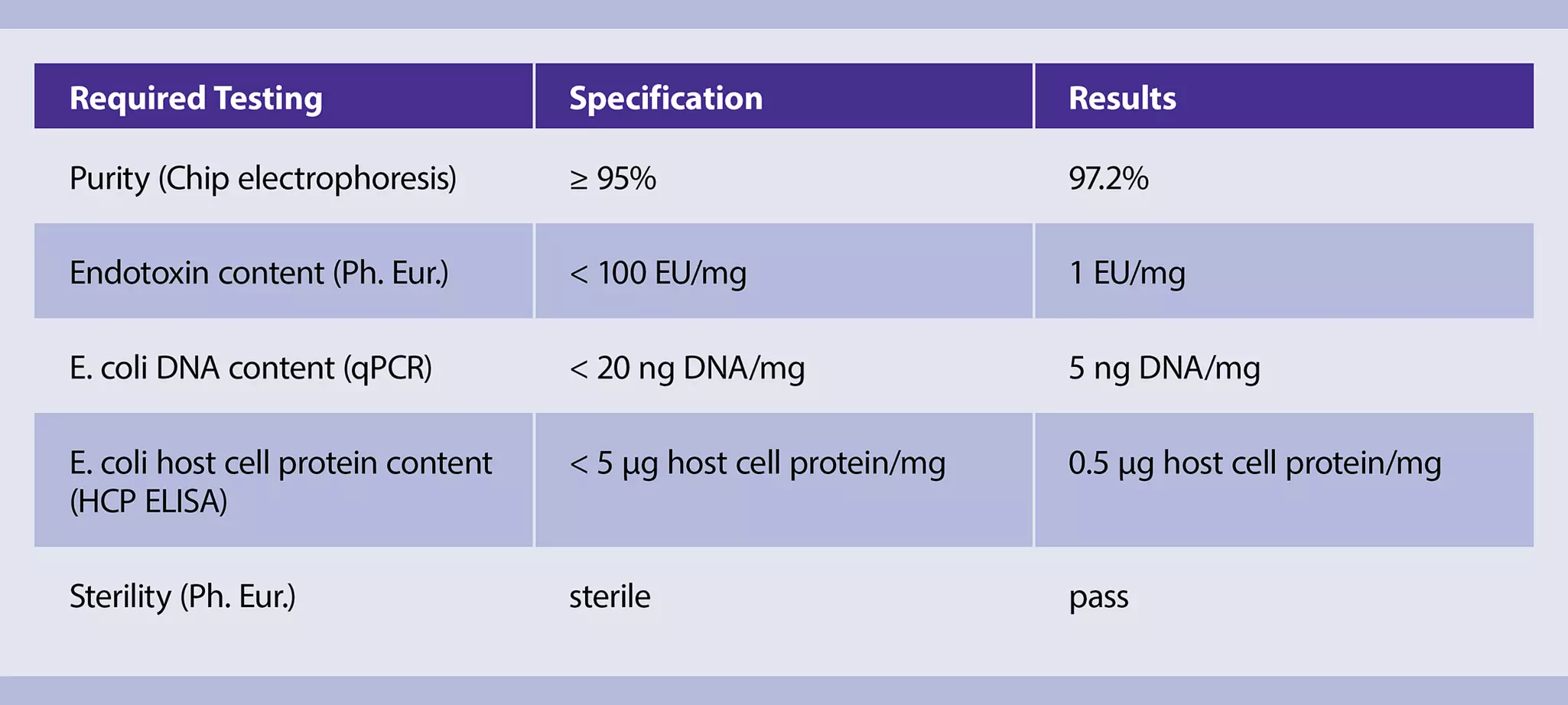
For MACS GMP Cytokines, all QC results are therefore lot-specific. The table displays all QC tests conduced for MACS GMP Cytokines.
Most projects begin as research processes using research use only (RUO) reagents before being transferred to a clinical setting. Ideally, this transition requires as little change as possible, considering that process optimization with GMP reagents is very expensive.
However, many RUO products don't disclose critical parameters needed for proper process optimization. A prime example of such a parameter is the lot-specific cytokine activity. As a result, costly process optimization must be performed with GMP reagents.
When employing the unique combination of MACS Premium-Grade Cytokines and MACS GMP Cytokines, process development can be carried out with MACS Premium-Grade Cytokines as they are provided with lot-specific activity. Therefore, the switch to MACS GMP Cytokines can be made at a later point in time, significantly reducing costs during the development process. Learn more about our effective Premium-Grade Cytokines.
Efficient cellular production requires knowledge of the biological activity of the cytokines employed. This ensures a high degree of reproducibility and keeps costs to a minimum. However, cytokine activity specifications are not necessarily reliable. There are two main causes for such variabilities:
This leads to the question: How reliable are the activity values stated by suppliers? This is critical information when deciding which clinical-grade cytokines to purchase and the quantities needed. You can download our application note on reliability of stated cytokine activities to learn more about this important question.
In summary, the results of measuring cytokine activity can vary depending on the cell line and protocol. They are a oversimplified expression of a complex biological effect. We therefore recommend:
A detailed guide to side-by-side testing can be found in the following application note on side-by-side cytokine comparison.
The shelf life of lyophilized MACS GMP Cytokines at the recommended storage temperature of -20°C is indicated on the respective PQC. However, we test our cytokines much more vigorously.
You can find information about additional storage temperatures and conditions in the following application note on cytokine stability.

21 products found
|
You have previously chosen International as your location.
What do you want to do?
