Recombinant Human IL-12 (interleukin 12) can promote proliferation of NK and T cells, regulates their cytotoxic activity, and can induce TH1 differentiation of T cells. The T cell-stimulating factor IL-12 is a crucial regulator of cell mediated immune responses as it also induces the production of IFN-γ by PBMCs, among other cytokines. The recombinant protein is manufactured for use in differentiation studies, cell culture, and functional assays.


Related products for Human IL-12 (CHO)

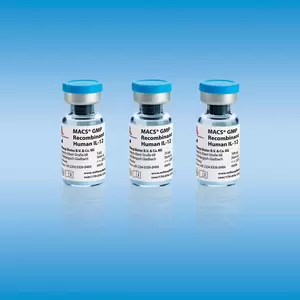
Recombinant Human IL-12 (interleukin 12) can promote proliferation of NK and T cells, regulates their cytotoxic activity, and can induce TH1 differentiation of T cells. The T cell-stimulating factor IL-12 is a crucial regulator of cell mediated immune responses as it also induces the production of IFN-γ by PBMCs, among other cytokines. The recombinant protein is manufactured for use in differentiation studies, cell culture, and functional assays.
Human IL-12 (CHO) can be used for a variety of applications, including:
- In vitro differentiation of naive CD4+ T cells towards TH1 cells.
- In vitro proliferation and stimulation of cytotoxic activity of NK cells and T cells.
Biological activity
Interleukin 12 (IL-12) is a heterodimeric proinflammatory cytokine and a modulator of cell-mediated immunity, which is mainly produced by macrophages, dendritic cells, and B cells. IL-12 stimulates the production and secretion of several cytokines, in particular IFN-γ, by NK cells and T cells, induces proliferation, and enhances the cytotoxic activity within these cell populations. Another important activity of IL-12, acting together with IFN-γ and IL-2, is to drive T helper cell responses toward the TH1 rather than the TH2 phenotype. Moreover, IL-12 is also important in resistance to viral disease and has significant antitumor activity. It has been shown that single chain fusion proteins of naturally occurring heterodimeric cytokines such as IL-12 or IL-23 are bioactive in vitro and in vivo.
Research-grade cytokines are suitable for a wide variety of cell culture applications. They are sterile-filtered prior to lyophilization. Generally, endotoxin levels are <0.1 ng/μg (<1 EU/μg), and purities are >95%. The biological activity is tested in appropriate bioassays.
Premium-grade cytokines offer the convenience of high and well-defined biological activities and allow exact unit dosing for demanding applications. The biological activity is determined after lyophilization and reconstitution, and normalized to WHO/NIBSC standards whenever available. In general, endotoxin levels are <0.01 ng/μg (<0.1 EU/μg), and purities are >97%. Lot-specific activities are stated in the Certificate of Analysis (www. miltenyibiotec.com/certificates).
Human IL-12 (CHO) activity assay. The biological activity of Human IL-12 (CHO) is determined by induction of IFN-γ secretion by PHA-activated T cells.
SDS-PAGE of Human IL-12 (CHO), premium grade under reducing (R) and non-reducing (NR) conditions.
To access a Certificate of Analysis (CoA) follow the link below and enter the specific lot of your product.
Should you wish to request additional documentation, such as a Safety Data Sheet (SDS) in other languages than English or Swedish, an SDS-replacement document, or a Certificate of Origin (CoO), please direct your inquiry to your local technical support team.
- Wulff, H. et al. (2007) Cloning and characterization of an adenoviral vector for highly efficient and doxycycline-suppressible expression of bioactive human single-chain interleukin 12 in colon cancer. BMC Biotechnol. 7: 35
You have previously chosen International as your location.
What do you want to do?