The CD146 MicroBead Kit was developed for the isolation of CD146+ cells. The kit consists of CD146 MicroBeads and FcR Blocking Reagent. The CD146 MicroBeads recognize the human CD146 antigen, also known as MUC18, MCAM, Mel-CAM, and S-Endo-1.


Related products for CD146 MicroBead Kit, human
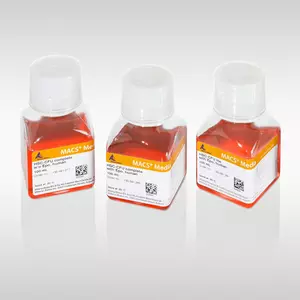
The CD146 MicroBead Kit was developed for the isolation of CD146+ cells. The kit consists of CD146 MicroBeads and FcR Blocking Reagent. The CD146 MicroBeads recognize the human CD146 antigen, also known as MUC18, MCAM, Mel-CAM, and S-Endo-1.
CD146 is a transmembrane glycoprotein belonging to the immunoglobulin superfamily and contains five extracellular immunoglobulin (Ig)-like domains.1,2
CD146 possesses a limited tissue expression distribution, including endothelial cells, smooth muscle cells, pericytes, follicular dendritic cells, melanoma cells, and a subpopulation of activated T lymphocytes.1,3 CD146+ cells isolated from umbilical cord4, lipoaspirate5, dental pulp, or endometrial tissue6, are described to contain cells with clonogenic fibroblastic colony (CFU-F) activity and multilineage differentiation potential, which are often called mesenchymal or marrow stromal cells (MSCs).
CD146 functions as a Ca2+-independent cell adhesion molecule, which is involved in heterophilic cell-cell interactions7, and may be involved in the extravasion and/or homing of activated T cells3. CD146 expression in melanoma is also directly associated with tumor growth and metastasis.7,8
The CD146 MicroBead Kit can be used for:
- isolation of human mesenchymal stromal cells (MSCs) from lipoaspirate and other tissue sources,
- isolation of endothelial cells and pericytes from human endothelial tissue,
- isolation of human umbilical vein endothelial cells (HUVECs) and human umbilical cord perivascular cells (HUCPVCs)4 from umbilical cord vein.
LS or XS Columns.
CD146+ cells were separated from lipoaspirate using the CD146 MicroBead Kit, an LS Column, and a MidiMACS™ Separator. Cells were stained with CD146-APC and CD34-FITC.
- Zannettino, A. C. et al. (2008) Multipotential human adipose-derived stromal stem cells exhibit a perivascular phenotype in vitro and in vivo. J. Cell. Physiol. 214: 413-421
- Xie, S. et al. (1997) Expression of MCAM/MUC18 by human melanoma cell leads to increased tumor growth and metastasis. Cancer Res. 57: 2295-2303
- Yan, X. et al. (2003) A novel anti-CD146 monoclonal antibody, AA98, inhibits angiogenesis and tumor growth. Blood 102: 184-191
- Schwab and Gargett (2005) Reprod. Fertil. Dev. 17: 111-111
- Bardin, N. et al. (2001) Identification of CD146 as a component of the endothelial junction involved in the control of cell-cell cohesion. Blood 98: 3677-3684
- Pickl, W. F. et al. (1997) MUC18/MCAM (CD146), an activation antigen of human T lymphocytes. J Immunol 158: 2107-2115
- Baksh, D. et al. (2007) Comparison of proliferative and multilineage differentiation potential of human mesenchymal stem cells derived from umbilical cord and bone marrow. Stem Cells 25: 1384-1392
- Satyamoorthy, K. et al. (2001) Mel-CAM-specific genetic suppressor elements inhibit melanoma growth and invasion through loss of gap junctional communication. Oncogene 20: 4676-4684
You have previously chosen International as your location.
What do you want to do?