CD4 is an accessory molecule involved in the recognition of foreign antigens in association with MHC class II antigens by T cells. T helper cells and to a lower degree monocytes and dendritic cells express CD4.
The CliniMACS® CD4 Product Line consists of murine anti-CD4 monoclonal antibodies conjugated to superparamagnetic iron dextran particles.
One vial contains 7.5 mL sterile, non-pyrogenic solution.
The performance of the CliniMACS CD4 Product Line depends on the individual separation strategy. For information on respective capacities, refer to the CliniMACS User Manua


Related products for CliniMACS® CD4 Product Line
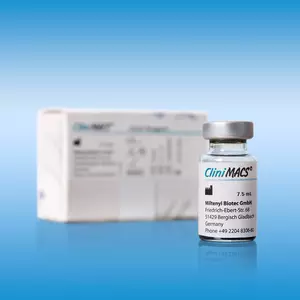
CD4 is an accessory molecule involved in the recognition of foreign antigens in association with MHC class II antigens by T cells. T helper cells and to a lower degree monocytes and dendritic cells express CD4.
The CliniMACS® CD4 Product Line consists of murine anti-CD4 monoclonal antibodies conjugated to superparamagnetic iron dextran particles.
One vial contains 7.5 mL sterile, non-pyrogenic solution.
The performance of the CliniMACS CD4 Product Line depends on the individual separation strategy. For information on respective capacities, refer to the CliniMACS User Manual or contact your local representative.
Please inquire about required CliniMACS System components and accessories.
The CliniMACS CD4 Product Line was developed for the depletion or enrichment of CD4+ cells from human heterogeneous hematologic cell populations in combination with the CliniMACS System.
CD4+ T cells have been used as the basis for various gene therapy approaches, for example, in the human immunodeficiency virus (HIV) setting.1-4
In the allogeneic transplantation setting, CD4+ T cells in donor lymphocyte infusions (DLI) may be capable of mounting GvT responses, concomitantly reducing the risk of GvHD5,6 and reconstituting the recipient’s immune system.7 Additionally, Th2 cells have been successfully used to support stem cell grafts.8
The combined depletion of CD4+ and CD8+ T cells results in a cellular product enriched for cells of the innate immune system, such as TCRγ/δ T cells and subpopulations of NK cells.9,10 The use of such donor innate lymphocyte infusions (DILI) is aiming at improving engraftment and anti-tumor effects, while at the same time reducing the risk of GvHD.
The CliniMACS® System components, including Reagents, Tubing Sets, Instruments, and PBS/EDTA Buffer, are designed, manufactured and tested under a quality system certified to ISO 13485.
In the EU, the CliniMACS System components are available as CE-marked medical devices for their respective intended use, unless otherwise stated. The CliniMACS Reagents and Biotin Conjugates are intended for in vitro use only and are not designated for therapeutic use or direct infusion into patients. The CliniMACS Reagents in combination with the CliniMACS System are intended to separate human cells. Miltenyi Biotec as the manufacturer of the CliniMACS System does not give any recommendations regarding the use of separated cells for therapeutic purposes and does not make any claims regarding a clinical benefit. For the manufacturing and use of target cells in humans the national legislation and regulations - e.g., for the EU the Directive 2004/23/EC ("human tissues and cells"), or the Directive 2002/98/EC ("human blood and blood components") - must be followed. Thus, any clinical application of the target cells is exclusively within the responsibility of the user of a CliniMACS System.
In the US, the CliniMACS CD34 Reagent System, including the CliniMACS Plus Instrument, CliniMACS CD34 Reagent, CliniMACS Tubing Sets TS and LS, and the CliniMACS PBS/EDTA Buffer, is FDA approved as a Humanitarian Use Device (HUD), authorized by U.S. Federal law for use in the treatment of patients with acute myeloid leukemia (AML) in first complete remission. The effectiveness of the device for this indication has not been demonstrated. Other products of the CliniMACS Product Line are available for use only under an approved Investigational New Drug (IND) application, Investigational Device Exemption (IDE) or FDA approval.
CR/GMP products are for ex vivo cell processing only, and are not intended for human in vivo applications. CR/GMP products are designed, manufactured and tested under an ISO 13485 quality management system and are in compliance with relevant GMP guidelines. They are designed following the recommendations of USP <1043> on ancillary materials. The manufacturing and testing of CR/GMP products of biological origin are in compliance with EP chapter 5.2.12 for “Raw materials of biological origin for the production of cell-based and gene therapy medicinal products”.
In Canada, any clinical application of the output product must be performed in accordance with applicable Canadian legislation and regulations that pertain to cellular therapies (e.g. for advanced cellular therapies, the applicable sections of the Food and Drugs Act and the Food and Drug Regulations).
Flow cytometric analysis of CD4–enriched cells using CliniMACS CD4 System.
Flow cytometric analysis of CD4–depleted cells using the CliniMACS CD4 System.
To access a Certificate of Analysis (CoA) follow the link below and enter the specific lot of your product.
Should you wish to request additional documentation, such as a Safety Data Sheet (SDS) in other languages than English or Swedish, an SDS-replacement document, or a Certificate of Origin (CoO), please direct your inquiry to your local technical support team.
- Bernstein, W. B. et al. (2004) Immune reconstitution following autologous transfers of CD3/CD28 stimulated CD4+ T cells to HIV-infected persons. Clin Immunol 111: 262-274
- Lamb, L. S. et al. (2001) Human gammadelta+ T lymphocytes have in vitro graft vs leukemia activity in the absence of an allogeneic response. Bone Marrow Transplant. 27: 601-606
- Alyea, E. P. et al. (1998) Toxicity and efficacy of defined doses of CD4+ donor lymphocytes for treatment of relapse after allogeneic bone marrow transplant. Blood 91: 3671-3680
- Levine, B. L. et al. (2002) Adoptive transfer of costimulated CD4+ T cells induces expansion of peripheral T cells and decreased CCR5 expression in HIV infection. Nat Med 8: 47-53
- Davis, B. M. et al. (2004) In vivo selection for human and murine hematopoietic cells transduced with a therapeutic MGMT lentiviral vector that inhibits HIV replication. Mol. Ther. 9: 160-172
- Smetak, M. et al. (2008) Clinical-scale single-step CD4(+) and CD8(+) cell depletion for donor innate lymphocyte infusion (DILI). Bone Marrow Transplant. 41: 643-650
- Klyuchnikov et al. (2010) Bone Marrow Transplant. 45 (suppl. 2): P956
- Bellucci, R. et al. (2002) Immunologic effects of prophylactic donor lymphocyte infusion after allogeneic marrow transplantation for multiple myeloma. Blood 99 (12): 4610-4617
- Levine, B. L. et al. (2006) Gene transfer in humans using a conditionally replicating lentiviral vector. Proc. Natl. Acad. Sci. U.S.A. 103: 17372-17377
- Fowler, D. H. et al. (2004) Immunoablative reduced-intensity stem cell transplantation: potential role of donor Tʜ2 and Tc2 cells. Semin. Oncol. 31: 56-67
You have previously chosen International as your location.
What do you want to do?