

Synonyms: Fex, GPR49, GPR67, GRP49, HG38
RECOMBINANT
- Clone:
- REA762 | DA03-22H2.8
- Type of antibody:
- Primary antibodies, Recombinant antibodies
- Isotype:
- recombinant human IgG1
- Applications:
- FC Glossary
- Select a conjugate:
- Select a size:


Other sizes
Related products for LGR5 Antibody, anti-human, REAfinity™

Flow cytometry applications
APC
APC-Vio 770
Biotin
FITC
PE
PE-Vio 615
PE-Vio 770
PerCP-Vio 700
Vio Bright B515
Vio Bright R720
Vio Bright V423
Recommended dilution:
1:50
Remark:
The antibody is suited for staining of formaldehyde-fixed cells.
Data source:
Miltenyi Biotec
Conjugate:
APC
Used products:
130-112-438, 130-112-510
Description:
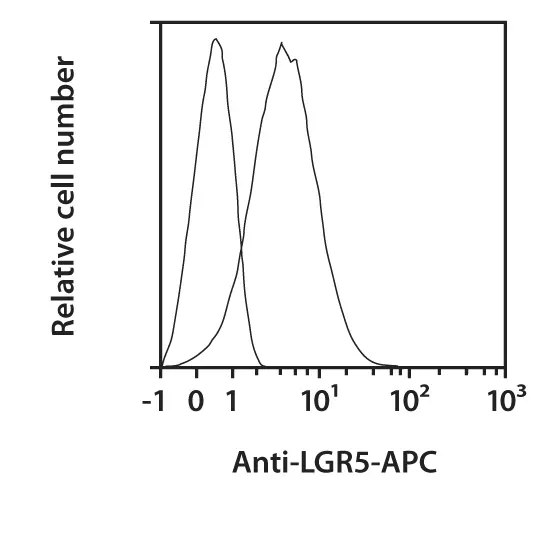
Human LGR5 transfected and untransfected 1881 cells (left peak) were stained with Anti-LGR5 antibodies. Flow cytometry was performed using the MACSQuant® Analyzer. The Tandem Signal Enhancer has been used to increase binding specificity of tandem-dye–conjugated antibodies. Cell debris and dead cells were excluded from the analysis based on scatter signals and propidium iodide fluorescence or 4',6-diamidino-2-phenylindole (DAPI) fluorescence, as in the case of tandem conjugates.
Specifications for LGR5 Antibody, anti-human, REAfinity™
Overview
Clone REA762 recognizes the human leucine-rich repeat-containing G-protein–coupled receptor 5 (LGR5) but not with its close homologues LGR4 or LGR6. LGR5 associates with Wnt-receptors and act as R-spondin receptor thereby playing a central role in the modulation of Wnt/β-catenin signaling in normal and neoplastic stem cells. Initially described as a highly specific marker for stem cells in the small intestine, colon, hair follicle, stomach, and during kidney development, LGR5 positive cells were also shown to be crucial during the development and progression of cancer. It was shown that LGR5 positive crypt stem cells are the cells-of-origin in intestinal cancer and that CSCs in human colorectal cancer can be identified and isolated based on LGR5 expression.
Additional information: Clone REA762 displays negligible binding to Fc receptors.
Fex, GPR49, GPR67, GRP49, HG38
Detailed product information
Technical specifications
Clone
REA762
Clonality
monoclonal
Isotype
recombinant human IgG1
Isotype control
REA Control Antibody (S), human IgG1
Host
human cell line
Type of antibody
Primary antibodies, Recombinant antibodies
Species reactivity
human
Antigen
LGR5
Molecular mass of antigen [kDa]
98
Distribution of antigen
stem cells, cancer stem cells
Entrez Gene ID
RRID
AB_2652610, AB_2652615, AB_2652608, AB_2652609, AB_2652619, AB_2652612, AB_2652613, AB_2652618, AB_2652617, AB_2921988, AB_2652611, AB_2652616, AB_2652614, AB_2921985
Recombinant antibodies at Miltenyi Biotec
As an innovation-powered company with a commitment to quality and excellence, Miltenyi Biotec applies cutting-edge methods to discover and develop newer and better antibodies to satisfy both market demand and regulatory requirements.
The Miltenyi way of generating best-in-class antibodies and antibody conjugates
At Miltenyi Biotec, we opt for recombinant antibodies, which enable sequence verification and optimization for lot-to-lot consistency, making them superior to hybridoma-based antibodies.
Infusing our unique expertise
Recombinants are the result of combining genetic material from different immunized animals, and using display technologies to screen in-house antibody libraries for the best antibodies. Additional analyses on existing hybridoma-based antibodies can also give rise to sequences contributing to novel recombinants.
Maximizing value for your research
By further re-engineering these antibody sequences, we can precisely control their properties to achieve the following benefits:
reduce undesirable binding to Fc gamma receptors,
- eliminate destabilizing amino acid motifs,
- increase specific bonding affinity for stronger, more accurate targeting, and
- optimize fluorochrome conjugation for brighter and clearer signals.
In a final step, by synthesizing and cloning the resulting gene sequence, we achieve an expression vector that develops a cell line, which in turn produces a special recombinant antibody.
Better science with quality antibodies
Already in 2015, 100 of the world’s leading scientists collectively called for better standards and reproducibility in antibody production, proposing recombinant antibodies to circumvent variability (Baker, M. Reproducibility crisis: Blame it on the antibodies. Nature 521, 274–276 (2015). https://doi.org/10.1038/521274a). Moreover, by applying reverse engineering, which is encouraged by the EU Directive 2016/943 r, Miltenyi Biotec acts “[i]n the interest of innovation and fostering competition…” (§16).
Product data and images for LGR5 Antibody, anti-human, REAfinity™
Figure 1
Human LGR5 transfected and untransfected 1881 cells (left peak) were stained with Anti-LGR5 antibodies. Flow cytometry was performed using the MACSQuant® Analyzer. The Tandem Signal Enhancer has been used to increase binding specificity of tandem-dye–conjugated antibodies. Cell debris and dead cells were excluded from the analysis based on scatter signals and propidium iodide fluorescence or 4',6-diamidino-2-phenylindole (DAPI) fluorescence, as in the case of tandem conjugates.
Resources for LGR5 Antibody, anti-human, REAfinity™
Certificates
To access a Certificate of Analysis (CoA) follow the link below and enter the specific lot of your product.
Should you wish to request additional documentation, such as a Safety Data Sheet (SDS) in other languages than English or Swedish, an SDS-replacement document, or a Certificate of Origin (CoO), please direct your inquiry to your local technical support team.
 Powered by Bioz
You have previously chosen International as your location.
What do you want to do?