Recombinant human FGF-2 (FGF-basic or bFGF) is used for the cultivation of undifferentiated embryonic and induced pluripotent stem cells. The basic fibroblast growth factor (FGF) also promotes the growth of a variety of cell types belonging to the mesodermal, ectodermal, and endodermal lineage. Thus, it has implications for diverse processes, such as angiogenesis, tissue repair, neuronal functions or embryogenesis.


Related products for Human FGF-2


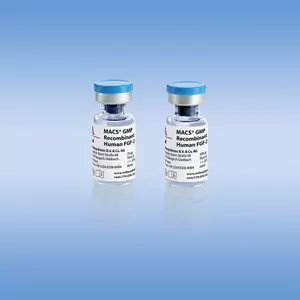
Recombinant human FGF-2 (FGF-basic or bFGF) is used for the cultivation of undifferentiated embryonic and induced pluripotent stem cells. The basic fibroblast growth factor (FGF) also promotes the growth of a variety of cell types belonging to the mesodermal, ectodermal, and endodermal lineage. Thus, it has implications for diverse processes, such as angiogenesis, tissue repair, neuronal functions or embryogenesis.
Human FGF-2 can be used for a variety of applications, including:
- Stimulation of proliferation and differentiation of several cell types, such as mesenchymal stromal cells, neural cells, and endothelial cells.
- Long-term maintenance and propagation of undifferentiated embryonic and induced pluripotent stem cells.
- Differentiation of neural cells starting from embryonic and induced pluripotent stem cell cultures.
basic FGF, HBGF-2
Biological activity
Fibroblast growth factor 2 (FGF-2), also termed fibroblast growth factor basic (FGF-b) or basic FGF (bFGF), belongs to the FGF family. It functions as a wide-spectrum mitogenic, angiogenic, and neurotrophic factor and stimulates the proliferation of a wide variety of cells including mesenchymal, neuroectodermal, and endothelial cells. FGF-2 has been implicated in a multitude of physiological and pathological processes, including limb development, angiogenesis, wound healing, and tumor growth.
Research-grade cytokines are suitable for a wide variety of cell culture applications. They are sterile-filtered prior to lyophilization. Generally, endotoxin levels are <0.1 ng/μg (<1 EU/μg), and purities are >95%. The biological activity is tested in appropriate bioassays.
Premium-grade cytokines offer the convenience of high and well-defined biological activities and allow exact unit dosing for demanding applications. The biological activity is determined after lyophilization and reconstitution, and normalized to WHO/NIBSC standards whenever available. In general, endotoxin levels are <0.01 ng/μg (<0.1 EU/μg), and purities are >97%. Lot-specific activities are stated in the Certificate of Analysis (www. miltenyibiotec.com/certificates).
Human FGF-2 activity assay. The biological activity of Human FGF-2, premium grade was determined by proliferation assay using 3T3 cells.
In vitro generation of primary mouse neurospheres. A single-cell suspension was prepared from mouse brain using the Neural Tissue Dissociation Kit (P) and the gentleMACS™ Dissociator. Isolated Prominin-1+ cells were cultivated for 7 days in MACS NeuroMedium containing MACS NeuroBrew, Human FGF-2 (20 ng/mL), and Human EGF (20 ng/mL).
SDS-PAGE of Human FGF-2, premium grade under reducing (R) and non-reducing (NR) conditions.
Human FGF-2 biological activity. Activity of Human FGF-2, premium grade (red bar) was compared to another commercially available product (black bar).
Mass spectrometry analysis (ESI-MS) of Human FGF-2, premium grade. The peaks correspond to the mature form of human FGF-2, both with the N-terminal proline (146 amino acids) and without the N-terminal proline (145 amino acids), respectively.
To access a Certificate of Analysis (CoA) follow the link below and enter the specific lot of your product.
Should you wish to request additional documentation, such as a Safety Data Sheet (SDS) in other languages than English or Swedish, an SDS-replacement document, or a Certificate of Origin (CoO), please direct your inquiry to your local technical support team.
- Zhu, X. et al. (2015) All-Trans Retinoic Acid-Induced Deficiency of the Wnt/β-Catenin Pathway Enhances Hepatic Carcinoma Stem Cell Differentiation. PLoS One 10 (11): e0143255
- van Tienen, F. et al. (2019) Healthy, mtDNA-mutation free mesoangioblasts from mtDNA patients qualify for autologous therapy. Stem Cell Res Ther. 10 (1): 405
- Borchin, B. et al. (2013) Derivation and FACS-mediated purification of PAX3+/PAX7+ skeletal muscle precursors from human pluripotent stem cells. Stem Cell Reports 1: 620-631
- Lamanuzzi, A. et al. (2016) Role of erythropoietin in the angiogenic activity of bone marrow endothelial cells of MGUS and multiple myeloma patients. Oncotarget. 7 (12): 14510-14521
- Margariti A. et al. (2012) Direct reprogramming of fibroblasts into endothelial cells capable of angiogenesis and reendothelialization in tissue-engineered vessels. Proc. Natl. Acad. Sci. U.S.A. 109: 13793-13798
- Lehnen, D. et al. (2017) IAP-Based Cell Sorting Results in Homogeneous Transplantable Dopaminergic Precursor Cells Derived from Human Pluripotent Stem Cells. Stem Cell Reports 9 (4): 1207-1220
- Barral, S. et al. (2013) Efficient neuronal in vitro and in vivo differentiation after immunomagnetic purification of mESC derived neuronal precursors. Stem Cell Res. 10 (2): 133-46
- Golebiewska, A. et al. (2013) Side population in human glioblastoma is non-tumorigenic and characterizes brain endothelial cells. Brain 136: 1462-1475
- Koch, C. et al. (2020) Characterization of circulating breast cancer cells with tumorigenic and metastatic capacity. EMBO Mol. Med. 12 (9): e11908
- Eberle, D. et al. (2011) Increased integration of transplanted CD73-positive photoreceptor precursors into adult mouse retina. Invest. Ophthalmol. Vis. Sci. 52 (9): 6462-6471
- Ferreras, C. et al. (2019) Chondral Differentiation of Induced Pluripotent Stem Cells Without Progression Into the Endochondral Pathway. Front Cell Dev Biol. 7: 270
- Goikuria, H. et al. (2018) Characterization of Carotid Smooth Muscle Cells during Phenotypic Transition. Cells 7 (3): 23
- Sriram, K. et al. (2019) Detection and Quantification of GPCR mRNA: An Assessment and Implications of Data from High-Content Methods. ACS Omega 4 (16): 17048-17059
- Barroso-delJesus, A. et al. (2011) The nodal inhibitor lefty is negatively modulated by the microRNA miR-302 in human embryonic stem cells. FASEB J. 25 (5): 1497-1508
- Smit, D. J. et al. (2020) High Sensitivity of Circulating Tumor Cells Derived from a Colorectal Cancer Patient for Dual Inhibition with AKT and mTOR Inhibitors. Cells 9 (9): 2129
- Robinson, C. J. and Gaines-Das, R. (1994) The international standard for basic fibroblast growth factor (FGF-2); comparison of candidate preparations by in vitro bioassays and immunoassays. Growth Factors 11: 9-16
You have previously chosen International as your location.
What do you want to do?