The CD34 antigen is a single transmembrane glycoprotein that is mainly expressed on human hematopoietic stem and progenitor cells but is also present on endothelial progenitor cells.
The CD34 antigen is involved in cell adhesion and is thought to function as a signaling molecule.
The CliniMACS® CD34 Product Line consists of murine anti-CD34 monoclonal antibodies conjugated to superparamagnetic iron dextran particles.
One vial contains 7.5 mL sterile, non-pyrogenic solution.
The performance of the CliniMACS CD34 Product Line depends on the individual separation strate


Related products for CliniMACS® CD34 Product Line

The CD34 antigen is a single transmembrane glycoprotein that is mainly expressed on human hematopoietic stem and progenitor cells but is also present on endothelial progenitor cells.
The CD34 antigen is involved in cell adhesion and is thought to function as a signaling molecule.
The CliniMACS® CD34 Product Line consists of murine anti-CD34 monoclonal antibodies conjugated to superparamagnetic iron dextran particles.
One vial contains 7.5 mL sterile, non-pyrogenic solution.
The performance of the CliniMACS CD34 Product Line depends on the individual separation strategy. For information on respective capacities, refer to the CliniMACS User Manual or contact your local representative.
Please inquire about required CliniMACS System components and accessories.
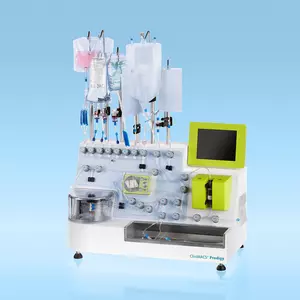
The CliniMACS CD34 Product Line was developed for the enrichment of CD34+ cells from human heterogeneous hematologic cell populations in combination with the CliniMACS System.
CD34 enrichment of hematopoietic progenitor cells (HPC) is performed to provide an allogeneic stem cell graft highly purified for CD34+ cells and depleted of unwanted cells.
Highly purified CD34+ enriched stem cell grafts were reportedly used for HLA mismatched (MMUD/MMRD) and haploidentical hematopoietic stem cell transplantations (haplo-HSCT)1-3, as well as for HLA identical sibling (MRD) and matched unrelated donor (MUD) cell transplantations4–7. To overcome poor graft function (PGF) after HSCT CD34+ selected stem cell boosts (SCB) were utilized in pediatrics and adults8–11. T cell depletion (TCD) facilitated by CD34+ cell enrichment is also described in combination with reduced intensity conditioning (RIC)12 and umbilical cord blood transplantation13,14. In addition outcomes of TCD in both malignant1,4,6 and non-malignant diseases have been published7,15. Different methods of graft manipulation and future prospects of ex vivo TCD in allogeneic HSCT have been reviewed27.
In autologous transplantation CD34+ progenitor cells can be enriched in order to passively remove tumor cells from the graft (tumor cell purging)16,17. Enriched CD34+ cells have also been used to deplete auto-reactive cells from stem cell grafts for refractory autoimmune diseases, such as multiple sclerosis, severe scleroderma, systemic lupus erythematosus, and systemic sclerosis18-22. Genetically engineered hematopoietic stem cells for clinical gene therapy have been studied for over a decade and early limitations have been addressed23. The first ex vivo stem cell gene therapy for patients with ADA-SCID are commercially available autologous CD34+ enriched cells transduced to express adenosine deaminase24-26.
The CliniMACS® System components, including Reagents, Tubing Sets, Instruments, and PBS/EDTA Buffer, are designed, manufactured and tested under a quality system certified to ISO 13485.
In the EU, the CliniMACS System components are available as CE-marked medical devices for their respective intended use, unless otherwise stated. The CliniMACS Reagents and Biotin Conjugates are intended for in vitro use only and are not designated for therapeutic use or direct infusion into patients. The CliniMACS Reagents in combination with the CliniMACS System are intended to separate human cells. Miltenyi Biotec as the manufacturer of the CliniMACS System does not give any recommendations regarding the use of separated cells for therapeutic purposes and does not make any claims regarding a clinical benefit. For the manufacturing and use of target cells in humans the national legislation and regulations - e.g., for the EU the Directive 2004/23/EC ("human tissues and cells"), or the Directive 2002/98/EC ("human blood and blood components") - must be followed. Thus, any clinical application of the target cells is exclusively within the responsibility of the user of a CliniMACS System.
In the US, the CliniMACS CD34 Reagent System, including the CliniMACS Plus Instrument, CliniMACS CD34 Reagent, CliniMACS Tubing Sets TS and LS, and the CliniMACS PBS/EDTA Buffer, is FDA approved as a Humanitarian Use Device (HUD), authorized by U.S. Federal law for use in the treatment of patients with acute myeloid leukemia (AML) in first complete remission. The effectiveness of the device for this indication has not been demonstrated. Other products of the CliniMACS Product Line are available for use only under an approved Investigational New Drug (IND) application, Investigational Device Exemption (IDE) or FDA approval.
CR/GMP products are for ex vivo cell processing only, and are not intended for human in vivo applications. CR/GMP products are designed, manufactured and tested under an ISO 13485 quality management system and are in compliance with relevant GMP guidelines. They are designed following the recommendations of USP <1043> on ancillary materials. The manufacturing and testing of CR/GMP products of biological origin are in compliance with EP chapter 5.2.12 for “Raw materials of biological origin for the production of cell-based and gene therapy medicinal products”.
In Canada, any clinical application of the output product must be performed in accordance with applicable Canadian legislation and regulations that pertain to cellular therapies (e.g. for advanced cellular therapies, the applicable sections of the Food and Drugs Act and the Food and Drug Regulations).
Flow cytometric analysis of CD34–enriched cells from HPC, Apheresis product using the CliniMACS CD34 Reagent System. Cells are gated on viable CD45+ cells.
To access a Certificate of Analysis (CoA) follow the link below and enter the specific lot of your product.
Should you wish to request additional documentation, such as a Safety Data Sheet (SDS) in other languages than English or Swedish, an SDS-replacement document, or a Certificate of Origin (CoO), please direct your inquiry to your local technical support team.
- Mainardi, C. et al. (2018) CD34+ selected stem cell boosts can improve poor graft function after paediatric allogeneic stem cell transplantation. Br J Haematol 180 (31): 90-99
- Atkins, H. L. et al. (2016) Immunoablation and autologous haemopoietic stem-cell transplantation for aggressive Multiple sclerosis: A multicentre single-group phase 2 trial. Lancet 388 (10044): 576-585
- Tsai, S. B. et al. (2018) Reduced-intensity allogeneic transplant for acute myeloid leukemia and myelodysplastic syndrome using combined CD34-selected haploidentical graft and a single umbilical cord unit compared with matched unrelated donor stem cells in older adults. Biol. Blood Marrow Transplant. 24 (5): 997-1004
- Yahng, S. A. et al. (2014) Influence of ex vivo purging with CliniMACS CD34+ selection on outcome after autologous stem cell transplantation in non-hodgkin lymphoma. Br J Haematol 164 (4): 555-564
- Sullivan, K. M. et al. (2018) Myeloablative Autologous Stem-Cell Transplantation for Severe Scleroderma. N. Engl. J. Med. 378 (1): 35-47
- Stirnadel-Farrant, H. et al. (2018) Gene therapy in rare diseases: the benefits and challenges of developing a patient-centric registry for Strimvelis in ADA-SCID. Orphanent J Rare Dis 13 (1): 49
- Pasquini, M. C. et al. (2012) Comparative outcomes of donor graft CD34+ selection and immune suppressive therapy as graft-versus-host disease prophylaxis for patients with acute myeloid leukemia in complete remission undergoing HLA-matched sibling allogeneic hematopoietic cell transplantation. J. Clin. Oncol. 30 (26): 3194-3201
- Psatha, N. et al. (2016) Optimizing autologous cell grafts to improve stem cell gene therapy. Exp. Hematol. 44 (7): 528-539
- Martelli, M. F. et al. (2014) "Designed" grafts for HLA-haploidentical stem cell transplantation. Blood 123 (7): 967-973
- Chandra, S. et al. (2018) Post-transplant CD34+ selected stem cell "boost" for mixed chimerism after reduced-intensity conditioning hematopoietic stem cell transplantation in children and young adults with primary immune deficiencies. Biol. Blood Marrow Transplant. 24 (7): 1527-1529
- Ciurea, S. O. et al. (2010) Reduced-intensity conditioning using Fludarabine, Melphalan and Thiotepa for adult patients undergoing haploidentical SCT. Bone Marrow Transplant. 45 (3): 429-436
- Alchi, B. et al. (2013) Autologous Haematopoietic Stem Cell Transplantation for Systemic Lupus Erythe-matosus: Data from the European Group for Blood and Marrow Transplantation registry. Lupus 22 (3): 245-253
- van Besien, K. and Childs, R. (2016) Haploidentical cord transplantation - the best of both worlds. Semin. Hematol. 53 (4): 257-266
- Montoro, J. et al. (2016) Advances in haploidentical stem cell transplantation for hematologic malignancies. Leuk Lymphoma 57 (8): 1766-1775
- Teltschik, H. M. et al. (2016) Treatment of graft failure with TNI-based reconditioning and haploidentical stem cells in paediatric patients. Br J Haematol 175 (1): 115-122
- Keever-Taylor, C. A. et al. (2017) Manufacture of autologous CD34+ selected grafts in the NIAID-sponsored HALT-MS and SCOT multicenter clinical trials for autoimmune diseases. Biol. Blood Marrow Transplant. 23 (9): 1463-1472
- Mehta, P. A. et al. (2017) Radiation-free, alternative-donor HCT for Fanconi anemia patients: results from a prospective multi-institutional study. Blood 129 (16): 2308-2315
- Cho, C. et al. (2017) Long-term prognosis for 1-year relapse-free survivors of CD34+ cell-selected allogeneic hematopoietic stem cell transplantation: a landmark analysis. Bone Marrow Transplant. 52 (12): 1629-1636
- Shah, G. L. et al. (2018) Impact of toxicity on survival for older adult patients after CD34 selected allogeneic hematopoietic stem cell transplantation. Biol. Blood Marrow Transplant. 24 (1): 142-149
- Aiuti, A. et al. (2009) Gene therapy for immunodeficiency due to adenosine deaminase deficiency. N. Engl. J. Med. 360 (5): 447-458
- Saad, A. and Lamb, L. S. (2017) Ex vivo T-cell depletion in allogeneic hematopoietic stem cell transplant: past, present and future. Bone Marrow Transplant. 52 (9): 1241-1248
- Haen, S. P. et al. (2015) Poor graft function can be durably and safely improved by CD34+-selected stem cell boosts after allogeneic unrelated matched or mismatched hematopoietic cell transplantation. J. Cancer Res. Clin. Oncol. 141 (12): 2241-2251
- Berger, M. D. et al. (2015) CD34+ selected versus unselected autologous stem cell transplantation in patients with advanced-stage mantle cell and diffuse large B-cell lymphoma. Leuk. Res. 39 (6): 561-567
- Cicalese, M. P et al. (2016) Update on the safety and efficacy of retroviral gene therapy for immunodeficiency due to adenosine deaminase deficiency. Blood 128 (1): 45-54
- Ghobadi, A. et al. (2017) Fresh or cryopreserved CD34+ selected mobilized peripheral blood stem and progenitor cells for the treatment of poor graft function after allogeneic hematopoietic cell transplantation. Biol. Blood Marrow Transplant. 23 (7): 1072-1077
- Oliveira, M. C. et al. (2016) Does ex vivo CD34+ positive selection influence outcome after autologous hematopoietic stem cell transplantation in systemic sclerosis patients? Bone Marrow Transplant. 51 (4): 501-505
- Gilman, A. L. et al. (2017) Alternative donor hematopoietic stem cell transplantation for sickle cell disease. Blood Adv 1 (16): 1215-1223
You have previously chosen International as your location.
What do you want to do?