StemMACS HSC-CFU Media have been developed for the expansion of CD34+ cells and to assess the differentiation potential of human hematopoietic stem and progenitor cells as Colony Forming Units (CFU). They are ideally suited for use with
- unseparated blood3, bone marrow4, or fetal liver cells
- sorted cell populations1,4
- or ES and iPS cell-derived hematopoietic precursors2


Related products for StemMACS™ HSC-CFU Media, human


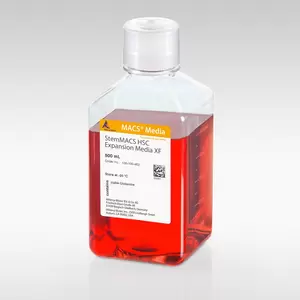

StemMACS HSC-CFU Media have been developed for the expansion of CD34+ cells and to assess the differentiation potential of human hematopoietic stem and progenitor cells as Colony Forming Units (CFU). They are ideally suited for use with
- unseparated blood3, bone marrow4, or fetal liver cells
- sorted cell populations1,4
- or ES and iPS cell-derived hematopoietic precursors2
StemMACS HSC-CFU Media are standardized semi-solid media based on methylcellulose in IMDM, supplemented with FBS, BSA, and different growth factors. StemMACS HSC-CFU media are designed to maximize growth and differentiation of progenitor cells and allow the clonal progeny of a single cell to grow in a distinct cluster or colony. They are produced under tightly controlled manufacturing conditions and use highly qualified raw materials to provide a consistent and optimally performing colony assay.
StemMACS HSC-CFU media are available in different formats.
Technical specifications

Formulation of StemMACS HSC-CFU media
- Liu, G.-H. et al. (2014) Modelling Fanconi anemia pathogenesis and therapeutics using integration-free patient-derived iPSCs. Nat Commun 5: 4330
- Bissels, U. et al. (2011) Combined characterization of microRNA and mRNA profiles delineates early differentiation pathways of CD133+ and CD34+ hematopoietic stem and progenitor cells. Stem Cells 29: 847-857
- Tormin, A. et al. (2011) CD146 expression on primary nonhematopoietic bone marrow stem cells is correlated with in situ localization. Blood 117: 5067-5077
- Del Fante, C. et al. (2005) Immunomagnetic cell selection performed for HLA haploidentical transplants with the CliniMACS device: effect of additional platelet removal on CD34+ cell recovery. Stem Cells Dev. 14: 734-739
- Liedtke, S. et al. (2020) GMP‐grade CD34+ selection from HLA‐homozygous licensed cord blood units and short‐term expansion under European ATMP regulations. Vox sang. (doi: 10.1111/vox.12978)
- Biedermann, B. et al. (2007) Analysis of the CD33-related siglec family reveals that Siglec-9 is an endocytic receptor expressed on subsets of acute myeloid leukemia cells and absent from normal hematopoietic progenitors. Leuk. Res. 31: 211-220
- Brault, J. et al. (2014) Optimized generation of functional neutrophils and macrophages from patient-specific induced pluripotent stem cells: ex vivo models of X0-linked, AR220- and AR470- chronic granulomatous diseases. Biores Open Access 3 (6): 311-326
- Venton, G. et al. (2016) Aldehyde dehydrogenases inhibition eradicates leukemia stem cells while sparing normal progenitors. Blood Cancer J. 6 (9): 469
- Zhou, J. et al. (2011) The histone methyltransferase inhibitor, DZNep, up-regulates TXNIP, increases ROS production, and targets leukemia cells in AML. Blood 118: 2830-2839
- Watts et al. (2008) Cytotherapy 10 (suppl. 1): poster no. 150
- Lambert, J. R. et al. (2009) In essential thrombocythemia, multiple JAK2-V617F clones are present in most mutant-positive patients: a new disease paradigm. Blood 114: 3018-3023
- Chang, K. H. et al. (2006) Definitive-like erythroid cells derived from human embryonic stem cells coexpress high levels of embryonic and fetal globins with little or no adult globin. Blood 108: 1515-1523
You have previously chosen International as your location.
What do you want to do?