
Understanding lupus: genetic insights and promising new treatments in development

Logo

Understanding lupus: genetic insights and promising new treatments in development

Systemic Lupus Erythematosus (SLE), commonly referred to as lupus, is a chronic autoimmune disease that can affect multiple organ systems in the body. It’s a condition marked by periods of illness, or flares, and periods of remission.

In this blog post, we explore recent breakthroughs in lupus research, from novel biomarkers and immunopathogenic mechanisms to emerging therapeutic strategies.

Read time: 5–10 minutes

This information is intended for biological researchers and should not be viewed as advice on medical treatments for lupus.

Check out our blog and get up to speed on lupus biology and next-generation T cell therapies

Content overview

Content

  • What is systemic lupus erythematosus?
  • What are the triggers, risk factors, and the role of genetics for lupus?
  • What are the immunopathogenic mechanisms of lupus?
  • What treatment options are available for lupus?
  • What new developments are there in lupus research?

What is systemic lupus erythematosus?

Lupus occurs when the immune system mistakenly attacks healthy tissue, leading to inflammation and damage. Unlike diseases that target a specific organ, lupus is systemic, meaning it can impact various parts of the body including the skin, joints, kidneys, brain, heart, and lungs.

SLE is the most common and serious form of lupus, distinguished from other types like discoid lupus (which primarily affects the skin) or drug-induced lupus (caused by certain medications).

The global prevalence of lupus is estimated to be between 20 to 150 cases per 100,000 people, which totals roughly five to seven million people worldwide.1

Icon showing a shining lightbulb with an exclamaiton mark on it

Did you know?

The terms "lupus”, meaning "wolf" in Latin, and "erythros," meaning "red", can be interpreted as "wolf-like redness" or "red wolf," referring to the characteristic skin lesions and rashes associated with the disease.2

What are the triggers, risk factors, and the role of genetics for lupus?

The exact cause of lupus remains unknown, but researchers believe it results from a combination of genetic, environmental, and hormonal factors. Common risk factors include:

  • Gender: Women are disproportionately affected by lupus, with 90% of cases occurring in women, particularly of childbearing age (between 15 and 45 years). Hormonal fluctuations, such as those during pregnancy or menstrual cycles, can sometimes trigger lupus symptoms or flares. Some studies suggest that genes influencing estrogen metabolism, such as Estrogen Receptor 1 (ESR1), may contribute to lupus risk in women.3
  • Ethnicity: Lupus is more common in people of African, Hispanic, Asian, and Native American descent.4
  • Environmental triggers: Sun exposure, infections, and certain medications may trigger or exacerbate lupus in genetically predisposed individuals.5

Genetic factors play a significant role in the development of lupus, though no single gene is solely responsible for the disease. Instead, lupus arises from complex interactions among multiple genetic variants that influence immune system function. Here are some key genetic factors associated with lupus:

  • Human Leukocyte Antigen (HLA): Variants like HLA-DR2 and HLA-DR3 are strongly linked to lupus susceptibility, particularly in specific ethnic groups. Variants in the ITGAM gene are strongly associated with lupus in people of African and Hispanic descent.6
  • Complement system: Mutations or deficiencies in C1q, C2, and C4 genes (components of the complement system) are associated with an increased risk of lupus, as they impair the clearance of immune complexes and apoptotic debris. C1q deficiency is one of the strongest genetic risk factors for lupus.7
  • Interferon pathway: Lupus patients often exhibit an "interferon signature," meaning heightened activity of interferon-related genes. Variants in genes like IRF5 and STAT4 are implicated in the overproduction of type I interferons, contributing to inflammation and autoimmunity.8
  • Genes involved in B and T cell function: PTPN22, a gene that regulates T cell activity, is linked to an increased risk of lupus and other autoimmune diseases. In addition BANK1, a gene involved in B cell signaling and activation, may contribute to the overproduction of autoantibodies seen in lupus.9,10

What are the immunopathogenic mechanisms of lupus?

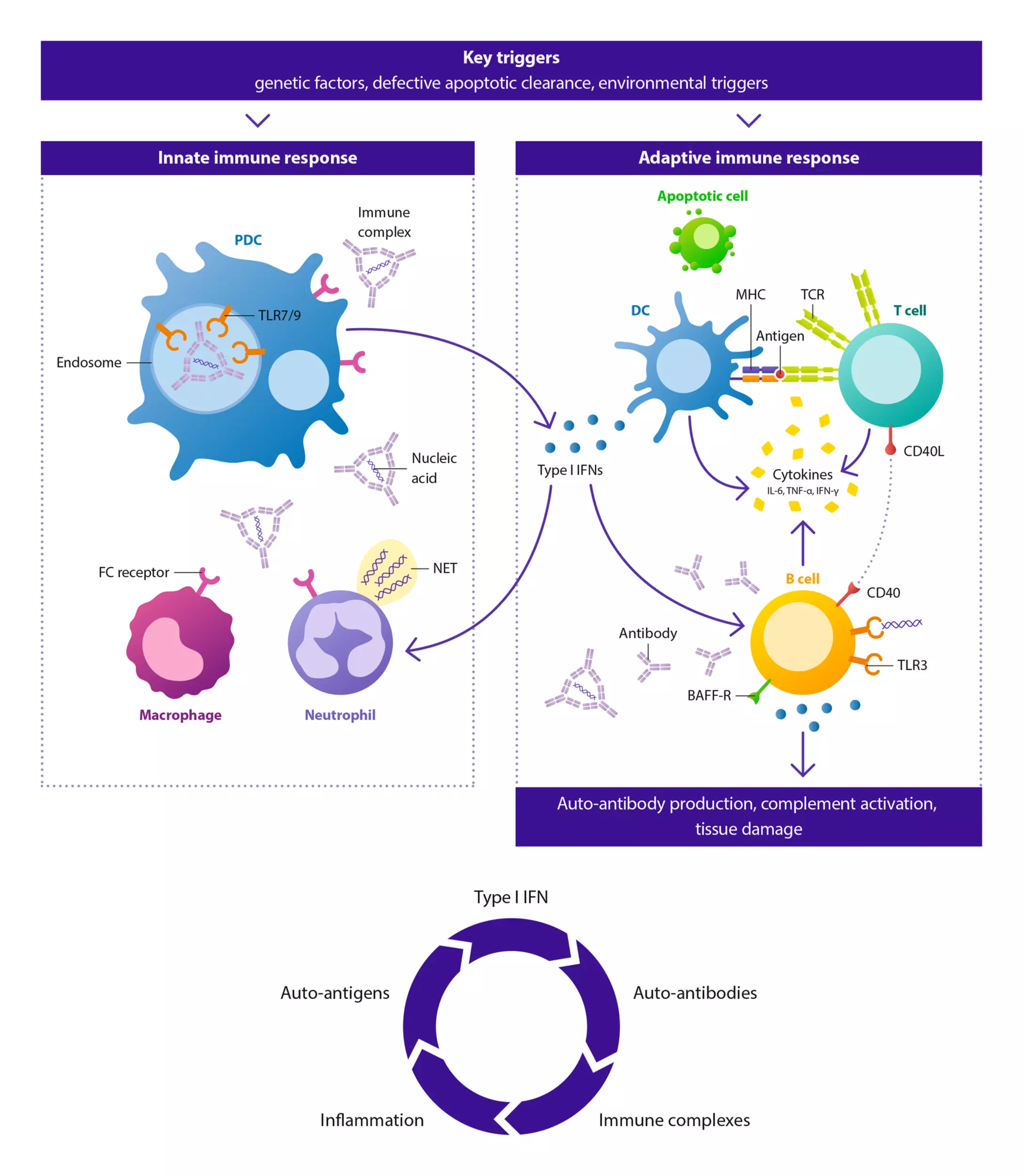
The immune response in SLE is complex, dysregulated, and involves both innate and adaptive immunity. Far from a single malfunction, lupus reflects a deep interplay between genetic susceptibility, environmental triggers, and immune system dysregulation. Although much about the immune response in lupus remains unclear, research has shown that an overproduction of type I interferons (IFNs) is a hallmark of the disease development and progression. Below is a simplified breakdown of some of the key steps and players in the lupus immune response, based on current understanding of the disease.11-15

A diagram showing the key triggers, genetic factors, defective apoptotic clearance, and environmental triggers known to be associated with Lupus.
Key triggers and contributing factors in lupus

  • Key triggers: SLE begins with breakdown of immune tolerance to nuclear self-antigens (DNA, histones, ribonucleoproteins). Contributing factors include defective clearance of apoptotic cells, genetic susceptibility (e.g., HLA-DR2, C1q/C4 deficiency, IRF5, PTPN22), and environmental triggers, such as UV light, EBV infection, and estrogen.
  • Innate immune response: Plasmacytoid dendritic cells recognize self-nucleic acids via TLR7 and TLR9, driving excessive type I interferon production. This enhances antigen presentation, B-cell survival, and autoantibody generation. Neutrophil extracellular traps (NETs) further expose nuclear antigens, and impaired NET clearance sustains inflammation.
  • Adaptive immune response: Hyperactive CD4⁺ T cells (Th1/Th17) promote inflammation, while Tregs and CD8⁺ T–cell function are impaired. B-cell tolerance fails, BAFF levels rise, and autoreactive B cells undergo abnormal activation and differentiation, producing autoantibodies.
  • Autoantibodies and tissue damage: Autoantibodies form immune complexes that deposit in organs (kidneys, skin, joints, CNS), activating complement and Fc receptors. Complement activation recruits inflammatory cells, leading to chronic inflammation and organ damage despite low complement levels from consumption.
  • Chronic amplification: Ongoing exposure to self-antigens from apoptotic cells and NETs perpetuates immune activation and disease chronicity.

What treatment options are available for lupus?

Although there is no cure for lupus, treatments aim to manage symptoms, prevent flares, and reduce organ damage. Common therapies include NSAIDs for mild inflammation, corticosteroids for severe cases, antimalarial drugs like hydroxychloroquine, and immunosuppressants, such as methotrexate or mycophenolate. Meanwhile, biologic therapies for lupus represent a newer class of treatments designed to target specific components of the immune system involved in the disease process. They are typically used in cases where traditional treatments fail or when the disease is severe and unresponsive to other therapies. The most common such treatments currently in use include:

  • B cell therapies:
    • Belimumab (Benlysta): The first FDA-approved biologic for lupus, it blocks BLyS (a B-cell survival protein) to reduce autoantibody production.16
    • Obinutuzumab and Rituximab: These monoclonal antibodies deplete B cells and are being evaluated for lupus nephritis and systemic lupus.17
  • Interferon-targeting drugs: High interferon levels are linked to lupus flares. Drugs like anifrolumab (approved in 2021) target type I interferon receptors, reducing inflammation and disease activity.18
  • Cytokine inhibitors: Therapies targeting other inflammatory cytokines (e.g., IL-6, IL-17, or IL-10) are in clinical trials.19,20

Person operating a CliniMACS Prodigy with a document icon
Research highlight

Read more about how the CliniMACS Prodigy® System and REAfinity® Antibodies contributed to generating CAR T cells for the treatment of lupus

Successful Generation of CD19 Chimeric Antigen Receptor T Cells from Patients with Advanced Systemic Lupus Erythematosus
Kretschmann, S. et al. (2023) Transplant Cell Ther. 29(1):27-33. | Read article

Icon showing publications
Research highlight

Read about how REAfinity Antibodies, magnetic beads, MACS® Separation Columns, TexMacs™ Medium, and MACSQuant® Analyzer 10 help investigate the effects of prolactin on B cells, proliferation, and auto-reactivity in lupus.

Prolactin promotes proliferation of germinal center B cells, formation of plasma cells, and elevated levels of IgG3 anti-dsDNA autoantibodies
Carreón-Talavera, R. et al. (2022) Front Immunol. 13:1017115. | Read article

What new developments are there in lupus research?
Ongoing research is shedding new light on the underlying mechanisms of lupus. Scientists are developing more effective and targeted therapies, which may one day lead to better treatments – or even cures – for autoimmune diseases. Some exciting areas of research include:

  • TCR T–cell therapy: By making use of engineered T cells to specifically recognize and suppress harmful immune responses, clinicians are trying to develop more targeted and potentially long-lasting treatments for autoimmune conditions.21
  • CAR T–cell therapy: While originally designed to destroy cancer cells, researchers are adapting the technology to deplete autoimmune B cells that produce harmful autoantibodies in autoimmune diseases like lupus.22

Launch of the Lupus Landmark Study

The Lupus Research Alliance and its clinical affiliate, Lupus Therapeutics, have initiated the Lupus Landmark Study, the largest prospective observational study in lupus to date. Over five years, the study aims to enroll 3,500 patients across North America to accelerate the development of personalized treatments. This initiative is part of the Lupus Nexus, a comprehensive resource designed to transform lupus research and drug development.

Lupus Research Alliance and its clinical research affiliate Lupus Therapeutics launch the Lupus Landmark Study to accelerate personalized treatments in lupus
Lupus Landmark Study. NEW YORK, NY. May 23, 2023 | Read article

Enzyme-based treatment offers new hope

Yale researchers have developed an enzyme-based treatment that mitigated autoimmunity and reduced mortality in mouse models of lupus. The engineered enzyme replicates the activity of DNAse1L3, an enzyme lacking in certain lupus patients. Weekly doses prevented the onset of autoimmunity and reduced death rates, indicating potential for a new therapeutic approach in humans.

These developments reflect significant strides in lupus research, offering hope for more effective treatments and a deeper understanding of the disease.

A dual-acting DNASE1/DNASE1L3 biologic prevents autoimmunity and death in genetic and induced lupus models
Stabach, P.R. et al. (2024) JCI Insight. 18;9(14):e177003. | Read article

You have previously chosen International as your location.
What do you want to do?