

Synonyms: Bp50, CDW40, TNFRSF5, p50
EXTENDED VALIDATION
- Clone:
- HB14
- Type of antibody:
- Primary antibodies
- Isotype:
- mouse IgG1κ
- Applications:
- FC, MICS, IF, IHC, MC, FA Glossary
- Select a conjugate:
- Select a size:


Other sizes
Related products for CD40 Antibody, anti-human


Flow cytometry applications
APC
Biotin
PE
PE-Vio 770
Recommended dilution:
1:50
Remark:
The antibody is suited for staining of formaldehyde-fixed cells.
Data source:
Miltenyi Biotec
Conjugate:
APC
Used products:
130-124-009, 130-123-798
Description:
Human peripheral blood mononuclear cells (PBMCs) were stained with CD40 antibodies as well as with CD19 antibodies and analyzed by flow cytometry. Cell debris and dead cells were excluded from the analysis based on scatter signals and propidium iodide fluorescence.

MICS (MACSima Imaging Cyclic Staining) applications
APC
PE
Fixation:
frozen – PFA
Species tested:
human
Recommended dilution:
1:50
Data source:
Miltenyi Biotec
Compatible applications:
IF, IHC, ICC
Conjugate:
APC
Used products:
130-124-009, 130-123-798
Testing grade:
Fixation:
frozen – Acetone
Species tested:
human
Recommended dilution:
1:50
Data source:
Miltenyi Biotec
Compatible applications:
IF, IHC
Conjugate:
APC
Used products:
130-124-009, 130-123-798
Testing grade:
Functional assay applications
pure-functional grade
Type of functional assay:
blocking of receptor-ligand binding
Conjugate:
pure-functional grade
Used products:
130-094-133
Reported:
Mass cytometry applications
pure
Conjugate:
pure
Used products:
130-108-041
Extended validation for CD40 Antibody, anti-human
Specificity
To ensure antibody specificity, the target gene is knocked out in a suitable cell line using the CRISPR/Cas9 system and the knockout is confirmed by sequencing of the target locus. The antibody is considered to bind specifically to the intended epitope if no antibody binding to the knockout cells can be detected. The antibody staining is controlled by fluorescence microscopy and/or flow cytometry.
WT
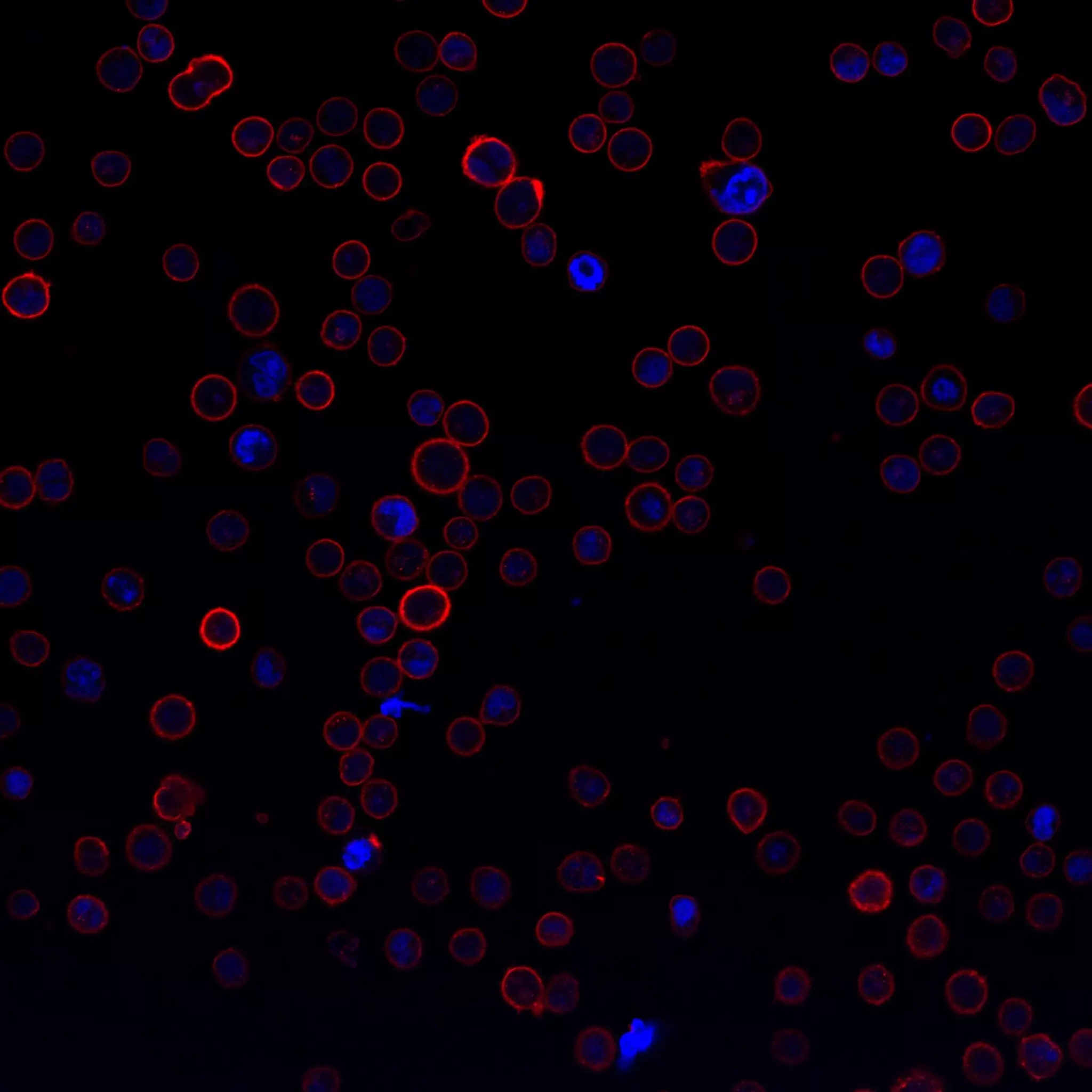
KO
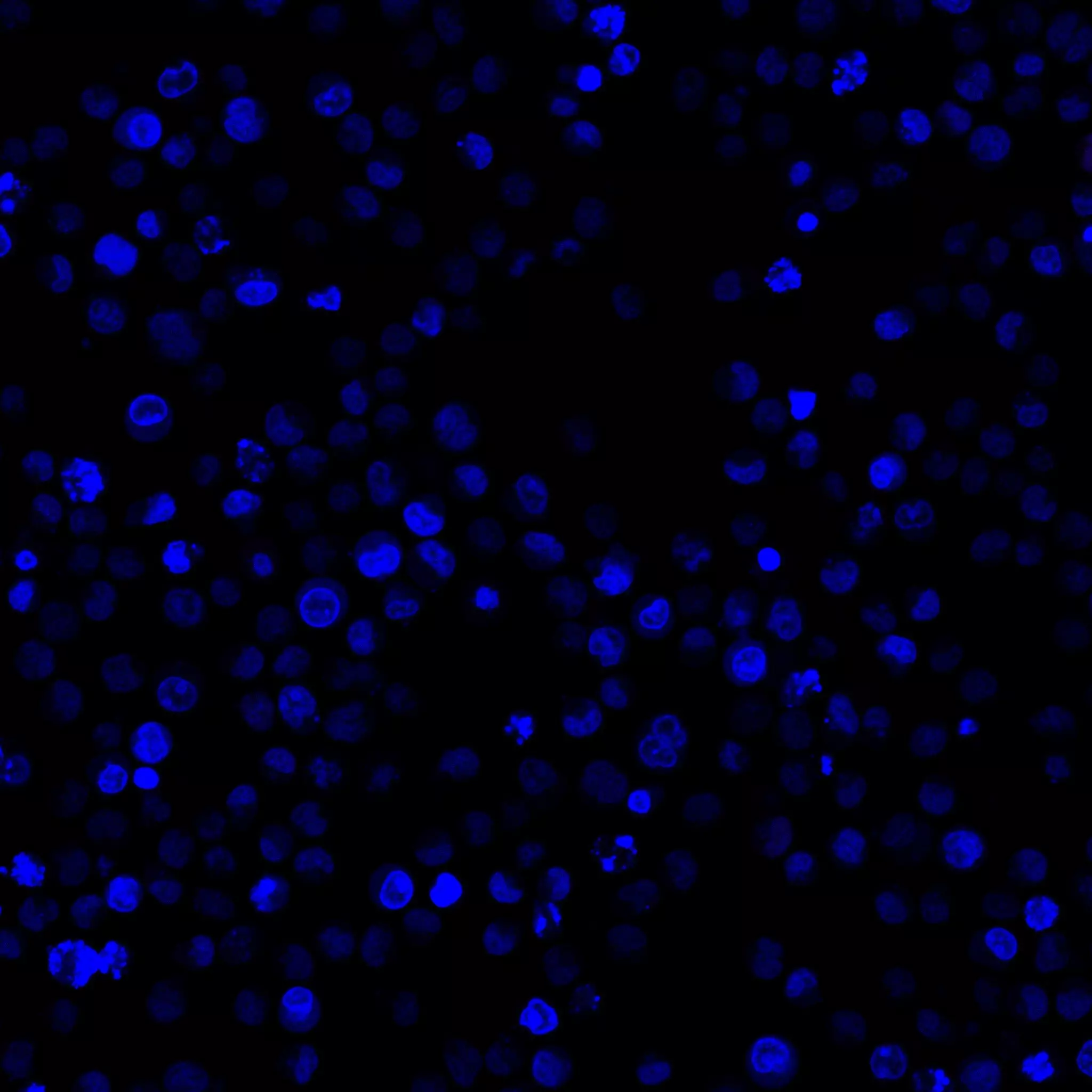
Fluorescence microscopy image of CD40 knockout cells. Wild type (WT, left) and knockout cells (KO, right) were stained with CD40-PE (HB14, red) and counterstained with DRAQ5 (blue) as DNA stain.
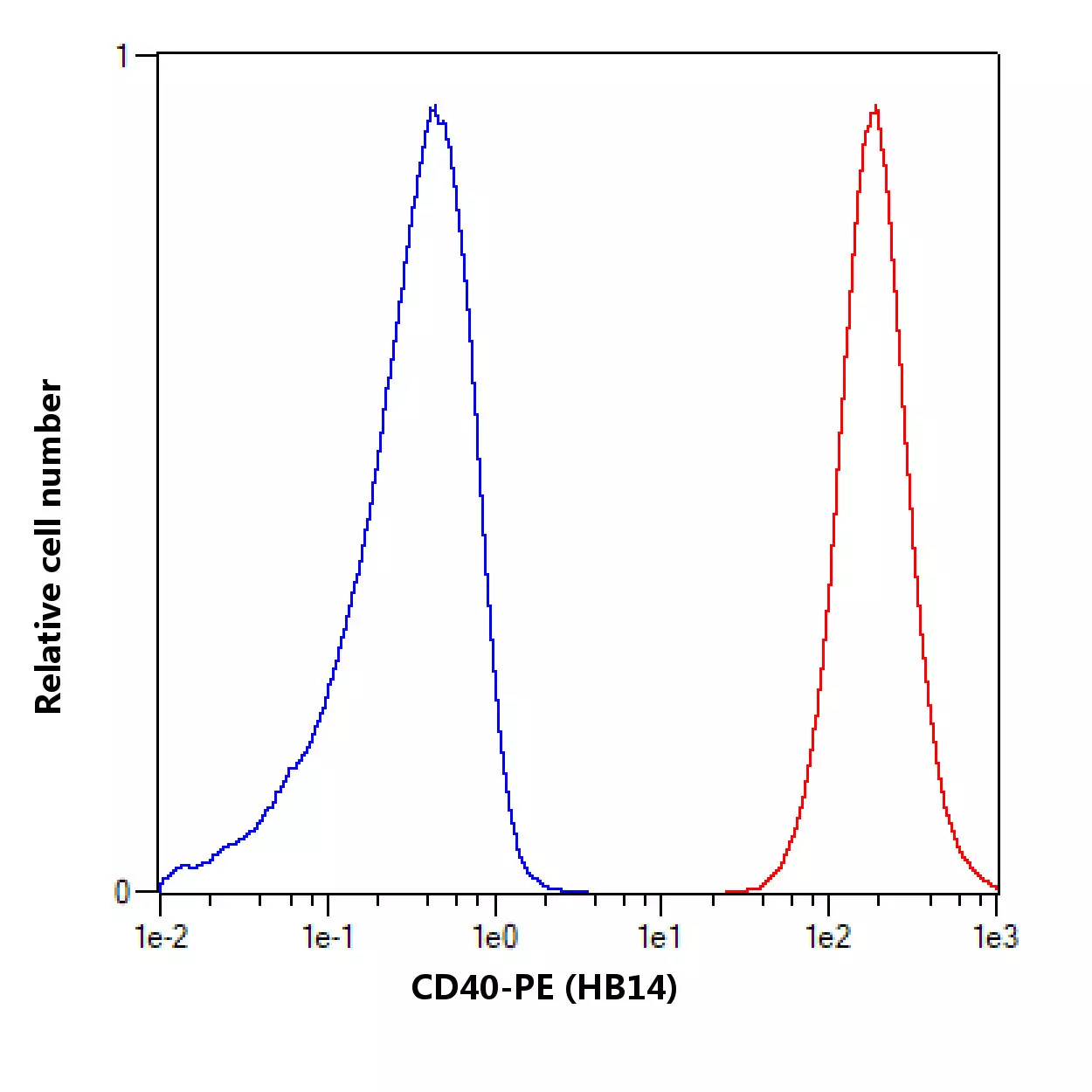
Overlay histogram showing flow cytometric analysis of CD40 knockout cells. Wild type (red) and knockout cells (blue) were stained with CD40-PE, clone (HB14). Flow cytometry was performed with the MACSQuant® Analyzer. Cell debris, dead cells and cell doublets were excluded from the analysis based on scatter signals and propidium iodide fluorescence.
Specifications for CD40 Antibody, anti-human
Overview
The HB14 monoclonal antibody reacts with human CD40, a 45–50 kDa type I transmembrane glycoprotein and member of the tumor necrosis factor receptor (TNFR) superfamily. It is expressed primarily on B cells, macrophages, dendritic cells, endothelial cells, and fibroblasts and at lower levels on plasma cells and a subset of peripheral T cells. CD40 is involved in B cell differentiation and proliferation, isotype class-switching, and protection of B cells from apoptosis. Interaction of CD40 with its ligand CD154 is important in T cell–B cell interaction and plays a role in co-stimulation and immune regulation. Clone HB14 blocks the binding of CD40 to CD154.
Bp50, CDW40, TNFRSF5, p50
Detailed product information
Technical specifications
Clone
HB14
Clonality
monoclonal
Isotype
mouse IgG1κ
Isotype control
Isotype Control Antibody, mouse IgG1
Host
mouse
Type of antibody
Primary antibodies
Species reactivity
human, non-human primate
Cross-reactivity
rhesus monkey (Macaca mulatta), cynomolgus monkey (Macaca fascicularis)
Antigen
CD40
Molecular mass of antigen [kDa]
28
Distribution of antigen
B cells, dendritic cells, endothelial cells, epithelial cells, fibroblasts, Langerhans cells, lymphocytes, macrophages, mast cells, monocytes, platelets, leukemia cells, plasma cells
Entrez Gene ID
RRID
AB_2811582, AB_2728026, AB_2728049, AB_2811556, AB_10839704, AB_10828550, AB_2660897, AB_2811547, AB_2811578
Resources for CD40 Antibody, anti-human
Certificates
To access a Certificate of Analysis (CoA) follow the link below and enter the specific lot of your product.
Should you wish to request additional documentation, such as a Safety Data Sheet (SDS) in other languages than English or Swedish, an SDS-replacement document, or a Certificate of Origin (CoO), please direct your inquiry to your local technical support team.
 Powered by Bioz
You have previously chosen International as your location.
What do you want to do?