Recombinant human IL-4 (interleukin 4) can be used for Tʜ2 differentiation of T cells and stimulation of B cells. The pleiotropic cytokine is associated with allergies and asthma, as it plays a central role in humoral and adaptive immune responses. The recombinant protein IL-4 is optimized for use in functional assays, differentiation studies, and cell culture.


Related products for Human IL-4


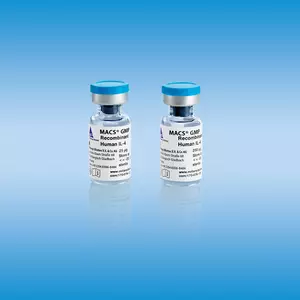
Recombinant human IL-4 (interleukin 4) can be used for Tʜ2 differentiation of T cells and stimulation of B cells. The pleiotropic cytokine is associated with allergies and asthma, as it plays a central role in humoral and adaptive immune responses. The recombinant protein IL-4 is optimized for use in functional assays, differentiation studies, and cell culture.
Human IL-4 can be used for a variety of applications including:
- In vitro generation of Mo-DCs together with GM-CSF.
- In vitro differentiation of naive CD4+ T cells towards Tʜ2 cells.
Biological activity
Interleukin 4 (IL-4) is a pleiotropic cytokine and plays a central role in humoral and adaptive immune responses. IL-4 is predominantly secreted by activated CD4+ memory and effector Tʜ2 cells, basophils, and mast cells. It promotes the proliferation and differentiation of B cells, as well as immunoglobulin isotype switching, and MHC class II antigen and low-affinity IgE receptor expression. Furthermore, IL-4 induces the differentiation of naive CD4+ T cells into helper Tʜ2 cells, while suppressing Tʜ1 development, and promotes chemotaxis of mast cells and basophils. Excessive IL-4 production and mechanisms involving Tʜ2 types have been associated with immunological disorders, such as IgE-mediated allergy.
Research-grade cytokines are suitable for a wide variety of cell culture applications. They are sterile-filtered prior to lyophilization. Generally, endotoxin levels are <0.1 ng/μg (<1 EU/μg), and purities are >95%. The biological activity is tested in appropriate bioassays.
Premium-grade cytokines offer the convenience of high and well-defined biological activities and allow exact unit dosing for demanding applications. The biological activity is determined after lyophilization and reconstitution, and normalized to WHO/NIBSC standards whenever available. In general, endotoxin levels are <0.01 ng/μg (<0.1 EU/μg), and purities are >97%. Lot-specific activities are stated in the Certificate of Analysis (www. miltenyibiotec.com/certificates).
Human IL-4 activity assay. The biological activity of Human IL-4, premium grade was determined by proliferation assay using TF-1 cells.
Human IL-4 activity assay. The biological activity of Human IL-4, premium grade was determined by proliferation assay using TF-1 cells.
SDS-PAGE of Human IL-4, premium grade under reducing (R) and non-reducing (NR) conditions.
Human IL-4 biological activity. Activity of Human IL-4, premium grade, (red bar) was compared to another commercially available product (black bar).
Human IL-4 biological activity. Activity of Human IL-4, premium grade, (red bar) was compared to another commercially available product (black bar).
Mass spectrometry analysis (ESI-MS) of Human IL-4, premium grade. The peak corresponds to the calculated molecular mass of 15088 Da.
Mass spectrometry analysis (ESI-MS) of Human IL-4, premium grade. The peak corresponds to the calculated molecular mass of 15088 Da.
To access a Certificate of Analysis (CoA) follow the link below and enter the specific lot of your product.
Should you wish to request additional documentation, such as a Safety Data Sheet (SDS) in other languages than English or Swedish, an SDS-replacement document, or a Certificate of Origin (CoO), please direct your inquiry to your local technical support team.
- Foord, E. et al. (2020) Profound functional suppression of tumor-infiltrating T-cells in ovarian cancer patients can be reversed using PD-1-blocking antibodies or DARPin® proteins. J Immunol Res : 7375947
- Giroud, P. et al. (2020) Expression of TAM-R in human immune cells and unique regulatory function of MerTK in IL-10 production by tolerogenic DC. Front Immunol 11: 564133
- Koliha, N. et al. (2016) Melanoma affects the composition of blood cell-derived extracellular vesicles. Front Immunol 7: 282
- Bacher, P. et al. (2014) Antigen-specific expansion of human regulatory T cells as a major tolerance mechanism against mucosal fungi. Mucosal Immunol 7 (4): 916-928
- Chase A. J. et al. (2011) Impairment of CD4+ T cell polarization by dengue virus-infected dendritic cells. J. Infect. Dis. 203: 1763-1774
- Grötsch, B. et al. (2014) The AP-1 transcription factor Fra1 inhibits follicular B cell differentiation into plasma cells. J. Exp. Med. 211 (11): 2199-2212
- Kassianos, A. J. et al. (2013) Human proximal tubule epithelial cells modulate autologous dendritic cell function. Nephrol Dial Transplant 28: 303-312
- Zanoni, M. et al. (2020) Innate, non-cytolytic CD8+ T cell-mediated suppression of HIV replication by MHC-independent inhibition of virus transcription. PLoS Pathog. 16 (9): e1008821
- Thépaut, M. et al. (2021) DC/L-SIGN recognition of spike glycoprotein promotes SARS-CoV-2 trans-infection and can be inhibited by a glycomimetic antagonist. PLoS Pathog. 17 (5): e1009576
- Novak, N. et al. (2020) Interaction of monocyte-derived dendritic cells with Ara h 2 from raw and roasted peanuts. Foods 9 (7): 863
- Klatka, J. et al. (2013) Expression of selected regulatory molecules on the CD83+ monocyte-derived dendritic cells generated from patients with laryngeal cancer and their clinical significance. Eur. Arch. Otorhinolaryngol. 270 (10): 2683-2693
- Johnson, M. J. et al. (2018) Transcriptional profiles of human islet and exocrine endothelial cells in subjects with or without impaired glucose metabolism. Sci Rep 8 (1): 12144
- Kaebisch R. et al. (2014) Helicobacter pylori cytotoxin-associated gene A impairs human dendritic cell maturation and function through IL-10-mediated activation of STAT3. J Immunol 192: 316-323
- Guery, L. et al. (2014) Fine-tuning nucleophosmin in macrophage differentiation and activation. Blood 118: 4694-4704
- De Laere, M. et al. (2018) Shuttling tolerogenic dendritic cells across the blood-brain barrier in vitro via the introduction of de novo C-C chemokine receptor 5 expression using messenger RNA electroporation. Front Immunol 8: 1964
- Feray, A. et al. (2020) How to address the adjuvant effects of nanoparticles on the immune system. Nanomaterials (Basel) 10 (3): 425
- Kitamura, T. et al. (1991) IL-1 up-regulates the expression of cytokine receptors on a factor-dependent human hemopoetic cell line, TF-1. Int. Immunol. 3: 571-577
- Perriard, G. et al. (2015) Interleukin-22 is increased in multiple sclerosis patients and targets astrocytes. J. Neuroinflammation 12: 119
- Herr, F. et al. (2014) IL-2 phosphorylates STAT5 to drive IFN-γ production and activation of human dendritic cells. J Immunol 192: 5660-5670
- Sampangi, S. et al. (2015) The mechanisms of human renal epithelial cell modulation of autologous dendritic cell phenotype and function. PLoS One 10 (7): e0134688
- Kandler, K. et al. (2006) The anti-microbial peptide LL-37 inhibits the activation of dendritic cells by TLR ligands. Int. Immunol. 18: 1729-1736
- Hsieh, S.-H. et al. (2017) Persistence within dendritic cells marks an antifungal evasion and dissemination strategy of Aspergillus terreus. Sci Rep 6;7 (1): 10590
- Ackaert, C. et al. (2021) Immunogenicity risk profile of nanobodies. Front Immunol 12: 632687
- Zhu, J. et al. (2006) Gfi-1 plays an important role in IL-2-mediated Tʜ2 cell expansion. Proc. Natl. Acad. Sci. U.S.A. 103: 18214-18219
You have previously chosen International as your location.
What do you want to do?