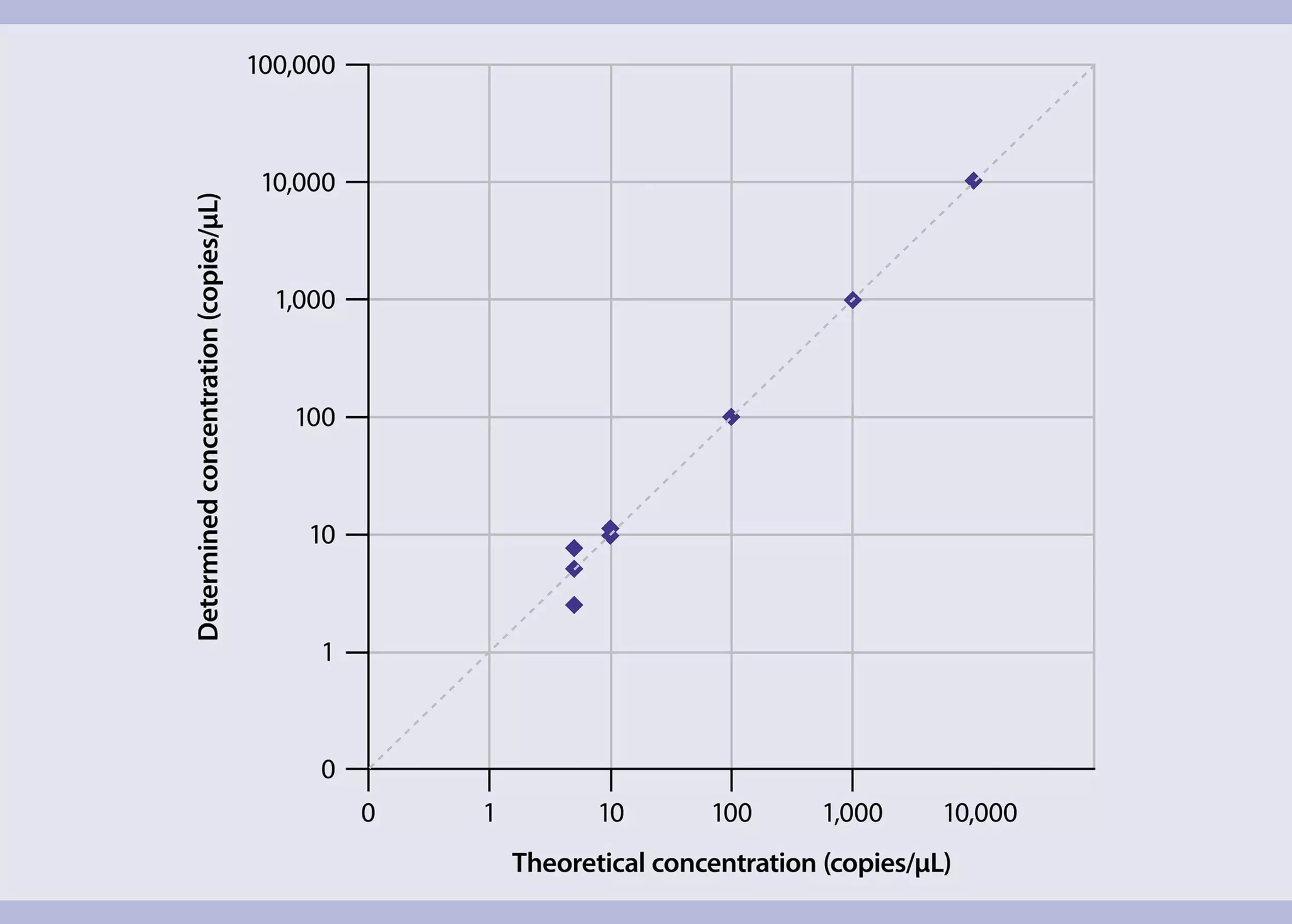
▲ All components of the MACS dPCR LENTIcheck Kit (BaEV), human are ready to use. When MACS dPCR LENTIcheck (BaEV) Control was stored at –20 °C, reheat at +50 °C for 20 minutes. Adjust all reagents to room temperature (+19 to +25 °C) before use.
▲ Before opening, mix the components of the MACS dPCR LENTIcheck Kit (BaEV), human briefly with a vortex mixer before use and perform a short spin.
▲ For more information about the QIAcuity Systems, refer to the respective user manual.
Preparation of mastermix
1. Calculate the amount of master mix. Each run requires a master mix for three reactions for the no-template control (NTC) (3 × 7 µL), 5 × 3 reactions for the standard curve (5 × 3 × 7 µL), and 5 × 5 reactions for each sample including the respective controls (5 × 5 × 7 µL) (see table 1, 2, and in tab Materials table 6).
2. Prepare a master mix solution for the MACS dPCR LENTIcheck Kit (BaEV) assay in the DNA-free PCR workstation according to table 1. Mix well and perform a short spin.
Table 1: Master mix for QIAcuity Systems.
| Component | Volume per reaction (µL) | Volume per n reactions (µL) | Final concentration |
| MACS dPCR LENTIcheck (BaEV) Primers | 0.5 | n × 0.5 | 0.8 µM each primer |
| MACS dPCR CENTIcheck (BaEV) Probe | 0.9 | n × 0.9 | 0.4 µM |
| 4× dPCR master mix, e.g., Probe PCR Master Mix | 3 | n × 3 | 1× |
| MluI restriction endonuclease (20,000 units/mL) | 0.25 | n × 0.25 | 0.42 units/µL |
| BclI restriction endonuclease (20,000 units/mL) | 0.25 | n × 0.25 | 0.42 units/µL |
| Water | 2.1 | n × 2.1 | |
| Total volume w/o DNA | 7 | n × 7 |
3. In the DNA-free PCR workstation, add 7 μL of master mix (table 1) into a 96-well plate for each of the 3 reactions for the no-template controls (NTCs), 5 × 3 reactions for the standard curve, and 5 × 5 reactions for each sample including the respective controls (see table 2 and in tab Materials table 6).
Table 2: Loading scheme for QIAcuity Nanoplate 8.5k 96-Well.
| 1 | 2 | 3 | 4 | 5 | 6 | 7 | 8 | 9 | 10 | 11 | 12 | |
| A | ST 5 5 copies /µL | ST 4 1 × 101 copies /µL | ST 3 1 × 10² copies /µL | ST 2 1 × 10³ copies /µL | ST 1 MACS dPCR LENTIcheck (BaEV) Kit Control 1 × 10⁴ copies /µL | NTC | Extraction control negative sample 3 | |||||
B | Negative control sample (non-transduced cells) sample 3 | |||||||||||
| C | Replicate 2 – test sample 3 (transduced T cells) | |||||||||||
| D | DNA extraction negative control test sample 1 | Negative control sample (non-transduced cells) sample 1 | Replicate 1 – test sample 1 (transduced cells) | Replicate 2 – test sample 1 (transduced cells) | DNA extraction positive control sample 1 | Extraction control negative sample 2 | Negative control sample (non-transduced cells) sample 2 | Replicate 1 – test sample 2 (transduced T cells) | Replicate 2 – test sample 2 (transduced T cells) | DNA extraction positive control sample 2 | Replicate 2 – test sample 3 (transduced T cells) | DNA extraction positive control sample 3 |
| E | ||||||||||||
| F | ||||||||||||
| G | ||||||||||||
| H | ||||||||||||
4. Add 5 µL of nuclease-free water to each of the 3 no-template control (NTC) wells of the 96-well plate marked as no-template control in table 2. Mix well by pipetting up and down.
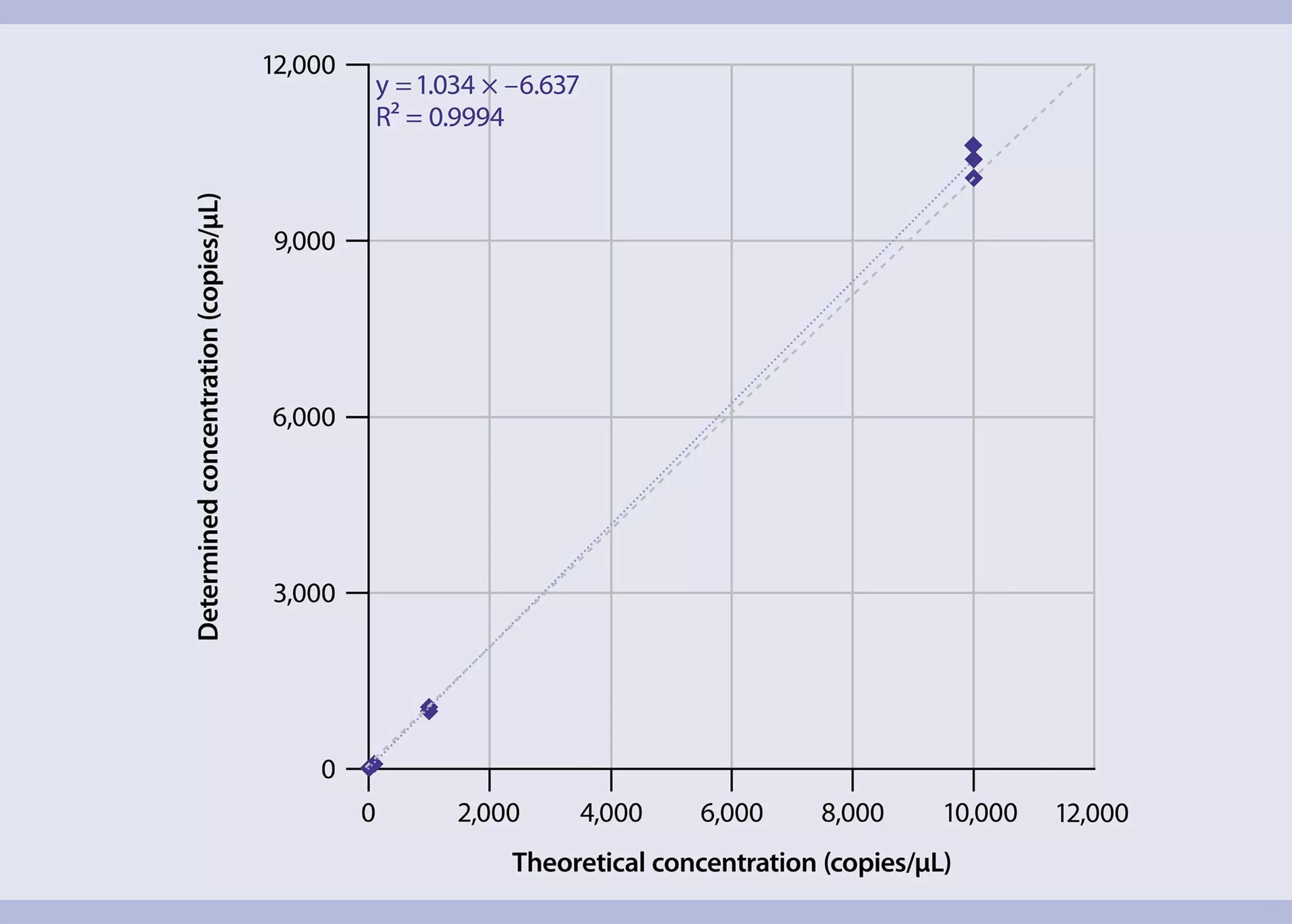
 View details