MACS GMP Recombinant Human Interleukin-12 (IL-12) is a recombinant protein optimized as an ancillary material for ex vivo cell processing. It is not intended for human in vivo applications.


Related products for MACS® GMP Recombinant Human IL-12
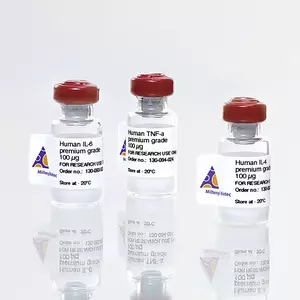
MACS GMP Recombinant Human Interleukin-12 (IL-12) is a recombinant protein optimized as an ancillary material for ex vivo cell processing. It is not intended for human in vivo applications.
Biological activity
IL-12 is a heterodimeric cytokine composed of two subunits (p35 and p40), which are encoded by two different genes, IL-12A (p35) and IL-12B (p40). The complete heterodimeric protein complex is termed IL-12p70. IL-12 is the most prominent member of the IL-12 cytokine family, which also contains other heterodimeric cytokines such as IL-23, IL-27 and IL-356.
The p35 subunit of IL-12 contains 4 α-helix bundles, while the p40 subunit is structurally related to soluble IL-6 receptor alpha (sIL-6Rα). Hence, the structure of IL-12 is in essence that of a cytokine bound to a soluble receptor, and the ability to secrete the cytokine-like subunit (p35) depends upon association with the receptor-like subunit (p40)7.
IL-12 can affect many cell types, but its influence on T-cell-dependent responses has been most extensively studied: It is secreted by professional antigen presenting cells (mostly dendritic cells, but also macrophages and B cells) upon activation by microbial pathogens and binds to the IL-12 receptor complex (comprised IL-12Rβ1 and IL-12Rβ2) on T and NK cells. Receptor engagement induces the upregulation of transcription factor T-bet in CD4+ and CD8+ T cells and promotes their differentiation into Th1 cells or CTLs respectively. These activated T cells then secrete IFNγ and TNFα. IL-12 can also induce IFNγ production by NK cells7.
Naïve T cells express the IL-12 receptor subunit IL-12Rβ1, however expression of IL-12Rβ2 - and thereby responsiveness of naïve T cells to IL-12 - is dependent on TCR engagement, co-stimulation by CD28 and IL-2 signaling8. Signaling through the IL-12 receptor seems to be necessary for full-fledged T cell effector functions of the T cells and for IL-2 dependent proliferation2.
MACS GMP Recombinant Human IL-12 can be used for a variety of applications, including:
Optimization of ex vivo expansion protocols for adoptive cell transfer. Studies have demonstrated that ex vivo activation of T cells in the presence of IL-12 can improve expansion and effector function and prevent in vivo T cell exhaustion in animal models.1
Generation of cytokine-induced memory-like natural killer cells (CIML NK). Memory-like NK cells can be generated ex vivo by cultivating human NK cells with a combination of IL-12, IL-15 and IL-18. Such CIML NK cells demonstrated an increased longevity and enhanced anticancer functionality compared to normal effector NK cells.2
In vitro differentiation of naive CD4+ T cells towards Th1 cells. After activation, naïve CD4+ T cells can be differentiated into Th1 effector cells when cultured with a combination of IL-2, IL-12 and IFNγ.3
Technical specifications
MACS GMP Recombinant Human IL-12 is manufactured and released based on the stringent specifications displayed below.
Lot-specific results of the respective QC measurements are depicted on each Product Quality Certificate (PQC). Learn more here
- Identity: Confirmed by isoelectric focusing and chip electrophoresis. This corresponds to the mature form of IL-12.
- Purity: ≥ 95 % as determined by chip electrophoresis.
- Product-related proteins: ≤15% as determined by chip electrophoresis.
- Endotoxin content: < 50 EU/mg, as determined by kinetic Limulus Amoebocyte Lysate (LAL) assay (Pharmacopoeia Europaea (Ph. Eur.)).
- Residual host cell DNA content: < 20 ng/mg, as determined by quantitative PCR specific for CHO genomic DNA.
- Residual host cell protein content: < 25 µg/mg, as determined by CHO HCP ELISA.
MACS GMP Recombinant Human IL-12 is expressed as a single chain fusion protein. It has been shown that such fusion proteins of naturally occurring heterodimeric cytokines such as IL-12 or IL-23 are bioactive in vitro and in vivo.5 The product is lyophilized without carrier protein or preservatives.
MACS GMP Products are manufactured and tested under a quality management system (ISO 13485) and are in compliance with relevant GMP guidelines. They are designed following the recommendations of USP <1043> on ancillary materials.
MACS GMP Products are for ex vivo cell processing only, and are not intended for human in vivo applications. For regulatory status in the USA, please contact your local representative.
The biological activity of MACS GMP Recombinant Human IL-12 was determined by induction of IFN-γ secretion by PHA-activated T cells.
MACS GMP Recombinant Human IL-12 biological activity. Activity of Human MACS GMP IL-12 (blue bar), was compared to another commercially available product (black bar).
Enter the lot number from your product label to access its Product Quality Certificated (PQC).
- Tarannum, M. et al. (2021) Cytokine‑induced memory‑like natural killer cells for cancer immunotherapy. Stem Cell Res Ther. 12: 592
- Lieschke, G. J. et al. (1997) Bioactive murine and human interleukin-12 fusion proteins which retain antitumor activity in vivo. Nat. Biotechnol. 15: 35-40
- Valenzuela, J. et al. (2002) The Roles of IL-12 in Providing a Third Signal for Clonal Expansion of Naive CD8 T Cells. J Immunol 169 (12): 6842-6849
- Wojno, E. D. et al. (2019) The Immunobiology of the Interleukin-12 Family: Room for Discovery. Immunity 50 (4): 851-870
- Wulff, H. et al. (2007) Cloning and characterization of an adenoviral vector for highly efficient and doxycycline-suppressible expression of bioactive human single-chain interleukin 12 in colon cancer. BMC Biotechnol. 7: 35
- Vignali, D. et al. (2014) IL-12 Family Cytokines: Immunological Playmakers. Nat Immunol 13 (8): 722-728
- Tucker, C. G. et al. (2020) Adoptive T Cell Therapy with IL-12-Preconditioned Low-Avidity T Cells Prevents Exhaustion and Results in Enhanced T Cell Activation, Enhanced Tumor Clearance, and Decreased Risk for Autoimmunity. J Immunol 205 (5): 1449-1460
You have previously chosen International as your location.
What do you want to do?