

Synonyms: CLEC4C, BDCA-2, CLECSF11, CLECSF7, DLEC, HECL, PRO34150
EXTENDED VALIDATION
- Clone:
- AC144
- Type of antibody:
- Primary antibodies
- Isotype:
- mouse IgG1κ
- Applications:
- FC, MC Glossary
- Select a conjugate:
- Select a size:


Other sizes
Related products for CD303 (BDCA-2) Antibody, anti-human


Flow cytometry applications
APC
Biotin
FITC
PE
PE-Vio 615
PE-Vio 770
VioBlue
pure
Recommended dilution:
1:50
Remark:
Cells should be stained prior to fixation, if formaldehyde is used as a fixative.
Data source:
Miltenyi Biotec
Conjugate:
APC
Used products:
130-113-752, 130-113-190
Description:
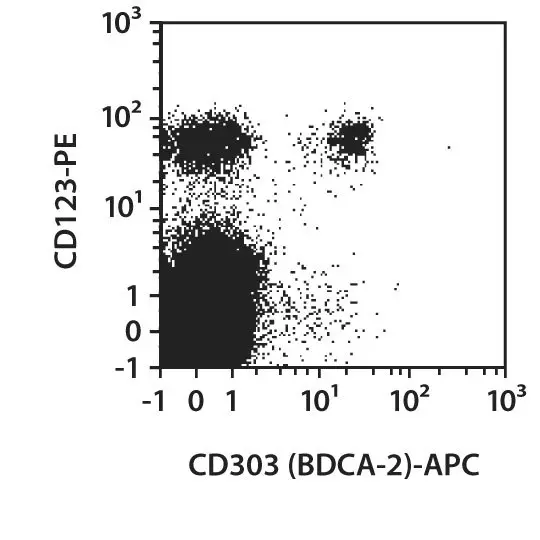
Human peripheral blood mononuclear cells (PBMCs) were stained with CD303 (BDCA-2) antibodies as well as with CD123 antibodies and CD45 antibodies and analyzed by flow cytometry using the MACSQuant® Analyzer. The Tandem Signal Enhancer has been used to increase binding specificity of tandem-dye–conjugated antibodies. For all other conjugates the FcR Blocking Reagent has been used to avoid Fc receptor–mediated antibody labeling. A pre-gate of CD45+ cells was used. Cell debris and dead cells were excluded from the analysis based on scatter signals and propidium iodide fluorescence or 4',6-diamidino-2-phenylindole (DAPI) fluorescence, as in the case of tandems.
Mass cytometry applications
pure
Conjugate:
pure
Used products:
130-108-063
Extended validation for CD303 (BDCA-2) Antibody, anti-human
Sensitivity
Selected fluorochrome conjugated antibodies from Miltenyi Biotec were compared to commercially available hybridoma clones in flow cytometry analysis.

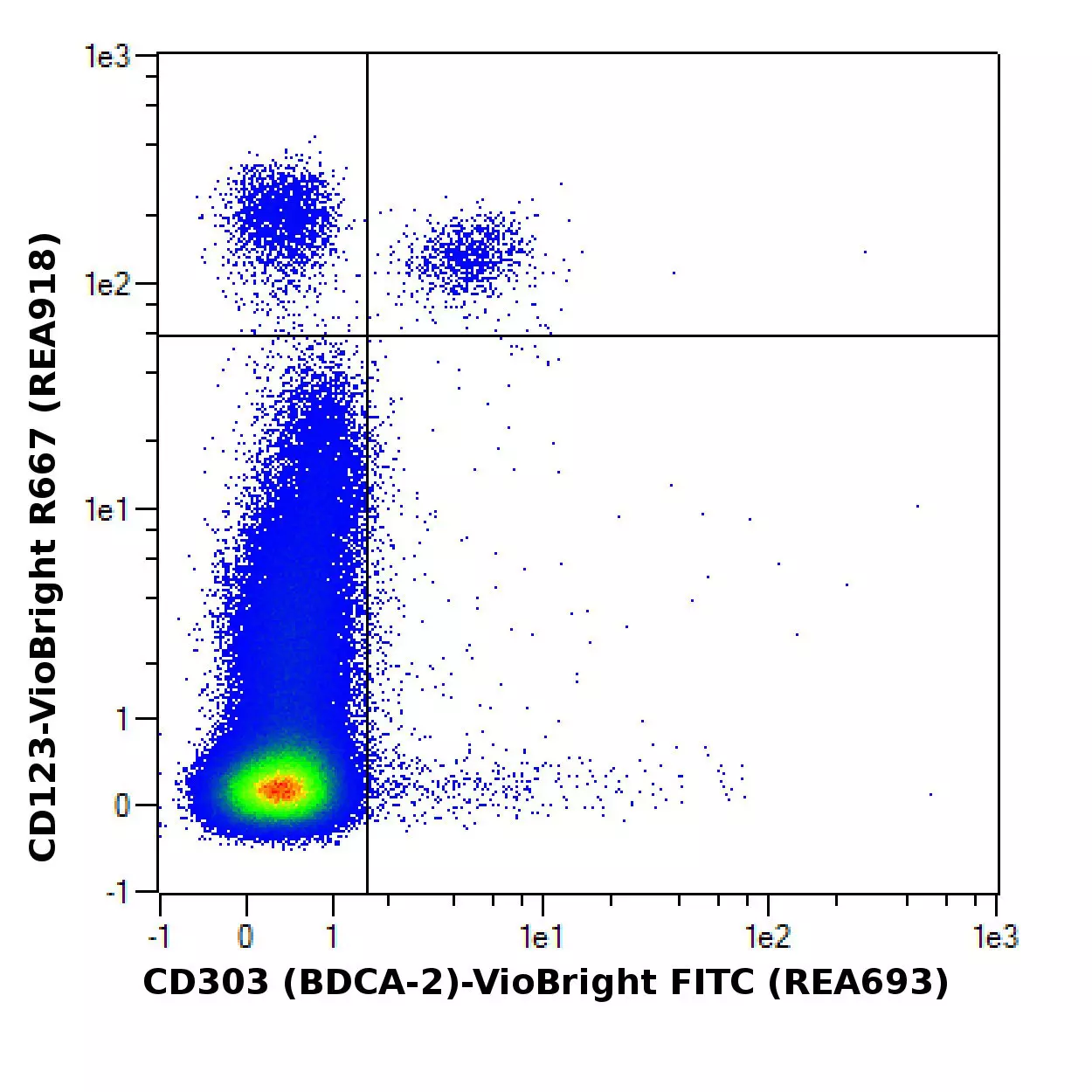
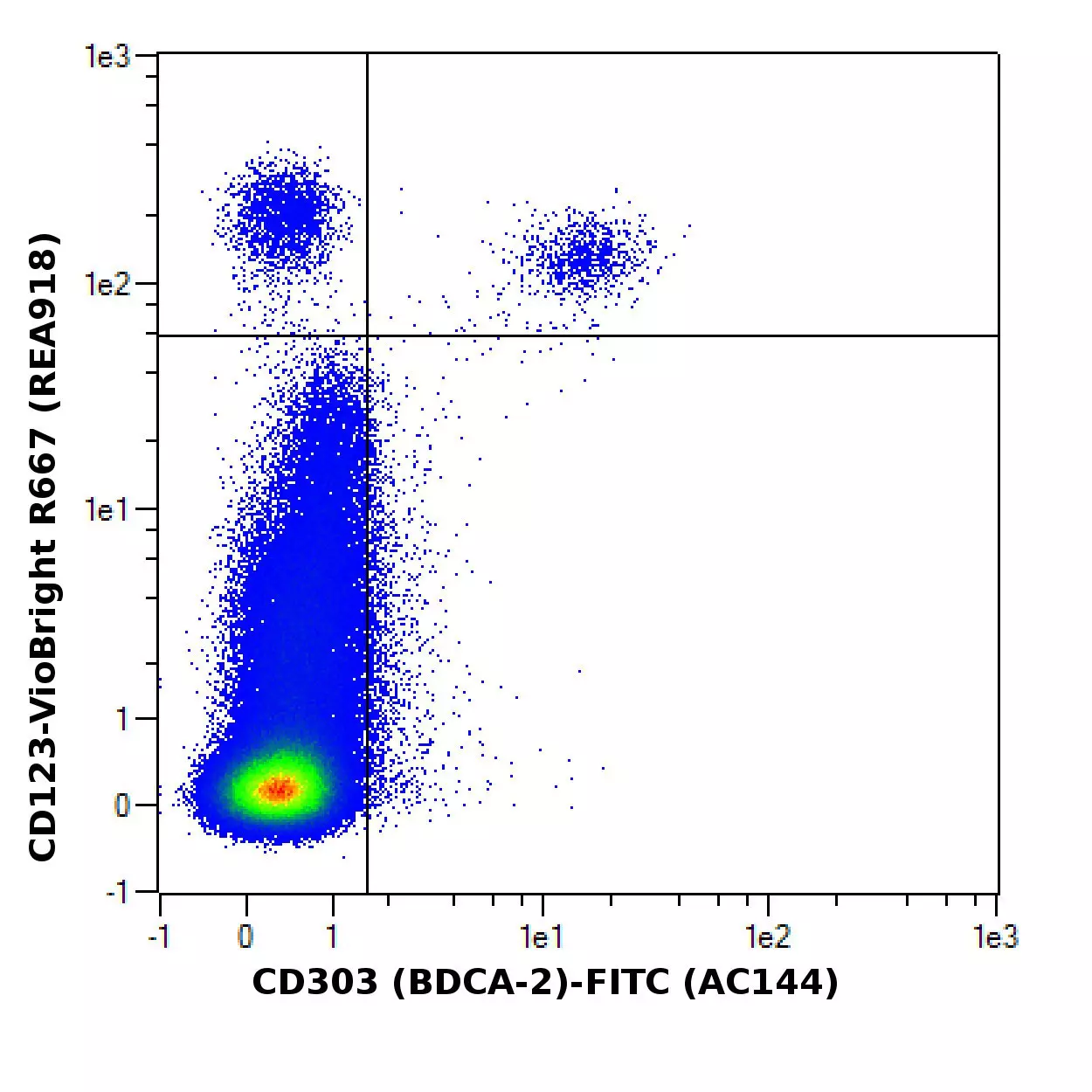
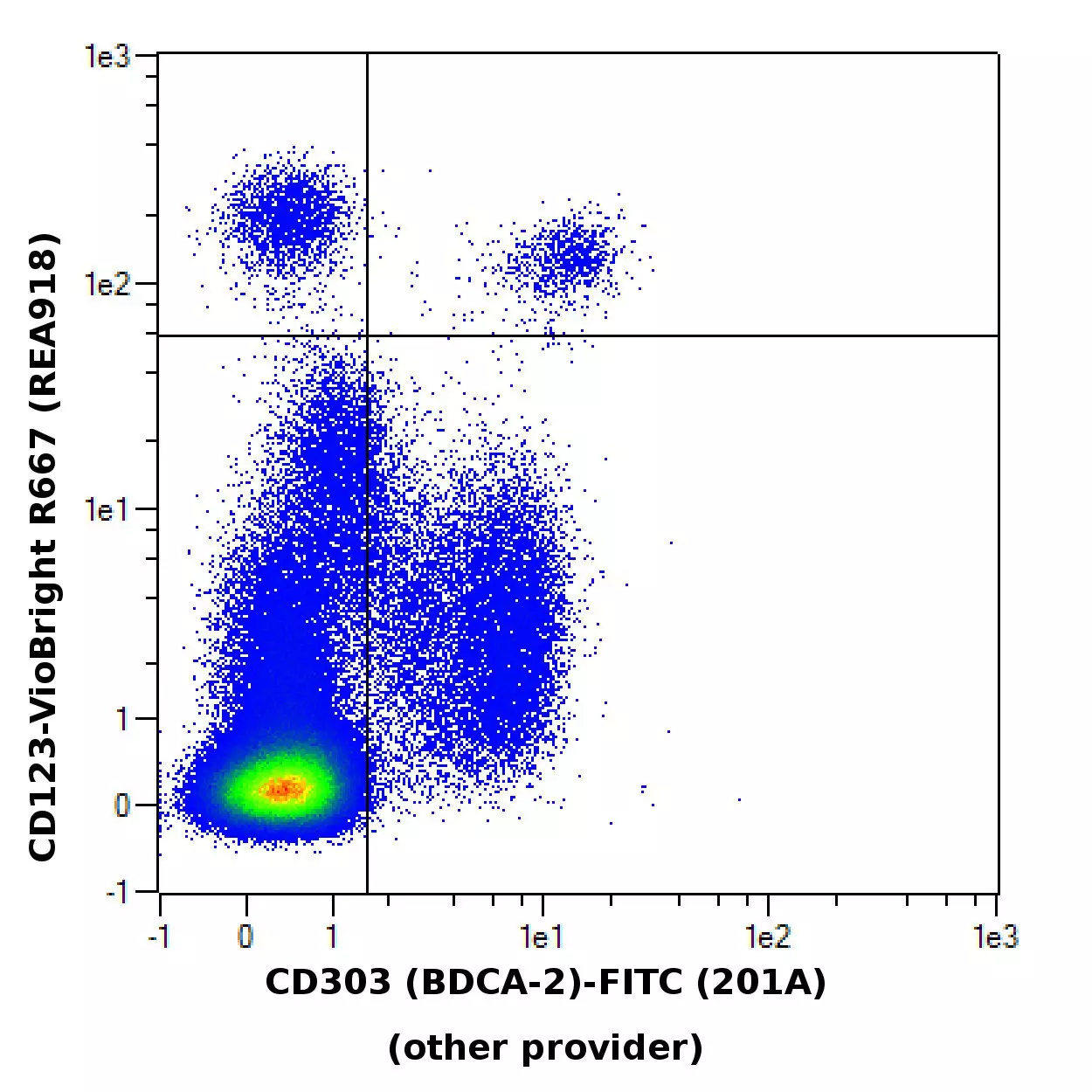
Flow cytometric comparison of different clones for CD303 (BDCA-2). Human peripheral blood mononuclear cells (PBMCs) were stained with CD303 (BDCA-2) antibodies and with a suitable counterstaining. As a control, CD303 (BDCA-2) antibody staining was omitted and cells were measured in the same channels. Flow cytometry was performed with the MACSQuant® Analyzer. Cell debris, dead cells, and cell doublets were excluded from the analysis based on scatter signals and propidium iodide fluorescence. No FcR Blocking Reagent was used. The recommended titers of respective antibodies from different suppliers were used.
To provide an indication on how an antibody performs after fixation of cells, in-house data on staining results before and after fixation with 3.7% formaldehyde using Miltenyi Biotec antibodies are provided. Different experimental settings may lead to different results.
No fixation
Post fixation

Comparison of staining pattern on non-fixed and fixed cells using CD303 (BDCA-2) (AC144). The performance of the antibody after fixation was tested by comparing the staining pattern on fresh (no fixation) versus fixed (post fixation) cells.
Specifications for CD303 (BDCA-2) Antibody, anti-human
Overview
CD303 (BDCA-2) antibodies have been used, for example, to identify, characterize, and enumerate plasmacytoid dendritic cells in whole blood of healthy and HIV-infected individuals, and for analyzing the role of DC-SIGN in HIV infection and transmission.7,11 Furthermore, CD303 (BDCA-2) antibodies were used to identify and enumerate plasmacytoid dendritic cells in blood and bone marrow samples before and after hematopoietic stem cell mobilization8 or transplantation10. CD303 (BDCA-2) antibodies were also used for immunohistochemical staining, for example to identify plasmacytoid dendritic cells in tissue sections from patients with different inflammatory skin diseases.5,12,13
Clone AC144 recognizes the the CD303 (BDCA-2) antigen1,3 which is expressed on human plasmacytoid dendritic cells in blood, lymphoid (e.g. tonsils and bone marrow) and non-lymphoid tissue.3,6 Specific expression allows direct identification of plasmacytoid dendritic cells using just one marker.1–11 CD303 (BDCA-2)+ plasmacytoid dendritic cells in blood and bone marrow are CD11c–, CD123high, CD4+, Lin–, CD45RA+, CD304 (BDCA-4/Neuropilin-1)+, CD141 (BDCA-3)low, CD1c (BDCA-1)–, CD14–, and CD2–. They express neither myeloid lineage markers (CD13, CD33) nor Fc receptors (CD32, CD64, FcRI).1,6 CD303 (BDCA-2) is strongly expressed on freshly isolated plasmacytoid dendritic cells but down-regulated within 48 hours of culturing.1 Unlike CD304 (BDCA-4/Neuropilin-1), CD303 (BDCA-2) is not detectable on ex vivo generated monocyte-derived or hematopoietic precursor cell-derived CD1a+ dendritic cells.1,9
The CD303 (BDCA-2) antigen is a novel type II transmembrane C-type lectin.3 Remarkably, plasmacytoid dendritic cells can take up ligands via CD303 (BDCA-2), then process and present the ligands to T cells.1,3 Unlike binding of antibodies to CD304 (BDCA-4), binding of antibodies to CD303 (BDCA-2) inhibits type I IFN production, which is induced in plasmacytoid dendritic cells by, for example, the influenza virus.3,6
CLEC4C, BDCA-2, CLECSF11, CLECSF7, DLEC, HECL, PRO34150
Detailed product information
Technical specifications
Clone
AC144
Clonality
monoclonal
Isotype
mouse IgG1κ
Isotype control
Isotype Control Antibody, mouse IgG1
Host
mouse
Type of antibody
Primary antibodies
Species reactivity
human, non-human primate
Cross-reactivity
cynomolgus monkey (Macaca fascicularis)
Antigen
CD303 (BDCA-2)
Molecular mass of antigen [kDa]
25
Distribution of antigen
dendritic cells, macrophages, monocytes, neutrophils
Entrez Gene ID
RRID
AB_2889543, AB_244164, AB_2661176, AB_2726015, AB_2726294, AB_2889544, AB_2726293, AB_2726016, AB_2726290, AB_2726017, AB_2726018, AB_2726019, AB_2726295, AB_2726291, AB_2726292, AB_2726020
Resources for CD303 (BDCA-2) Antibody, anti-human
Documents and Protocols
Certificates
To access a Certificate of Analysis (CoA) follow the link below and enter the specific lot of your product.
Should you wish to request additional documentation, such as a Safety Data Sheet (SDS) in other languages than English or Swedish, an SDS-replacement document, or a Certificate of Origin (CoO), please direct your inquiry to your local technical support team.
 Powered by Bioz
You have previously chosen International as your location.
What do you want to do?