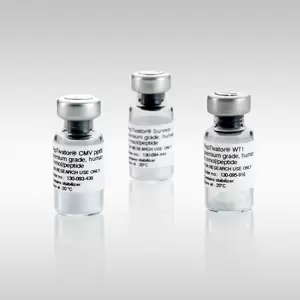
Stimulate T cells reactive to the membrane glycoprotein of the SARS-CoV-2 Wuhan wild-type using PepTivator Peptide Pools. PepTivators are pools of lyophilized peptides, consisting mainly of 15-mer sequences with 11 amino acids overlap. PepTivator SARS-CoV-2 Prot_M is a pool of lyophilized peptides, covering the complete sequence of the membrane glycoprotein (“M”) of SARS-Coronavirus 2 (GenBank MN908947.3, Protein QHD43419.1).
In vitro stimulation of antigen-specific T cells with PepTivator Peptide Pools causes the secretion of effector cytokines and the up-regulation of act


Related products for PepTivator® SARS-CoV-2 Prot_M

(excl. tax)

Stimulate T cells reactive to the membrane glycoprotein of the SARS-CoV-2 Wuhan wild-type using PepTivator Peptide Pools. PepTivators are pools of lyophilized peptides, consisting mainly of 15-mer sequences with 11 amino acids overlap. PepTivator SARS-CoV-2 Prot_M is a pool of lyophilized peptides, covering the complete sequence of the membrane glycoprotein (“M”) of SARS-Coronavirus 2 (GenBank MN908947.3, Protein QHD43419.1).
In vitro stimulation of antigen-specific T cells with PepTivator Peptide Pools causes the secretion of effector cytokines and the up-regulation of activation markers, which then allow the detection and isolation of antigen-specific T cells.
SARS-CoV-2 (severe acute respiratory syndrome coronavirus 2), also known as novel coronavirus 2019-nCoV, causes fever, severe respiratory illness and can lead to life threatening pneumonia. The first cases of this disease, termed COVID-19 for coronavirus disease 2019 have been detected in December 2019 in Wuhan, China.
SARS-CoV-2 Prot_M stands for the membrane glycoprotein of SARS-CoV-2. This protein is known to shape the viral envelope of coronaviruses and is involved in virion assembly as well as budding. Thus, the membrane glycoprotein (“M”) of SARS-CoV-2 has been suggested as possible target for vaccine development.
PepTivator® SARS-CoV-2 Prot_M – research grade has been specifically developed for in vitro stimulation of SARS-CoV-2–specific T cells. Peptides of 15 amino acids in length and 11 amino acids overlap represent an optimized solution for stimulating both CD4+ and CD8+ T cells in various applications, including:
- Detection and analysis of SARS-CoV-2–specific CD4+ and CD8+ effector/memory T cells in PBMCs by MACS® Cytokine Secretion Assays, intracellular cytokine staining, or other technologies.
- Isolation of viable SARS-CoV-2–specific CD4+ T cells with the CD154 MicroBead Kit, or of viable CD4+ and CD8+ T cells using MACS Cytokine Secretion Assay – Cell Enrichment and Detection Kits. Subsequently, cells can be expanded for generation of T cell lines.
- Generation of SARS-CoV-2–specific CD4+ and CD8+ effector/ memory T cells from naive T cell populations.
- Pulsing of antigen-presenting cells, e.g. for research on dendritic cell vaccination.
More information regarding the work with antigen-specific T cells can be found in the T cell application section.
Exemplary analysis of SARS-CoV-2–specific CD4+ and CD8+ T cells. A) PBMCs were stimulated with a mix of PepTivator SARS-CoV-2 Prot_N, Prot_M, and Prot_S or unstimulated as negative control. The data shows CD154 and TNF-α for CD4+ T cells and TNF-α and IFN-γ for CD8+ T cells. B/C). Either PepTivators covering the complete sequence of the nucleoprotein (N; PepTivator SARS-CoV-2 Prot_N), the membrane protein (M; PepTivator SARS-CoV-2 Prot_M), the spike protein (S; PepTivator SARS-CoV-2 Prot_S, Prot_S1, and Prot_S+), or the mix of all were used to stimulate SARS-CoV-2–reactive T cells. Frequencies of CD154+ within CD4+ T cells and TNF-α+ within CD8+ T cells are shown. In the quantitative analysis (B) each dot corresponds to one donor and in the heat maps (C) SARS-CoV-2–reactive T cell frequencies measured for each donor are color coded.
Recovered COVID-19 patients show elevated levels of IFN-γ–producing CD3+ T cells upon stimulation with SARS‑CoV‑2 PepTivator Peptide Pools. Samples of a healthy donor and a recovered COVID-19 patient were stimulated for 4 h with the indicated SARS-CoV-2 PepTivator Peptide Pools (Prot_N, Prot_M, Prot_S, or a mix of all three) in the presence of BFA. As negative control, samples were left untreated without (w/o) antigen. Subsequently, T cell lineage surface markers and intracellular cytokines were stained. The presented plots are exemplary data showing IFN-γ+CD3+ T cells.
- Sir Karakus, G. et al. (2021) Preclinical efficacy and safety analysis of gamma-irradiated inactivated SARS-CoV-2 vaccine candidates. Sci Rep 11 (1): 5804
- Demaret, J. et al. (2020) Severe SARS‐CoV‐2 patients develop a higher specific T‐cell response. Clin Transl Immunology 9 (12): e1217
- Thieme, C. J. et al. (2020) Robust T Cell Response Toward Spike, Membrane, and Nucleocapsid SARS-CoV-2 Proteins Is Not Associated with Recovery in Critical COVID-19 Patients. Cell Rep Med. 1 (6): 100092
- Cooper, R. S. et al. (2021) Rapid GMP-Compliant Expansion of SARS-CoV-2-Specific T Cells From Convalescent Donors for Use as an Allogeneic Cell Therapy for COVID-19. Front Immunol 11: 598402
- Vallejo, A. et al. (2021) IFN-γ+ cell response and IFN-γ release concordance after in vitro SARS-CoV-2 stimulation. Eur J Clin Invest 51 (12)
- Bacher, P. et al. (2020) Low avidity CD4+ T cell responses to SARS-CoV-2 in unexposed individuals and humans with severe COVID-19. Immunity 53: 1258-1271
- Ferreras, C. et al. (2020) SARS-CoV-2-Specific Memory T Lymphocytes From COVID-19 Convalescent Donors: Identification, Biobanking, and Large-Scale Production for Adoptive Cell Therapy. Front Cell Dev Biol. 9: 9:620730
- Sattler, A. et al. (2020) SARS-CoV-2-specific T cell responses and correlations with COVID-19 patient predisposition. J. Clin. Invest. 130 (12): 6477-6489
- Jung, J. H. et al. (2021) SARS-CoV-2-specific T Cell Memory is Sustained in COVID-19 Convalescents for 8 Months with Successful Development of Stem Cell-like Memory T Cells. Nat Commun 12 (1): 4043
- Aiello, A. et al. (2021) Spike is the most recognized antigen in the whole-blood platform in both acute and convalescent COVID-19 patients. Int J Infect Dis 106: 338-347
- Habel, J. R. et al. (2020) Suboptimal SARS-CoV-2-specific CD8+ T cell response associated with the prominent HLA-A*02:01 phenotype. Proc. Natl. Acad. Sci. U.S.A. 117 (3): 24384-24391
- Ram, R. et al. (2021) Safety and Immunogenicity of the BNT162b2 mRNA COVID-19 Vaccine in Patients after Allogeneic HCT or CD19-based CART therapy-A Single-Center Prospective Cohort Study. Transplant Cell Ther. 27 (9): 788-749
- Riou, C. et al. (2020) Rapid, simplified whole blood-based multiparameter assay to quantify and phenotype SARS-CoV-2 specific T cells. Eur. Respir. J. 59 (1): 2100
- Strafella, C. et al. (2021) Case Report: Sars-CoV-2 Infection in a Vaccinated Individual: Evaluation of the Immunological Profile and Virus Transmission Risk. Front Immunol 12 (doi: 10.3389/fimmu.2021.708820)
- Leung, W. et al. (2020) Rapid production of clinical-grade SARS-CoV-2 specific T cells. Adv Cell Gene Ther : doi: 10.1002/acg2.101
- Singh, D. K. et al. (2021) Responses to acute infection with SARS-CoV-2 in the lungs of rhesus macaques, baboons and marmosets. Nat Microbiol 6 (1): 73-86
- Kusnadi, A. et al. (2021) Severely ill COVID-19 patients display augmented functional properties in SARS-CoV-2-reactive CD8+ T cells. Sci Immunol 6: eabe4782
- Shomuradova, A. S. et al. (2020) SARS-CoV-2 epitopes are recognized by a public and diverse repertoire of human T cell receptors. Immunity 53 (6): 1245-1257
- Meckiff, J. et al. (2020) Imbalance of Regulatory and Cytotoxic SARS-CoV-2-Reactive CD4+ T Cells in COVID-19. Cell 183 (5): 1340-1353
- Chan, Y.-H. et al. (2021) Asymptomatic COVID-19: disease tolerance with efficient anti-viral immunity against SARS-CoV-2. EMBO Mol. Med. 13 (6)
- Fendler, A. et al. (2021) Adaptive immunity to SARS-CoV-2 in cancer patients: The CAPTURE study. Nat Cancer 2: 1321-1337
- Bonifacius, A. et al. (2021) COVID-19 immune signatures reveal stable antiviral T cell function despite declining humoral responses. Immunity 54 (2): 340-354
- Au, L. et al. (2021) Cytokine release syndrome in a patient with colorectal cancer after vaccination with BNT162b2. Nat Med 27 (8): 1362-1366
- Riou, C. et al. (2021) Profile of SARS-CoV-2-specific CD4 T cell response: Relationship with disease severity and impact of HIV-1 and active Mycobacterium tuberculosis co-infection. J. Clin. Invest. 131 (12): doi: 10.1172/JCI149125
- Anft, M. et al. (2021) Detection of pre-existing SARS-CoV-2-reactive T cells in unexposed renal transplant patients. J Nephrol. 34 (4): 1025-1037
- Grau-Expósito, J. et al. (2021) Peripheral and lung resident T cell responses against SARS-CoV-2. Nat Commun 12 (1): 3010
- Sekine, T. et al. (2020) Robust T Cell Immunity in Convalescent Individuals with Asymptomatic or Mild COVID-19. Cell 183 (1): 158-168
You have previously chosen International as your location.
What do you want to do?