Granulocyte-macrophage colony–stimulating factor (GM-CSF) is a hematopoietic growth factor, which is essential for proliferation and development of granulocyte and monocyte/macrophage progenitors.
MACS GMP Recombinant Human GM-CSF is designed for ex vivo cell culture processing. No animal- or human-derived materials were used for the manufacture of this product, unless otherwise stated in the respective Certificate of Origin. The product is lyophilized without carrier protein or preservatives.


Related products for MACS® GMP Recombinant Human GM-CSF


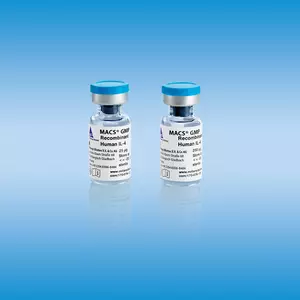
Granulocyte-macrophage colony–stimulating factor (GM-CSF) is a hematopoietic growth factor, which is essential for proliferation and development of granulocyte and monocyte/macrophage progenitors.
MACS GMP Recombinant Human GM-CSF is designed for ex vivo cell culture processing. No animal- or human-derived materials were used for the manufacture of this product, unless otherwise stated in the respective Certificate of Origin. The product is lyophilized without carrier protein or preservatives.
CSF2
Biological activity
Beside its role as growth factor for granulocyte and monocyte precursors, GM-CSF also functions as a growth factor for erythroid and megakaryocytic precursor cells in conjunction with erythropoietin. GM-CSF is secreted by various cell types including T cells, macrophages, endothelial cells, and fibroblasts in response to inflammatory stimuli and cytokines. In addition, GM-CSF is a potent chemoattractant for neutrophils and eosinophils and enhances the effector functions of neutrophils and macrophages.
MACS GMP Recombinant Human GM-CSF can be used for a variety of applications, including the ex vivo generation of human dendritic cells from enriched CD14+ monocytes.2–4
Technical specifications
- Identity/ Molecular mass: 14474 Da, determined by mass spectrometry. This corresponds to the mature form of human GM-CSF (127 amino acids).
- Purity: ≥ 95 % as determined by chip electrophoresis.
- Endotoxin content: < 50 EU/mg, as determined by kinetic Limulus Amoebocyte Lysate (LAL) assay (Pharmacopoeia Europaea (Ph. Eur.)).
- Residual host cell DNA content: < 20 ng/mg, as determined by quantitative PCR specific for E. coli genomic DNA.
- Residual host cell protein content: < 10 µg/mg, as determined by E. coli HCP ELISA.
The product quality certificate of our MACS® GMP Recombinant Human GM-CSF has been adapted. Learn more here
MACS GMP Products are manufactured and tested under a quality management system (ISO 13485) and are in compliance with relevant GMP guidelines. They are designed following the recommendations of USP <1043> on ancillary materials.
MACS GMP Products are for ex vivo cell processing only, and are not intended for human in vivo applications. For regulatory status in the USA, please contact your local representative.
Mass spectrometry analysis (ESI-MS) of MACS GMP Recombinant Human GM-CSF. The peak corresponds to the calculated molecular mass of 14474 Da.
MACS GMP Recombinant Human GM-CSF biological activity. Activity of Human GM-CSF, GMP grade, (blue bar) was compared to other commercially available products (black and grey bar).
MACS GMP Recombinant Human GM-CSF batch-to-batch variability. Activity of three different production batches of Human MACS GMP GM-CSF.
Enter the lot number from your product label to access its Product Quality Certificated (PQC).
- Kitamura, T. et al. (1989) Establishment and characterization of a unique human cell line that proliferates dependently on GM-CSF, IL-3, or erythropoietin. J. Cell. Physiol. 140: 323-334
- Bender, A. et al. (1996) Improved methods for the generation of dendritic cells from nonproliferating progenitors in human blood. J. Immunol. Methods 196: 121-135
- Romani, N. et al. (1996) Generation of mature dendritic cells from human blood. An improved method with special regard to clinical applicability. J. Immunol. Methods 196: 137-151
- Jonuleit, H. et al. (1997) Pro-inflammatory cytokines and prostaglandins induce maturation of potent immunostimulatory dendritic cells under fetal calf serum-free conditions. Eur. J. Immunol. 27: 3135-3142
You have previously chosen International as your location.
What do you want to do?