IL-23 stands for interleukin 23. Human IL-23 is a recombinant protein optimized for use in cell culture, differentiation studies, and functional assays.


Related products for Human IL-23
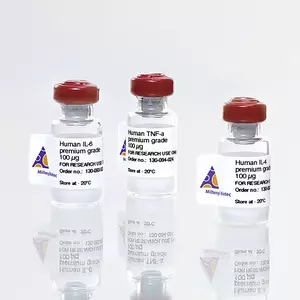
IL-23 stands for interleukin 23. Human IL-23 is a recombinant protein optimized for use in cell culture, differentiation studies, and functional assays.
Human IL-23 can be used for a variety of applications, including:
- In vitro differentiation of CD4+ T cells towards TH17 cells and proliferation of TH17 cells.
- Exploration of the role of IL-23 in autoimmune diseases or inflammatory bowel diseases.
- Investigation of IL-23–mediated molecular signaling pathways.
Biological activity
Interleukin 23 (IL-23) is a covalently linked heterodimeric cytokine, which is closely related to IL-12. Macrophages and dendritic cells (DCs) are the major sources of both IL-12 and IL-23, which act on receptors primarily expressed by T cells, NK cells, and NKT cells. IL-23 consists of the p40 subunit shared with IL-12 (IL-12B, IL-12 p40, IL-23 p40) and the 19 kDa protein p19 (IL-23 p19, IL-23A). Its effects are mediated by a receptor composed of IL-12 receptor subunit B1 and an IL-23 specific subunit. While IL-12 drives the development of TH1 cells, IL-23 mediates the full differentiation and maintenance of TH17 cells. IL-23 stimulates memory CD4+ rather than naive T cells and promotes the production of pro-inflammatory cytokines. As a key cytokine in the survival and proliferation of TH17 cells, IL-23 has central roles in autoimmune diseases and promotes chronic inflammation. It has been shown that single chain fusion proteins of naturally heterodimeric cytokines such as IL-12 or IL-23 are bioactive in vitro and in vivo.
Research-grade cytokines are suitable for a wide variety of cell culture applications. They are sterile-filtered prior to lyophilization. Generally, endotoxin levels are <0.1 ng/μg (<1 EU/μg), and purities are >95%. The biological activity is tested in appropriate bioassays.
SDS-PAGE of Human IL-23 under reducing conditions (R). Units p40 and p19 are fused by a flexible linker region resulting in glycosylated single-chain polypeptide of 504 amino acids.
To access a Certificate of Analysis (CoA) follow the link below and enter the specific lot of your product.
Should you wish to request additional documentation, such as a Safety Data Sheet (SDS) in other languages than English or Swedish, an SDS-replacement document, or a Certificate of Origin (CoO), please direct your inquiry to your local technical support team.
- Lieschke, G. J. et al. (1997) Bioactive murine and human interleukin-12 fusion proteins which retain antitumor activity in vivo. Nat. Biotechnol. 15: 35-40
- Miller, J. M. et al. (2010) Vesicular stomatitis virus modified with single chain IL-23 exhibits oncolytic activity against tumor cells in vitro and in vivo. Int. J. Infereron Cytokine Mediator Res. 2010: 63-72
- Damsker, J. M. et al. (2010) Tʜ1 and Tʜ17 cells: adversaries and collaborators. Ann. N. Y. Acad. Sci. 1183: 211-221
You have previously chosen International as your location.
What do you want to do?