The CD304 (BDCA-4/Neuropilin-1) MicroBead Kit has been developed for the enrichment of plasmacytoid dendritic cells (PDCs) from PBMCs by positive selection.


Related products for CD304 (BDCA-4/Neuropilin-1) MicroBead Kit, human

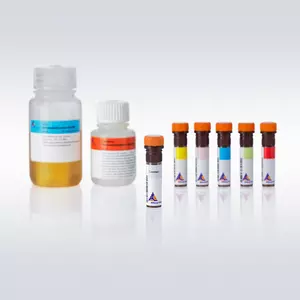
The CD304 (BDCA-4/Neuropilin-1) MicroBead Kit has been developed for the enrichment of plasmacytoid dendritic cells (PDCs) from PBMCs by positive selection.
CD304 (BDCA-4/Neuropilin-1)1 is specifically expressed by PDCs in human blood1–5, bone marrow6, and cord blood11. Exclusive expression of CD304 (BDCA-4/Neuropilin-1) on PDCs allows their direct isolation. In blood and bone marrow, CD304 (BDCA-4/Neuropilin-1)+ PDCs are CD4+, CD45RA+, CD303 (BDCA-2)+, CD141 (BDCA-3)dim, CD1c (BDCA-1)–, and CD2–. They lack expression of lineage markers (CD3, CD14, CD16, CD19, CD20, CD56) and neither express myeloid markers such as CD13 and CD33, nor Fc receptors such as CD32, CD64, or FcεRI. Their lymphoid origin is indicated by their plasmacytoid morphology and the expression of the pre-T cell receptor α-chain. Freshly isolated CD1c (BDCA-1)+ or CD141 (BDCA-3)++ myeloid blood dendritic cells and monocytes do not express CD304 (BDCA-4/Neuropilin-1), but expression of CD304 (BDCA-4/Neuropilin-1) is induced on myeloid blood dendritic cells and monocytes upon culturing.1, 6 In inflamed tonsils, CD304 (BDCA-4/Neuropilin-1) expression is, apart from PDCs, also detected on some other cells, primarily follicular B helper memory T cells.6
CD304 (BDCA-4) was shown to be identical to neuropilin-1 (NP-1).6 Neuropilin-1 has formerly been discovered to be expressed on numerous nonhematopoietic cell types including neurons, endothelial and tumor cells.
Unlike binding of antibodies to CD303 (BDCA-2), binding of antibodies to CD304 (BDCA-4/Neuropilin-1) does not have a substantial effect on IFN type I production in PDCs after induction by, e.g., influenza virus.5, 6, 14
Isolated CD304 (BDCA-4/Neuropilin-1)+ PDCs were used, for example, to examine expression of Toll-like receptors4, 7, 8, 12, chemokine receptors3, 8, 10, or antigens, e.g., EMR2,9 and for studies on dendritic cell activation4, migration3, cytokine production4, 6, 8, and T cell polarization4, 6, 13. Functional and phenotypical analysis was performed, e.g., of PDCs isolated from PMBCs and synovial fluid from psoriatic arthritis and rheumotoid arthritis patients15.
MS, LS, or autoMACS® Columns.
Isolation of CD304 (BDCA-4/Neuropilin-1)+ plasmacytoid dendritic cells from PBMCs using the CD304 (BDCA-4/Neuropilin-1) MicroBead Kit, MS Columns, and a MiniMACS™ Separator. Cells were stained with CD303 (BDCA-2)-FITC and CD123-APC. Like CD304 (BDCA-4/Neuropilin-1), the CD303 (BDCA-2) antigen is specifically expressed on plasmacytoid dendritic cells in blood, and allows their direct identification. Apart from plasmacytoid dendritic cells, CD123 is also expressed at high levels on basophils and at low levels on monocytes and myeloid dendritic cells.
Plasmacytoid dendritic cells were isolated from PBMCs by using the CD304 (BDCA-4/Neuropilin-1) MicroBead Kit, and May-Grünwald/Giemsa stained.
IFN-α secretion of CD304 (BDCA-4/Neuropilin-1)+ blood dendritic cells. Plasmacytoid dendritic cells were isolated using the CD304 (BDCA-4/Neuropilin-1) MicroBead Kit and cultured for 24 hours in the presence of 10 ng/mL IL-3 with and without influenza virus (5 HAU/mL, strain PR8). Secretion of IFN-α was determined by ELISA.5,6
- Jarrossay, D. et al. (2001) Specialization and complementarity in microbial molecule recognition by human myeloid and plasmacytoid dendritic cells. Eur. J. Immunol. 31: 3388-3393
- Grabbe, S. et al. (2000) Dendritic cells: multi-lineal and multi-functional. Immunol. Today 21: 431-433
- Penna, G. et al. (2001) Cutting Edge: Selective usage of chemokine receptors by plasmacytoid dendritic cells.. J Immunol 167: 1862-1866
- Penna, G. et al. (2002) Cutting edge: differential chemokine production by myeloid and plasmacytoid dendritic cells. J Immunol 169: 6673-6676
- Hornung, V. et al. (2002) Quantitative expression of toll-like receptor 1-10 mRNA in cellular subsets of human peripheral blood mononuclear cells and sensitivity to CpG oligodeoxynucleotides. J Immunol 168: 4531-4537
- Dzionek, A. et al. (2000) BDCA-2, BDCA-3, BDCA-4: Three markers for distinct subsets of dendritic cells in human peripheral blood. J Immunol 165: 6037-6046
- Krug, A. et al. (2001) Toll-like receptor expression reveals CpG DNA as a unique microbial stimulus for plasmacytoid dendritic cells which synergizes with CD40 ligand to induce high amounts of IL-12. Eur. J. Immunol. 31: 3026-3037
- Kwakkenbos, M. J. et al. (2002) The human EGF-TM7 family member EMR2 is a heterodimeric receptor expressed on myeloid cells. J Leukoc Biol 71 (5): 854-862
- Matsumoto, M. et al. (2003) Subcellular localization of Toll-like receptor 3 in human dendritic cells. J Immunol 171: 3154-3162
- Kaser, A. et al. (2004) Interleukin-18 attracts plasmacytoid dendritic cells (DC2s) and promotes Tʜ1 induction by DC2s through IL-18 receptor expression. Blood 103: 648-655
- Jongbloed, S. L. et al. (2006) Enumeration and phenotypical analysis of distinct dendritic cell subsets in psoriatic arthritis and rheumatoid arthritis. Arthritis Res. Ther. 8: R15
- Dzionek, A. et al. (2001) BDCA-2, a novel plasmacytoid dendritic cell–specific type II C-type lectin, mediates antigen capture and is a potent inhibitor of interferon α/β induction. J. Exp. Med. 194: 1823-1834
- Colonna, M. et al. (2004) Plasmacytoid dendritic cells in immunity. Nat Immunol 5: 1219-1226
- Dzionek, A. et al. (2002) Plasmacytoid dendritic cells: from specific surface markers to specific cellular functions. Hum Immunol 63: 1133-1148
- De Wit, D. et al. (2004) Blood plasmacytoid dendritic cell responses to CpG oligonucleotides are impaired in human newbornes. Blood 103: 1030-1032
You have previously chosen International as your location.
What do you want to do?