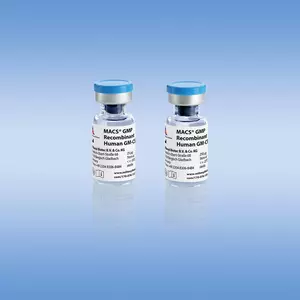
Recombinant human GM-CSF induces the differentiation of granulocytes, monocytes, and macrophages. The hematopoietic cytokine is a crucial part of the immune/inflammatory path and serves as both a survival and activation signal for mature myeloid cells. The recombinant granulocyte-macrophage colony-stimulating factor (GM-CSF) has been developed for use in cell culture, differentiation studies, and functional assays.


Related products for Human GM-CSF

Human GM-CSF activity assay. The biological activity of Human GM-CSF, premium grade was determined by proliferation assay using TF-1 cells. Activity of Human GM-CSF, premium grade, (red line) was compared to another commercially available product (black line).
SDS-PAGE of Human GM-CSF, premium grade under reducing (R) and non-reducing (NR) conditions.
Human GM-CSF biological activity. Activity of Human GM-CSF, premium grade (red bar) was compared to another commercially available product (black bar).
Mass spectrometry analysis (ESI-MS) of Human GM-CSF, premium grade. The peak corresponds to the calculated molecular mass of 14474 Da.
Recombinant human GM-CSF induces the differentiation of granulocytes, monocytes, and macrophages. The hematopoietic cytokine is a crucial part of the immune/inflammatory path and serves as both a survival and activation signal for mature myeloid cells. The recombinant granulocyte-macrophage colony-stimulating factor (GM-CSF) has been developed for use in cell culture, differentiation studies, and functional assays.
Human GM-CSF can be used for a variety of applications including:
- Cultivation of hematopoietic progenitor cells from human bone marrow in semi-solid medium.
- In vitro generation of Mo-DCs together with Human IL-4.
- In vitro differentiation of CD34+ cells towards eosinophils.
- Migration assays for eosinophils.
CSF2
Biological activity
GM-CSF is a hematopoietic growth factor, which is essential for proliferation and development of granulocyte and monocyte/macrophage progenitors. It also functions as a growth factor for erythroid and megakaryocytic precursor cells in conjunction with erythropoietin. GM-CSF is secreted by various cell types including T cells, macrophages, endothelial cells, and fibroblasts in response to inflammatory stimuli and cytokines. In addition, GM-CSF is a potent chemoattractant for neutrophils and eosinophils and enhances the effector functions of neutrophils and macrophages.
Research-grade cytokines are suitable for a wide variety of cell culture applications. They are sterile-filtered prior to lyophilization. Generally, endotoxin levels are <0.1 ng/μg (<1 EU/μg), and purities are >95%. The biological activity is tested in appropriate bioassays.
Premium-grade cytokines offer the convenience of high and well-defined biological activities and allow exact unit dosing for demanding applications. The biological activity is determined after lyophilization and reconstitution, and normalized to WHO/NIBSC standards whenever available. In general, endotoxin levels are <0.01 ng/μg (<0.1 EU/μg), and purities are >97%. Lot-specific activities are stated in the Certificate of Analysis (www. miltenyibiotec.com/certificates).
To access a Certificate of Analysis (CoA) follow the link below and enter the specific lot of your product.
Should you wish to request additional documentation, such as a Safety Data Sheet (SDS) in other languages than English or Swedish, an SDS-replacement document, or a Certificate of Origin (CoO), please direct your inquiry to your local technical support team.
- Foord, E. et al. (2020) Profound functional suppression of tumor-infiltrating T-cells in ovarian cancer patients can be reversed using PD-1-blocking antibodies or DARPin® proteins. J Immunol Res : 7375947
- Bernin, H. et al. (2016) The cytokine profile of human NKT cells and PBMCs is dependent on donor sex and stimulus. Med Microbiol Immunol. 205 (4): 321-322
- Kitamura, T. et al. (1989) Establishment and characterization of a unique human cell line that proliferates dependently on GM-CSF, IL-3, or erythropoietin. J. Cell. Physiol. 140: 323-334
- Laurenti, E. et al. (2015) CDK6 levels regulate quiescence exit in human hematopoietic stem cells. Cell Stem Cell 16 (3): 302-313
- Giroud, P. et al. (2020) Expression of TAM-R in human immune cells and unique regulatory function of MerTK in IL-10 production by tolerogenic DC. Front Immunol 11: 564133
- Bacher, P. et al. (2014) Antigen-specific expansion of human regulatory T cells as a major tolerance mechanism against mucosal fungi. Mucosal Immunol 7 (4): 916-928
- Chase A. J. et al. (2011) Impairment of CD4+ T cell polarization by dengue virus-infected dendritic cells. J. Infect. Dis. 203: 1763-1774
- Désy, O. et al. (2018) Allogeneic dendritic cells stimulated with antibodies against HLA class II polarize naive T cells in a follicular helper phenotype. Sci Rep 8 (1): 4025
- Kiener, R. et al. (2018) Vaccine vectors based on Adenovirus 19a/64 exhibit broad cellular tropism and potently restimulate HCMV-specific T cell responses ex vivo. Sci Rep 8 (1): 1474
- Marino, F. et al. (2020) Biogenesis of HLA Ligand Presentation in Immune Cells Upon Activation Reveals Changes in Peptide Length Preference. Front Immunol 11: 1981
- Ulfman, L. H. et al. (2008) Homeostatic intracellular-free Ca2+ is permissive for Pap1-mediated constitutive activation of α4 integrins on eosinophils. J Immunol 180: 5512-5519
- Dighe, N. et al. (2014) Long-term reproducible expression in human fetal liver hematopoietic stem cells with a UCOE-based lentiviral vector. PLoS One 9 (8): e104805
- Kaebisch R. et al. (2014) Helicobacter pylori cytotoxin-associated gene A impairs human dendritic cell maturation and function through IL-10-mediated activation of STAT3. J Immunol 192: 316-323
- Guery, L. et al. (2014) Fine-tuning nucleophosmin in macrophage differentiation and activation. Blood 118: 4694-4704
- Zubizarreta, I. et al. (2019) Immune tolerance in multiple sclerosis and neuromyelitis optica with peptide-loaded tolerogenic dendritic cells in a phase 1b trial. Proc. Natl. Acad. Sci. U.S.A. 116 (17): 8463-8470
- Feray, A. et al. (2020) How to address the adjuvant effects of nanoparticles on the immune system. Nanomaterials (Basel) 10 (3): 425
- Koning, F. A. et al. (2009) Defining APOBEC3 expression patterns in human tissues and hematopoietic cell subsets. J. Virol. 83: 9474-9485
- Sampangi, S. et al. (2015) The mechanisms of human renal epithelial cell modulation of autologous dendritic cell phenotype and function. PLoS One 10 (7): e0134688
- Brault, J. et al. (2014) Optimized generation of functional neutrophils and macrophages from patient-specific induced pluripotent stem cells: ex vivo models of X0-linked, AR220- and AR470- chronic granulomatous diseases. Biores Open Access 3 (6): 311-326
- Hsieh, S.-H. et al. (2017) Persistence within dendritic cells marks an antifungal evasion and dissemination strategy of Aspergillus terreus. Sci Rep 6;7 (1): 10590
- Perea-Gil, I. et al. (2015) Preclinical evaluation of the immunomodulatory properties of cardiac adipose tissue progenitor cells using umbilical cord blood mesenchymal stem cells: a direct comparative study. Biomed Res Int : 439808
You have previously chosen International as your location.
What do you want to do?