The CD34 MicroBead Kit has been developed for the positive selection of CD34+ hematopoietic stem and progenitor cells in a single step. CD34+ cells can be isolated from:
- peripheral blood (PBMCs)
- bone marrow1
- leukapheresis product2
- cord blood3
- differentiated ES and iPS cell lines4,5.


Related products for CD34 MicroBead Kit, human




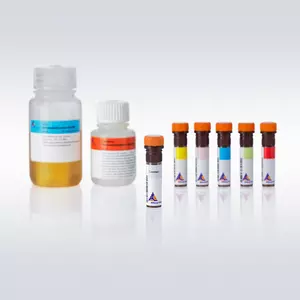
Flow cytometric analysis of CD34+ cells isolated from bone marrow mononuclear cells (BM-MNCs) using the CD34 MicroBead Kit, an MS Column, and a MiniMACS™ Separator.
The CD34 MicroBead Kit has been developed for the positive selection of CD34+ hematopoietic stem and progenitor cells in a single step. CD34+ cells can be isolated from:
- peripheral blood (PBMCs)
- bone marrow1
- leukapheresis product2
- cord blood3
- differentiated ES and iPS cell lines4,5.
CD34 is a well-established marker of human hematopoietic stem and progenitor cells and additionally expressed on hemangioblasts5,6, endothelial progenitor cells5,7-9, and mature endothelial cells8.
Control staining of cells isolated with the CD34 MicroBead Kit requires a monoclonal CD34 antibody other than QBEND/10, e.g., clone AC136.
Cells isolated with the CD34 MicroBead Kit are suitable for various downstream applications, including:
- flow cytometric analysis
- expansion in culture
- in vitro differentiation5
- reprogramming3
- retroviral transduction10
- gene expression analyses
- transplantation into humanized mice
MS, LS, XS, or autoMACS® Columns.
- Chen, T. H. P. et al. (2011) Knockdown of Hspa9, a del(5q31.2) gene, results in a decrease in hematopoietic progenitors in mice. Blood 117: 1530-1539
- Ban, H. et al. (2011) Efficient generation of transgene-free human induced pluripotent stem cells (iPSCs) by temperature-sensitive Sendai virus vectors. Proc. Natl. Acad. Sci. U.S.A. 108: 14234-9
- Bandi, S. and Akkina, R. (2008) Human embryonic stem cell (hES) derived dendritic cells are functionally normal and are susceptible to HIV-1 infection. AIDS Res. Ther. 5: 1
- Valgimigli, M. et al. (2004) CD34+ and endothelial progenitor cells in patients with various degrees of congestive heart failure. Circulation 110: 1209-1212
- Loges, S. et al. (2004) Identification of the adult human hemangioblast. Stem Cells Dev. 13: 229-242
- Peichev, M. et al. (2000) Expression of VEGFR-2 and AC133 by circulating human CD34+ cells identifies a population of functional endothelial precursors. Blood 95: 952-958
- Wang, Z. Z. et al. (2007) Endothelial cells derived from human embryonic stem cells form durable blood vessels in vivo. Nat. Biotechnol. 25: 317-318
- Rafii, S. and Lyden, D. (2003) Therapeutic stem and progenitor cell transplantation for organ vascularization and regeneration. Nat Med 9: 702-712
- Brault, J. et al. (2014) Optimized generation of functional neutrophils and macrophages from patient-specific induced pluripotent stem cells: ex vivo models of X0-linked, AR220- and AR470- chronic granulomatous diseases. Biores Open Access 3 (6): 311-326
- Schreiber, T. D. et al. (2009) The integrin alpha9beta1 on hematopoietic stem and progenitor cells: involvement in cell adhesion, proliferation and differentiation. Haematologica 94: 1493-1501
- Jing, D. et al. (2010) CD49d blockade by natalizumab in patients with multiple sclerosis affects steady-state hematopoiesis and mobilizes progenitors with a distinct phenotype and function. Bone Marrow Transplant. 45: 1489-1496
You have previously chosen International as your location.
What do you want to do?