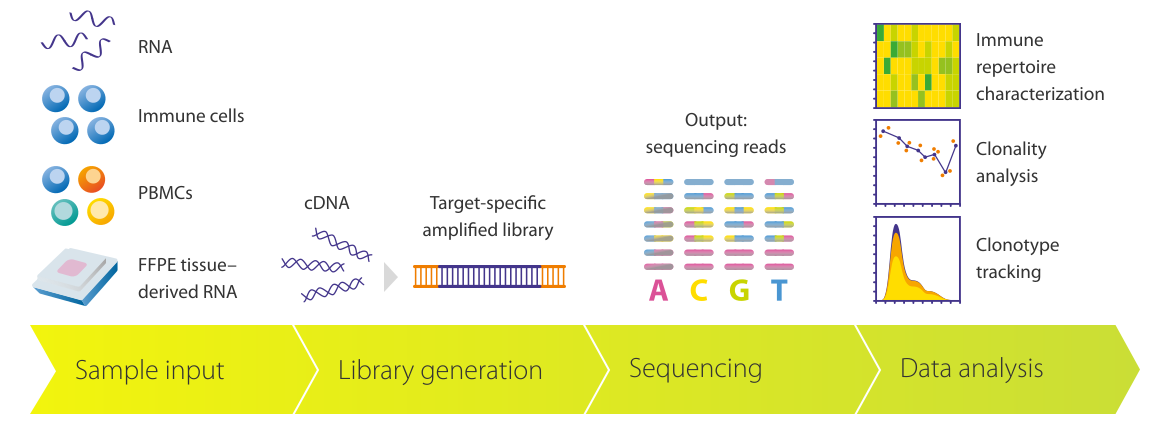
Bulk RNA immune repertoire sequencing is often described as a simplified alternative to single-cell approaches. But why would one want to analyze pooled receptor sequences when single-cell resolution is technically possible?
The simple answer is: There’s a fundamental difference between the two approaches and their application scenarios. Bulk and single-cell technologies address different biological questions and operate at different analytical scales. While single-cell methods provide phenotypic context, bulk immune repertoire sequencing offers unparalleled depth, quantitative robustness, and statistical power at the population level.
Rather than being a reduced version of single-cell analysis, bulk immune receptor profiling is a powerful, scalable approach for characterizing repertoires comprehensively, particularly when sensitivity, cohort size, and detection of rare clonotypes are critical.
| | Bulk receptor RNA sequencing | Single-cell receptor RNA sequencing |
| Advantages | Deep repertoire coverage | Receptor-transcriptome linkage |
| Sensitive clonotype detection | Direct α/β chain pairing |
| Cost effective | Immune cell subset identification |
| Robust clonotype quantification | Single-cell resolution |
| Application examples | Repertoire diversity analysis, clonality assessment, immune monitoring | Cell state characterization, TCR phenotype analysis |