Content overview
Basic principle
Protocol
Performance data
Portfolio information
Resources
Products
Content
- Basic principle
- Protocol
- Performance data
- Portfolio information
- Resources
- Products
TCR T cell therapies targeting disease-associated epitopes such as PRAME, MART-1, HPV, or MBP hold immense promise to revolutionize cancer, infection, and autoimmune care. However, reliable flow cytometry of antigen-specific T cells continues to pose significant challenges.
Our MHC multimer product portfolio is designed for precise enumeration, characterization, and isolation of antigen-specific T cells with flexible and simplified protocols. Our MHC MACSimers are available in a wide range of MHC allelic variants and can be used for both custom peptide loading and as ready-to-use, pre-loaded reagents. These versatile tools support the entire TCR T cell therapy development process — from fundamental research to clinical cell manufacturing.
Content overview
Basic principle
Protocol
Performance data
Portfolio information
Resources
Products
Antigen-specific T cells are key mediators of adaptive immunity and central players in the development of various human conditions such as cancer, infectious diseases, autoimmunity, and cardiovascular pathologies.
CD8 cytotoxic T cells and CD4 helper T cells recognize specific antigens through their T cell receptors (TCRs) only when presented by major histocompatibility complex (MHC) class I or II molecules, respectively. While this MHC-restricted nature of TCR-antigen recognition is crucial for T cell specificity and immune tolerance, it poses a significant challenge in analyzing rare antigen-specific T cells. MHC MACSimers overcome the MHC restriction by leveraging the natural mechanisms of T cell antigen recognition, enabling accurate analysis of T cells through their TCRs.
Flow cytometry staining and sorting of antigen-specific T cells with peptide-loaded MHC constructs is a powerful technology driving progress in the area of T cell immunology. When conjugated to a fluorophore, peptide-loaded MHC multimer constructs allow for analysis and isolation of very rare T cell subsets, even from diverse polyclonal populations.
Slide through and explore the basic principle of MHC MACSimers for the detection, analysis, and sorting of rare antigen-specific T cells via flow cytometry.



MHC MACSimers have been developed for accurate antigen-specific T cell analysis from various sources, including peripheral blood mononuclear cells (PBMCs), dissociated organs, and whole blood samples.
Structurally, MHC MACSimers are composed of several MHC class I or class II monomers stably multimerized on a fluorescently labeled backbone. The number of MHC monomers and fluorophores is optimized for maximum TCR avidity and stability.
With the MHC MACSimer FleX Kits, MHC multimers can be loaded with a peptide of interest, providing maximum flexibility for applications like neoantigen discovery, TCR screening, or monitoring of antigen-specific T cell responses.
Ready-to-use, peptide-loaded MHC MACSimers are offered in various combinations of peptide and MHC class I alleles, covering a growing portfolio of important T cell antigens associated with cancer, infection, and autoimmune diseases.

Peptide-loaded MHC MACSimers form highly specific and stable complexes with TCRs of their cognate T cells. By using the multivalency effect of MHC multimerization, MHC MACSimers enable accurate detection of rare antigen-specific T cells by linking multiple peptide-MHC complexes, increasing both TCR avidity and binding strength to the target cell. Their exceptional brightness enables improved staining performance.
Optionally, the complex can be co-stained with fluorescent antibodies for further T cell characterization.
Moreover, MHC MACSimers can be combined with anti-fluorochrome MicroBeads for magnetic cell isolation using MACS® Technology.

MHC MACSimers stably bind to their TCRs thereby labeling them for flow cytometry detection and analysis on the MACSQuant® Analyzer, or TCR-based cell sorting on the MACSQuant Tyto® Cell Sorter.

For multiple sequential sorting steps or further downstream analysis such as T cell potency assays, unlabeled T cells are desirable.
MHC MACSimers, REAlease® Releasable Antibodies, and REAlease MicroBeads can be gently removed from the cells of interest after cell sorting on the MACSQuant Tyto Cell Sorter using REAlease Technology.

Sorting rare antigen-specific T cells in Type 1 diabetes can feel like searching for a needle in a haystack. To address this challenge, I require a sensitive peptide–MHC reagent for T cell receptor detection. The MHC MACSimer FleX Kit is my reagent of choice, as it enables specific and efficient sorting on the MACSQuant® Tyto® Cell Sorter and can be released for downstream analyses such as sequencing, thereby optimizing my
workflow.

MHC biology is highly complex, and the analysis of antigen-specific T cells by flow cytometry can be both time-consuming and labor-intensive.
Unlike other products, MHC MACSimers are provided as fully multimerized constructs, eliminating the need for an additional, error-prone, and tedious multimerization step. This enables immediate peptide loading, significantly streamlining the workflow.
Our innovative protocol enables the acquisition of complex MHC multimer data in a significantly shorter time frame, with minimal hands-on time required.
MHC MACSimer workflow: minimal hands-on time, error-free peptide-loading, fast staining, easy analysis, sorting, and release for downstream applications.
| MHC multimerization | Peptide loading | TCR staining | Co-staining (optional) | Analysis and sorting | Release (optional) | |
| Incubation time | Not required | ≥ 16 h | 10 min | 10 min | Variable | 10 min |
| Hands-on time | Not required | 10 min | 7 min | 7 min | Variable | 5 min |
| Centrifugation | Not required | 5 min | 10 min | 10 min | Variable | 20 min |
The low affinity of a single peptide-MHC complex for its cognate T cell receptor (TCR) poses challenges for detecting antigen-specific T cells. To address this, MHC multimerization utilizes the multivalency effect by linking multiple peptide-MHC complexes, significantly increasing TCR avidity and overall binding strength. This allows more TCRs to bind simultaneously, facilitating reliable identification of rare antigen-specific T cells.
The overall design of MHC MACSimers is optimized for maximum TCR avidity and stability, delivering enhanced brightness and detection sensitivity.

Achieving superior performance hinges on optimal MHC multimerization, a delicate process that demands precision. While a sufficient number of MHC molecules and fluorochromes on a multimer is essential, several additional factors contribute to the successful analysis of rare antigen-specific T cells:
MHC MACSimers are designed with an optimal number of conjugated MHC monomers and fluorochromes on the construct, resulting in higher stain index compared to conventional MHC tetramers.

The fluorescent stain index (SI) measures the brightness of a fluorescently stained cell population relative to its negative counterpart. A higher SI indicates greater ability to detect and isolate rare antigen-specific T cell populations. Due to their optimized design, MHC MACSimers display higher SI when directly compared to conventional MHC tetramers.
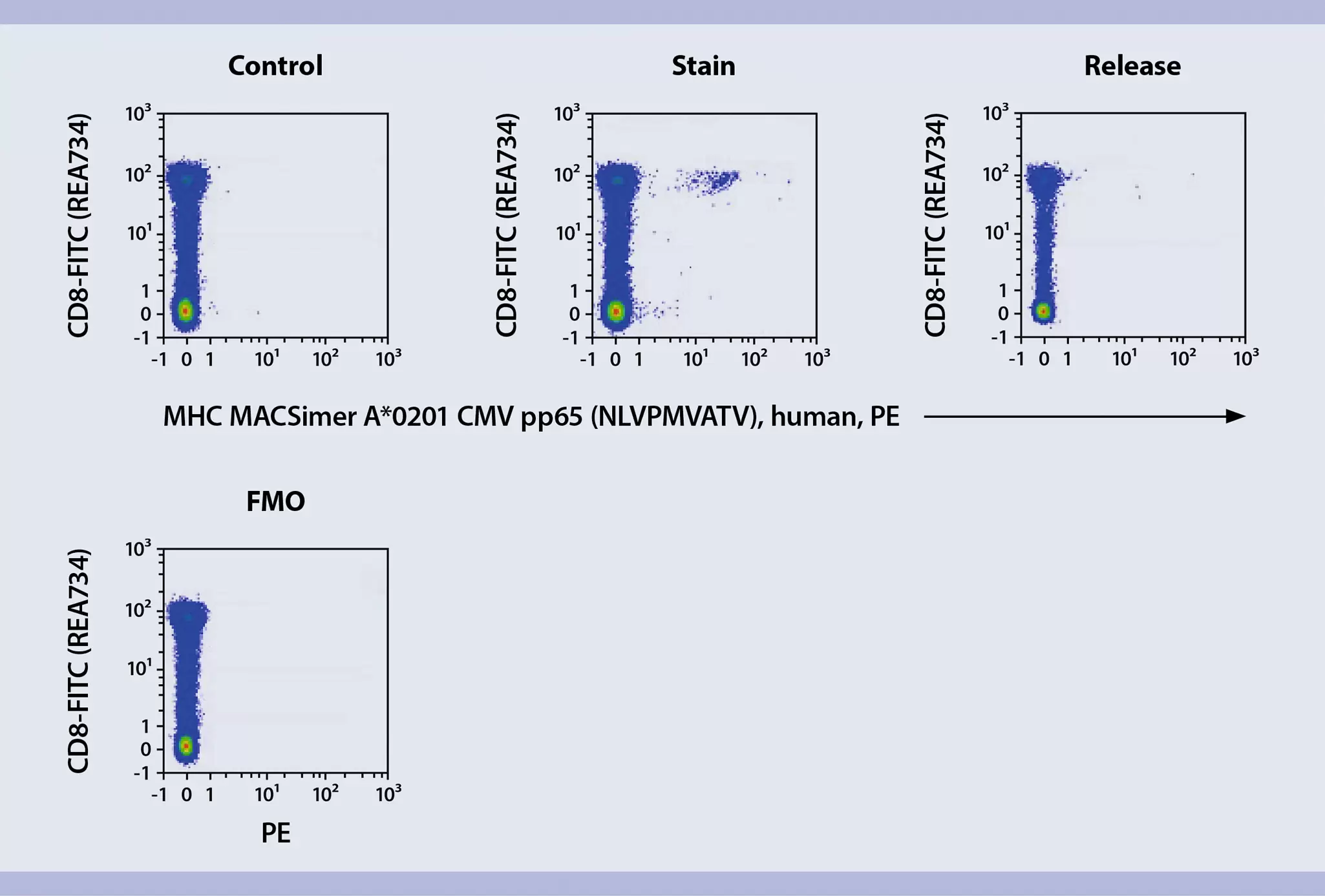
Antigen-specific T cells are extremely diverse and rare. To maximize the information obtained from these valuable samples, MHC MACSimers can be gently detached from cells using REAlease Technology, facilitating downstream applications that require label-free cells, such as T cell potency assays.
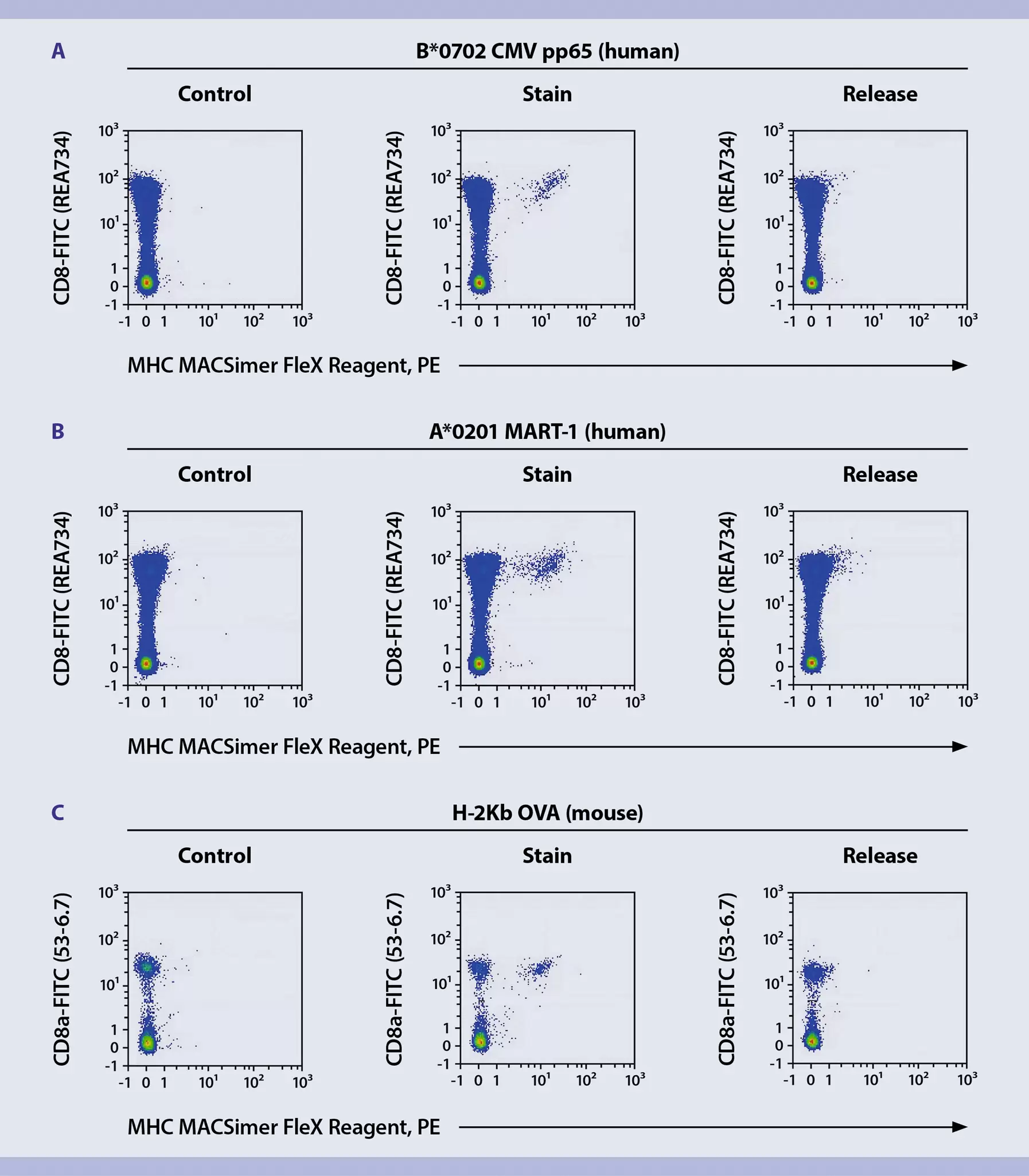
MHC MACSimer FleX Kits are offered in various human and murine MHC allele variants. The MHC allele variant of interest can be selected and loaded by a chosen MACSpep peptide. Importantly, MHC MACSimer negative control reagents are provided for each MHC allele variant to effectively exclude non-specific background signals.
MHC proteins are encoded by the most polymorphic gene cluster in the human genome, resulting in a vast diversity of MHC allotypes in the population. Moreover, each TCR is uniquely restricted to a specific peptide-MHC combination, adding significant complexity and exceptional diversity in the analysis of antigen-specific T cells.
Seamlessly integrate MHC MACSimers into your flow cytometry panels and transform complex TCR analytics into simple workflows!
We have developed three tailored MHC portfolios that conquer the complexity and diversity of TCR T cell analytics. Discover below how our MHC products are supporting the whole journey of TCR T cell therapy development, from basic research, to pre-clinical development and clinical testing. Whether you need maximum flexibility or maximum standardization in your MHC multimer workflow – our portfolio covers it all.
Select an MHC allele from our FleX Kit portfolio and simply load MHC MACSimers with your antigen of interest from our MACSpep Single Peptide portfolio, for fast TCR and epitope screening. Alternatively, opt for our ready-to-stain, peptide-loaded MHC MACSimers, tailored for standardized, reliable TCR analytics across cell therapy development workflows.
Our three tailored portfolios support you at every stage of TCR T cell therapy development, from epitope screening and TCR T discovery to clinical TCR T cell manufacturing, quality control, and patient monitoring.
| Basic research, epitope screening, and TCR T discovery | TCR T cell manufacturing and immune response monitoring | ||
| Portfolio | MHC MACSimer FleX Kits | MACSpep Single Peptides | Peptide-loaded MHC MACSimers |
| Format | Loadable MHC MACSimers Growing portfolio with MHC class I and II allelic variants | Single peptides for MHC loading Growing portfolio with cancer, infection, and autoimmune epitopes | Peptide-loaded MHC MACSimers Growing portfolio with relevant MHC I alleles and epitopes related to cancer, infection, and autoimmunity |
| Applications | Flexible and convenient screening for TCRs and epitopes | Fast and easy loading protocol with expert tips | Highly standardized TCR T cell analytics |
Although TCR T cell therapies are currently most advanced in the area of cancer research, they are equally rising for patients suffering from autoimmunity, infection, and allergy. Our MHC portfolio is continuously growing in order to keep up with the dynamic developments in the field of TCR T cell therapy.
Selection of some of our currently covered targets for antigen-specific T cell analytics.
| Cancer | Infection | Autoimmunity | Histocompatibility antigens and immune sensitization |
| MAGE-A4 | CMV | Insulin | OVA |
| NY-ESO-1 | EBV | MOG | APOL1 |
| KRAS-G12V | IAV | PLP | ALDOA |
| PRAME | HPV | MBP | |
| MART-1 | SARS-CoV-2 | ||
| AFP | HIV | ||
| gp100/pmel | ADV | ||
| HER-2/neu | Tetanus | ||
| WT-1 |
Watch our webinar for expert insights on TCR discovery and development of TCR-based therapies targeting solid cancers. Explore practical examples of robust assays for in-process and quality control (IPC/QC) and release testing using MHC MACSimers in flow cytometry.

Our products are covering every step of your antigen-specific T cell research workflow. Explore our solutions for T cell preparation, stimulation, and enrichment, to complement your MHC multimer analysis!

235 products found
|
You have previously chosen International as your location.
What do you want to do?

