MACSPlex Assays are designed for determining concentrations of multiple soluble analytes in a single sample. The analysis is based on MACSPlex Capture Beads, which display defined fluorescence properties and can be identified using standard flow cytometry techniques. MACSPlex Kits contain a cocktail of various MACSPlex Capture Beads populations, each coated with a specific antibody reacting with one of the respective analytes within the sample. Analytes are labeled directly or indirectly (via biotin) with APC-conjugated antibodies, depending on the chosen Kit. Standards of known quantities


MACSPlex Assays are designed for determining concentrations of multiple soluble analytes in a single sample. The analysis is based on MACSPlex Capture Beads, which display defined fluorescence properties and can be identified using standard flow cytometry techniques. MACSPlex Kits contain a cocktail of various MACSPlex Capture Beads populations, each coated with a specific antibody reacting with one of the respective analytes within the sample. Analytes are labeled directly or indirectly (via biotin) with APC-conjugated antibodies, depending on the chosen Kit. Standards of known quantities of given analytes are provided with the kit and are used for the quantification of the unknown analyte concentrations within the samples.
In combination with the Express Modes of the MACSQuant Analyzers, the MACSPlex Cytokine Kits are optimized for automated measurement of beads. They simplify flow cytometric analysis via predefined experiment settings as well as acquisition and analysis templates. They apply an automated gating strategy to populations of interest that will be automatically adjusted for each data file individually to achieve optimal results.
Besides the MACSQuant Analyzers, the MACSPlex Cytokine Kits are compatible with every other flow cytometer equipped with a blue (488 nm) and red (635 nm) laser, able to discriminate FITC, PE, and APC fluorescence channels. For automated quantitative analysis of MACSPlex data independent of MACSQuant Analyzer Express Modes, the MACSPlex InspectoR Tool is offered. The MACSPlex InspectoR is a free to use online tool providing a comprehensive automated analysis of complex multiplex data. MQD or FCS files can be uploaded, analyzed, and quantitative results downloaded: MACSPlex InspectoR tool | Miltenyi Biotec | Deutschland
MACSPlex Cytokine 12 Kit, human, MACSPlex Cytotoxic T/NK Cell Kit, human and MACSPlex Cytokine 10 Kit, mouse include fluorescently labeled MACSPlex Capture Bead populations that have been coated with antibodies reacting with one of the respective analytes within the sample. The bead populations can be distinguished by different fluorescence intensities detected in the FITC (B1) and PE (B2) channel of the MACSQuant® Analyzer, MACSQuant Analyzer 10 and MACSQuant Analyzer 16 (as well as respective channels of comparable flow cytometers). MACSPlex Capture Beads are added to the samples and to serial dilutions of the MACSPlex Cytokine Standard.
During a 2-hour incubation period, the cytokines are captured by the MACSPlex Capture Beads. MACSPlex Cytokine Detection Reagents, composed of a cocktail of APC-conjugated antibodies recognizing the different analytes, are added in order to form sandwich complexes during a 1-hour incubation period using the MACSPlex Cytokine 12 Kit, human and MACSPlex Cytokine 10 Kit, mouse. With the MACSPlex Cytotoxic T/NK Cell Kit, human APC labeling of the analytes is performed indirectly using analyte-specific biotinylated antibodies and APC-conjugated Biotin antibodies during a total incubation time of 1,5-hours.
Consequently, sandwich complexes are formed between the MACSPlex Capture Bead, the analyte and the detection reagent. These complexes can be analyzed based on the fluorescence characteristics of both the MACSPlex Capture Bead and the detection reagent. Standards of known quantities of given analytes are provided with the Kit and are used for the quantification of the unknown concentrations of analytes within samples. Standard curves for each of the cytokines are generated. The median of the APC fluorescence of each capture bead population gives the concentration of each cytokine in the sample.
The MACSPlex Cytotoxic T/NK Cell Kit, human has been developed for the simultaneous flow cytometric detection of soluble GM-CSF, Granzyme B, IFN-γ, IL-2, IL-4, IL-6, IL-10, IL-17A, IL-21, MCP-1, Perforin, and TNF-α in a single sample. The kit has been optimized for use with serum, plasma, and cell culture supernatant.
The MACSPlex Cytokine 12 Kit, human has been developed for the simultaneous flow cytometric detection of the soluble human cytokines GM-CSF, IFN-α, IFN-γ, IL-2, IL-4, IL-5, IL-6, IL-9, IL-10, IL-12p70, IL-17A, and TNF-α in a single sample. The kit has been optimized for use with serum, plasma, and cell culture supernatants.
MACSPlex Cytokine 10 Kit, mouse has been developed for the simultaneous flow cytometric detection of the soluble mouse cytokines GM-CSF, IFN-γ, IL-2, IL-4, IL-5, IL-10, IL-12p70, IL-17A, IL-23, and TNF-α in a single sample. The kit has been optimized for use with serum, plasma, and cell culture supernatants.
Technical specifications
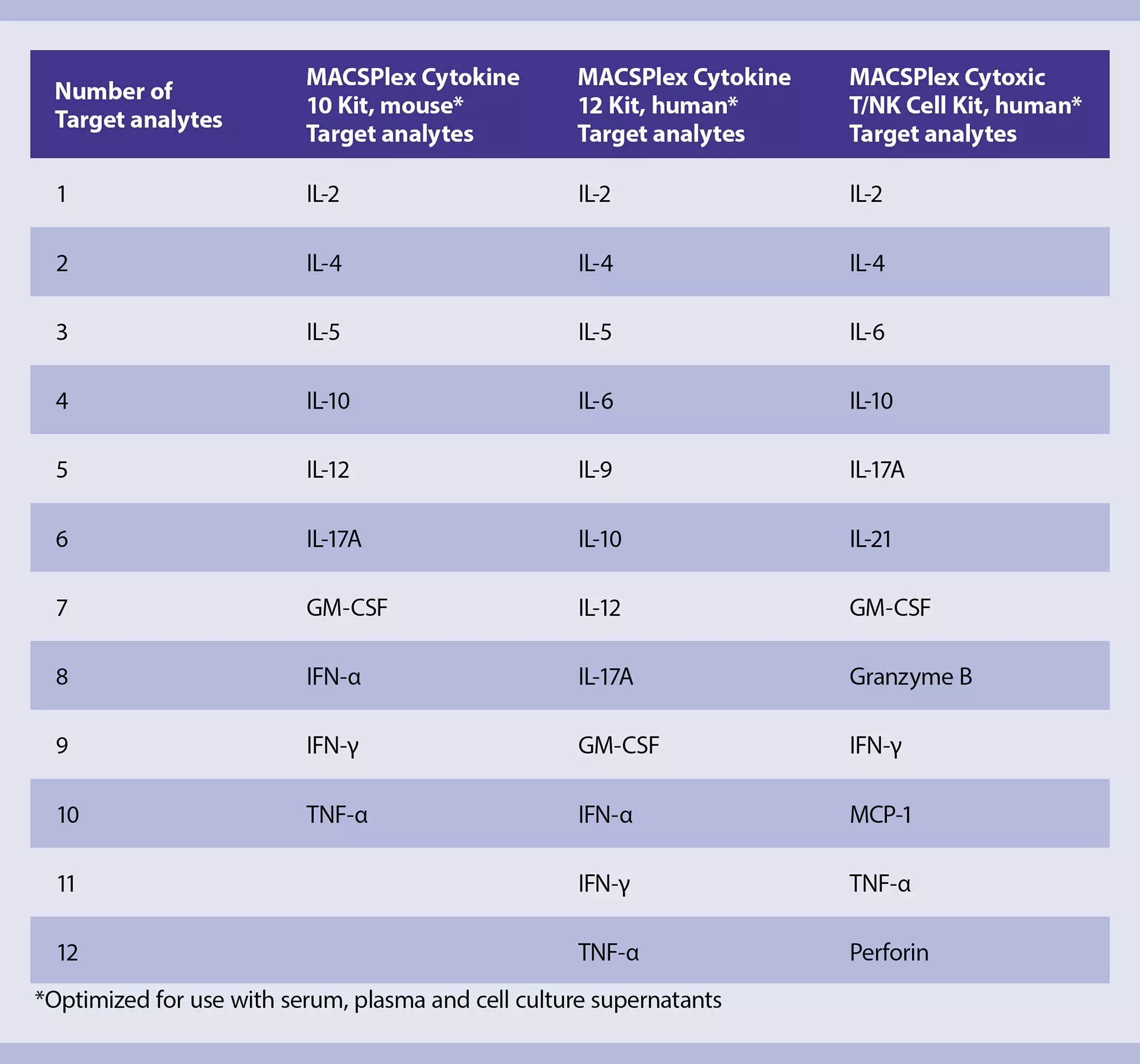
Overview of available MACSPlex Cytokine Kits
Samples containing unknown levels of analytes are incubated with antibody-coated MACSPlex Beads (MPx), and the analytes (e.g., Cytokines) bind to the specific antibodies. The analytes are labeled with APC-conjugated antibodies, the Detection Reagent, either directly (Figure 1) or indirectly via biotinylated antibodies (Figure 2) Consequently, sandwich complexes are formed between the MACSPlex Bead, the Cytokine and the Detection Reagent. These complexes can be analyzed based on the fluorescence characteristics of both the MACSPlex Bead and the Detection Reagent. Standards of known quantities of given analytes are provided with the Kit and are used for the quantification of the unknown concentrations of analytes within the samples.
To access a Certificate of Analysis (CoA) follow the link below and enter the specific lot of your product.
Should you wish to request additional documentation, such as a Safety Data Sheet (SDS) in other languages than English or Swedish, an SDS-replacement document, or a Certificate of Origin (CoO), please direct your inquiry to your local technical support team.
To access a Safety Data Sheet for a hazardous product or component in English or Swedish language, follow the link below and enter the catalog number of the product.
Please note, that the Safety Data Sheet has a cover sheet only in English language.
Should you wish a Safety Data Sheet (SDS) in other languages than English or Swedish, please contact Technical Support.
- Barone, M. et al. (2021) The role of circulating monocytes and JAK inhibition in the infectious-driven inflammatory response of myelofibrosis. Oncoimmunology 9 (1): 1782575
- Marimpietri, D. et al. (2024) Immunomodulatory properties of extracellular vesicles isolated from bone marrow of patients with neuroblastoma: role of PD-L1 and HLA-G. Front Immunol 15: 10.3389/fimmu.2024.1469771
- Teppert, K. et al. (2024) CAR'TCR-T cells co-expressing CD33-CAR and dNPM1-TCR as superior dual-targeting approach for AML treatment. Mol Ther Oncol 32 (2): 10.1016/j.omton.2024.200797
- Katzerke, C. et al. (2023) Reduced proliferation of bone marrow MSC after allogeneic stem cell transplantation is associated with clinical outcome. Blood Adv 7 (12): 10.1182/bloodadvances.2022008510
- Battistoni, A. et al. (2023) Nasal administration of recombinant Neospora caninum secreting IL-15/IL-15Rα inhibits metastatic melanoma development in lung. J Immunother Cancer 11 (5): 10.1136/jitc-2023-006683
- Leong, T. et al. (2020) Preclinical Activity of Embryonic Annexin A2-Specific Chimeric Antigen Receptor T Cells Against Ovarian Cancer. Int J Mol Sci 21 (2): 381
- Yang, Y. et al. (2020) Human umbilical cord mesenchymal stem cells ameliorate skin fibrosis development in a mouse model of bleomycin-induced systemic sclerosis. Exp Ther Med. 20 (6): 257
- Martarelli, N. et al. (2024) Artificial Intelligence-Powered Molecular Docking and Steered Molecular Dynamics for Accurate scFv Selection of Anti-CD30 Chimeric Antigen Receptors. Int J Mol Sci 25 (13): doi.org/10.3390/ijms24119184
- Teppert, K. et al. (2023) Combining CSPG4-CAR and CD20-CCR for treatment of metastatic melanoma. Front Immunol : doi: 10.3389/fimmu.2023.1178060
- Gianessi, F. et al. (2024) Macrophages treated with interferons induce different responses in lymphocytes via extracellular vesicles. iScience : 10.1016/j.isci.2024.109960
- Pfeiffer, A. et al. (2018) In vivo generation of human CD19-CAR T cells results in B-cell depletion and signs of cytokine release syndrome. EMBO Mol Med 10 (11)
- Loureiro, L. R. et al. (2023) Distinct profile of CD34+ cells and plasma-derived extracellular vesicles from triple-negative patients with Myelofibrosis reveals potential markers of aggressive disease. J Exp Clin Cancer Res. 42 (1): 10.1186/s13046-023-02912-w
- Daigre, J. et al. (2024) Preclinical Evaluation of Novel Folate Receptor 1-Directed CAR T Cells for Ovarian Cancer. Cancers (Basel) 16 (2): 333
- Giordano, C. et al. (2024) The FKBP51s Splice Isoform Predicts Unfavorable Prognosis in Patients with Glioblastoma. Cancer Res Commun 4 (5): 10.1158/2767-9764.CRC-24-0083
- Bethke, M. et al. (2024) Identification and Characterization of Fully Human FOLR1-Targeting CAR T Cells for the Treatment of Ovarian Cancer. Cells 13 (22): 10.3390/cells13221880
- Roato, I. et al. (2023) Denosumab and Zoledronic Acid Differently Affect Circulating Immune Subsets: A Possible Role in the Onset of MRONJ. Cells 12 (20): 10.3390/cells12202430
- Xiang, Y et al. (2019) In vitro expansion affects the response of human bone marrow stromal cells to irradiation. Stem Cell Res Ther. 10 (1): 82
- Ebbinghaus, M. et al. (2024) Endogenous Signaling Molecule Activating (ESMA) CARs: A Novel CAR Design Showing a Favorable Risk to Potency Ratio for the Treatment of Triple Negative Breast Cancer. Int J Mol Sci 25 (1): 10.3390/ijms25010615
- Ausejo-Mauleon, I. et al. (2024) Combination of locoregional radiotherapy with a TIM-3 aptamer improves survival in diffuse midline glioma models. JCI Insight 9 (18): 10.1172/jci.insight.175257
- Soto, K. E. G. et al. (2023) Targeting colorectal cancer cells using AND-gated adaptor RevCAR T-cells. Front Immunol 14: 10.3389/fimmu.2023.1302354
- Loureiro, L. R. et al. (2018) Development of a novel target module redirecting UniCAR T cells to Sialyl Tn-expressing tumor cells. Blood Cancer J 8 (9): 81
- Augello, M. et al. (2023) Association between SARS-CoV-2 RNAemia, skewed T cell responses, inflammation, and severity in hospitalized COVID-19 people living with HIV. iScience 27 (1): 108673
- Piermattei, A. et al. (2016) Toll-Like Receptor 2 Mediates In Vivo Pro- and Anti-inflammatory Effects of Mycobacterium Tuberculosis and Modulates Autoimmune Encephalomyelitis. Front Immunol 7: 191
- Schwarz, S. et al. (2024) Peptide-stimulated T cells bypass immune checkpoint inhibitor resistance and eliminate autologous microsatellite instable colorectal cancer cells. NPJ Precis Oncol. : 10.1038/s41698-024-00645-3
- Ruggiero, A. et al. (2024) Immune signature in vaccinated versus non-vaccinated aged people with COVID-19 pneumonia. J Transl Med. 22 (1): 10.1186/s12967-024-05556-2
- Tran, H. T. T. et al. (2021) Human T2R38 Bitter Taste Receptor Expression in Resting and Activated Lymphocytes. Front Immunol 12: 669005
- Rosshirt, N. et al. (2021) Proinflammatory T cell polarization is already present in patients with early knee osteoarthritis. Arthritis Res Ther. 23 (1): 37
- Koeneman, B. J. et al. (2024) Targeting Aberrantly Elevated Sialyl Lewis A as a Potential Therapy for Impaired Endometrial Selection Ability in Unexplained Recurrent Miscarriage. Front Immunol : 10.3389/fimmu.2024.1368103
- Kang, B. et al. (2024) Large-scale generation of IL-12 secreting macrophages from human pluripotent stem cells for cancer therapy. Mol Ther Methods Clin Dev : 10.1016/j.omtm.2024.101204
- Ogusuku, I. E. Y. et al. (2024) Automated manufacture of ΔNPM1 TCR-engineered T cells for AML therapy. Mol Ther Methods Clin Dev : 10.1016/j.omtm.2024.101224
- Foltz, J. A. et al. (2018) TGFβ Imprinting During Activation Promotes Natural Killer Cell Cytokine Hypersecretion. Cancers (Basel) 10 (11): 423
- Bachmann, D. et al. (2017) Retargeting of UniCAR T cells with an in vivo synthesized target module directed against CD19 positive tumor cells. Oncotarget. 9 (7): 7487-7500
- Conde, E. et al. (2021) Dual vaccination against IL-4 and IL-13 protects against chronic allergic asthma in mice. Nat Commun 12 (1): 2574
- Ustiuzhanina, M. O. et al. (2024) Autologous T-Cell-Free Antigen Presentation System Unveils hCMV-Specific NK Cell Response. Cells 13 (6): 10.3390/cells13060530
- Justicia-Lirio, P. et al. (2024) First-in-class transactivator-free, doxycycline-inducible IL-18-engineered CAR-T cells for relapsed/refractory B cell lymphomas. Mol Ther Nucleic Acids 35 (4): 10.1016/j.omtn.2024.102308
- Jureczek, J. et al. (2020) Highly Efficient Targeting of EGFR-Expressing Tumor Cells with UniCAR T Cells via Target Modules Based on Cetuximab®. Onco Targets Ther. 13: 5527
- Eliasse, Y. et al. (2019) Effect of thermal spring water on human dendritic cell inflammatory response. J Inflamm Res. 12: 181
- Pfeifer, R. et al. (2023) Targeting Stage-Specific Embryonic Antigen 4 (SSEA-4) in Triple Negative Breast Cancer by CAR T Cells Results in Unexpected on Target/off Tumor Toxicities in Mice Int J Mol Sci 24 (11): doi.org/10.3390/ijms24119184
- Lantier, L. et al. (2020) Neospora caninum: a new class of biopharmaceuticals in the therapeutic arsenal against cancer. J Immunother Cancer 8 (2): e001242
You have previously chosen International as your location.
What do you want to do?