T cell activation via CD3 and CD28 with T Cell TransAct™. This stimulation reagent is ready-to-use for in vitro activation and expansion of human T cells. Its polymeric nanomatrix structure ensures gentle and efficient activation of resting T cells from PBMCs and of enriched T cell populations, while maintaining high viability.


Related products for T Cell TransAct™, human

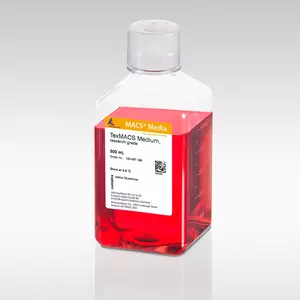
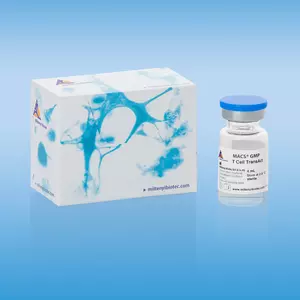
Comparison of T cell expansion after stimulation with T Cell TransAct and TexMACS™ Medium (serum-free) or a bead-based competitor product and RPMI (10% serum) was identical. Both media were supplemented with human IL-2 IS, Premium-Grade (50 U/mL).
Human purified T cells were isolated using the Pan T Cell Isolation Kit and activated for 48 hours using the T Cell TransAct™ (titer 1:100) in TexMACS™ Medium supplemented with Human IL-2 (20 IU/mL). The negative control experiment was performed without adding the T Cell TransAct. Cells were fluorescently stained using CD25-PE and CD69-APC and analyzed by flow cytometry using the MACSQuant® Analyzer. CD4-VioBlue® was used for selection of T helper cells and CD8-VioGreen™ was used for selection of cytotoxic T cells. Dead cells and debris were excluded from the analysis based on scatter signals and propidium iodide fluorescence.
T cell activation via CD3 and CD28 with T Cell TransAct™. This stimulation reagent is ready-to-use for in vitro activation and expansion of human T cells. Its polymeric nanomatrix structure ensures gentle and efficient activation of resting T cells from PBMCs and of enriched T cell populations, while maintaining high viability.
T Cell TransAct™ consists of a colloidal polymeric nanomatrix conjugated to humanized CD3 and CD28 agonists providing primary and co-stimulatory signals for an optimized and efficient T cell activation and expansion. The nanoscale structure of T Cell TransAct™ allows sterile filtration and excess reagent can be removed by centrifugation with following conventional supernatant replacement or simply by medium wash.
Polyclonal T cell expansion can be used when increased numbers of effector cells are required without the use of feeder cells or antigens, or when T cells are activated to enable gene modification.
In vitro stimulation and expansion of T cell populations, either from purified T cells or from PBMCs.
- Netsrithong. R. et al. (2020) Multilineage differentiation potential of hematoendothelial progenitors derived from human induced pluripotent stem cells. Stem Cell Res Ther. 11 (1): 481
- Ping, Y. et al. (2024) PD-1 signaling limits expression of phospholipid phosphatase 1 and promotes intratumoral CD8+ T cell ferroptosis. Immunity 57 (9): 2122-2139
- Noaks, E. et al. (2021) Enriching leukapheresis improves T cell activation and transduction efficiency during CAR T processing. Mol Ther Methods Clin Dev 20: doi: 10.1016/j.omtm.2021.02.002
- Schäfer, D. et al. (2021) Identification of CD318, TSPAN8 and CD66c as target candidates for CAR T cell based immunotherapy of pancreatic adenocarcinoma. Nat Commun 12 (1): 1453
- Feldmann, A. et al. (2020) Versatile chimeric antigen receptor platform for controllable and combinatorial T cell therapy Oncoimmunology : doi: 10.1080/2162402X.2020.1785608
You have previously chosen International as your location.
What do you want to do?